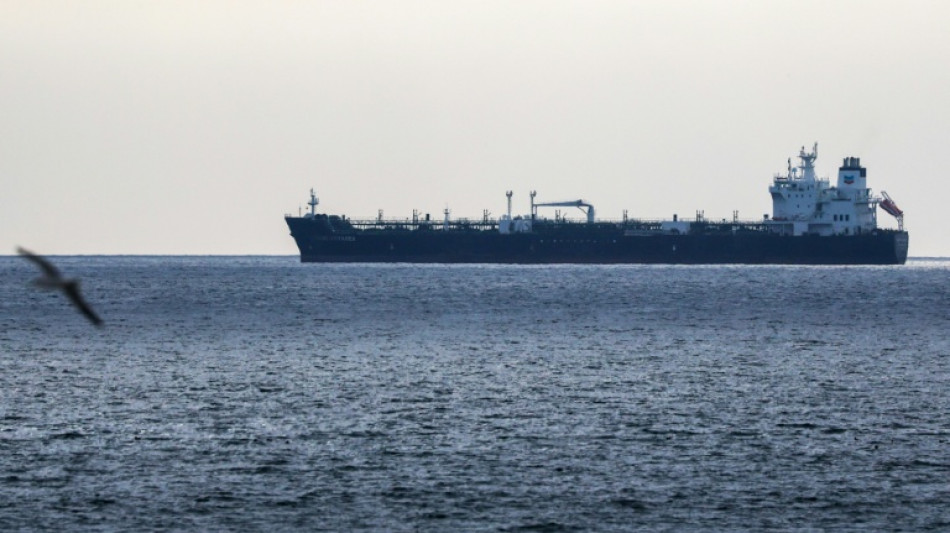
How will US oil sanctions waiver help Russia? / Photo: Patrick T. Fallon - AFP

 The alleged murder by US marine on Okinawa: five things to know

 End of an era as Messi prepares to hang up Argentina boots

 Superstar duo headline strong New Zealand squad for Rugby League World Cup
 South Korea warns of possible AI use in banking hacks

 EU vows AI rules will protect Europeans. Will they?

 Myanmar leader to visit Malaysia after migrant returns begin

 Germany's AfD poised to preside over state assembly for first time
 Australia's opposition vows 'largest cut to immigration' in country's history

 Ready, set, snooze: Sleep-deprived Japanese compete for best-rested

 Falcons thump Saints 45-24 as New Orleans marks Katrina anniversary

 Tuvalu govt adviser says Australia overstepped in pre-COP visit

 Asian stocks mixed despite tech-led Wall St record

 Tens of thousands expected in Paris for high school protests

 AI borrowing binge rattles US markets

 Young Canadians sue government over alleged climate failures

 White Sox down Guardians to take 2-0 series lead
 NHL record-breaker Ovechkin says current season will be his last

 France roar back in Nations League as Italy beat Turkey
 Messi readies for final farewell in Argentina send-off
 Esposito seals Italy win over Turkey in Nations League

 Russia downplays plague reports as Trump offers US help

 Trump says US moved bombers from UK base after 'threats'

 Brazilian stocks surge to record after Bolsonaro election lead

 Leaders to visit Pacific atoll at frontline of climate change

 ICC gives more details about arrest warrants for Taliban ministers

The United States has eased some restrictions on Russia's oil sales as it tries to stabilise global energy markets, upended by Iran blocking the Strait of Hormuz amid the war in the Middle East.
Will the US sanctions waiver deliver a major windfall for Moscow?
- Symbolic importance -
The US waiver allows countries to buy Russian oil that is currently at sea until April 11.
Given the short-term nature and technical limitations, it will not provide a huge immediate windfall to Russia, though nonetheless benefits Moscow, Kpler analyst Muyu Xu told AFP.
"The measure mainly allows Russian barrels already in transit to complete voyages and discharge," she said in a note, calling it a "wind-down, not reopening."
Announcing the sanctions relief, US Treasury Secretary Scott Bessent said the move would not provide "significant financial benefit to the Russian government, which derives the majority of its energy revenue from taxes assessed at the point of extraction."
Kpler suggests around 120 million barrels of Russian crude may be at sea at the moment.
That represents around two weeks of Russia's total oil output.
But Muyu Xu from Kpler said most of that had already been pre-ordered by Chinese or Indian clients, limiting the immediate bump in orders.
Washington had last week given a similar waiver to New Delhi, which "gave Indian refiners a big advantage to snap up the cargo," she said.
The waiver may carry more symbolic than financial weight for Moscow.
"It's a gift to Russia in terms of sanctions," said Richard Meade, editor-in-chief of Lloyd's List Intelligence, a maritime data company.
Media reports suggested that Japan, Thailand and the Philippines were considering buying Russian crude following the US decision.
But Kpler's Muyu Xu said some countries might still have concerns as the EU and UK sanctions still remain in place.
"It's not crystal clear that everybody is free to buy ... It's not as easy as Trump just opened the tap and then the oil will naturally flow to the rest of the world."
The Kremlin welcomed the decision by urging the United States to go further, with economic envoy Kirill Dmitriev saying the lifting of more sanctions looked "inevitable" given the volatility of the global energy market.
Russian President Vladimir Putin earlier this week offered to supply oil to Europe should it reverse on sanctions, but only on a "long-term" basis and "free from political pressure."
- Tens of billions -
Beyond the US waiver, the general surge in oil prices since the start of the war in the Middle East has helped to replenish Russia's coffers, depleted by more than four years of war against Ukraine and international sanctions.
Russia's ESPO blend, typically purchased by China and India, is trading $30-40 higher per barrel than before the conflict.
Every extra $10 per barrel brings an additional $1.6 billion a month in tax revenues for the Russian government, Sergey Vakulenko from Carnegie Endowment estimated.
If "it rose by $40 and held that level for six months, this would mean an extra $38 billion," he said in a post on Telegram.
That would be enough to cover most of Russia's 2025 deficit, which came in at around $50 billion.
Russia has posted a budget deficit in every year since it ordered troops into Ukraine and expects to do so again in 2026.
Oil-and-gas revenues -- roughly one-fifth of Russia's state income -- were running at a five-year low at the start of the year, hit by sanctions, production issues and Ukrainian attacks on energy facilities.
The measures, aimed at widening supply to push down prices, are a "godsend for Russia's shadow fleet," said Lloyd's analyst Bridget Diakun, referring to the opaque sanctions-busting tankers used by Russia.
"Russia can make a lot of money because it's given a pass," she added during a webinar.
- Outcry from Ukraine and Europe -
Ukrainian President Volodymyr Zelensky said the US sanctions relief "certainly does not help peace."
Europe, which has not eased its sanctions on Russian oil, also pushed back.
French President Emmanuel Macron said that the Strait of Hormuz's shutdown "in no way" justified lifting the sanctions on Russia.
Britain said "all partners should maintain pressure on Russia and its war chest", while German Chancellor Friedrich Merz said that "easing sanctions now, for whatever reason, is wrong."
burs/rl
Z.AlNajjar--SF-PST