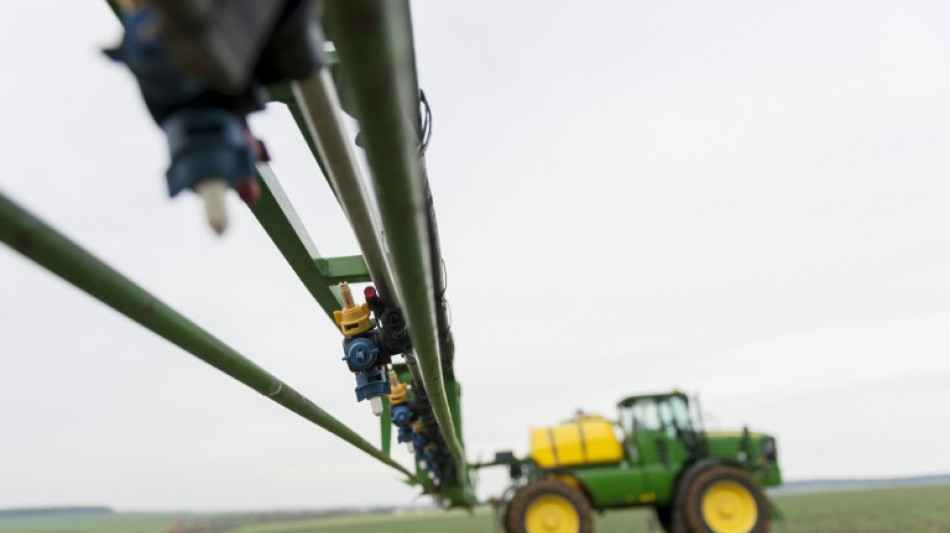
War disrupts fertiliser supplies, puts food security at risk / Photo: Jean Christophe VERHAEGEN - AFP

 Kenya reports first-ever Ebola death
 Tennis world No.1 Sinner's season over due to knee injury
 Yemen's Houthis claim attack on Riyadh airport, deny losing territory

 7-Eleven exits India amid mounting competition
 The alleged murder by US marine on Okinawa: five things to know

 End of an era as Messi prepares to hang up Argentina boots

 Superstar duo headline strong New Zealand squad for Rugby League World Cup
 South Korea warns of possible AI use in banking hacks

 EU vows AI rules will protect Europeans. Will they?

 Myanmar leader to visit Malaysia after migrant returns begin
 Germany's AfD poised to preside over state assembly for first time
 Australia's opposition vows 'largest cut to immigration' in country's history
 Ready, set, snooze: Sleep-deprived Japanese compete for best-rested

 Falcons thump Saints 45-24 as New Orleans marks Katrina anniversary

 Tuvalu govt adviser says Australia overstepped in pre-COP visit
 Asian stocks mixed despite tech-led Wall St record
 Tens of thousands expected in Paris for high school protests

 AI borrowing binge rattles US markets

 Young Canadians sue government over alleged climate failures

 White Sox down Guardians to take 2-0 series lead
 NHL record-breaker Ovechkin says current season will be his last
 France roar back in Nations League as Italy beat Turkey

 Messi readies for final farewell in Argentina send-off

 Esposito seals Italy win over Turkey in Nations League

 Russia downplays plague reports as Trump offers US help

With production in the Gulf countries at a standstill and gas prices rising, the war in the Middle East is disrupting the supply of fertilisers and posing risks for food security.
A third of fertiliser shipped by sea comes from the region and cannot make it to the global market as Iran has effectively closed the Strait of Hormuz.
That has sent global fertiliser prices soaring, with the UN expressing concern in particular about the impact on developing countries.
- The Gulf is a key manufacturer -
Natural gas is a key feedstock to make artificial fertilsers, and with its ample gas supplies the Gulf region has become a key manufacturer.
The region produces nearly half of the sulphur sold worldwide and a third of urea -- "the most widely traded fertiliser of all", said Sarah Marlow, global editor for fertilisers at Argus Media.
It also produces a quarter of globally traded ammonia, another feedstock for fertiliser production, she said.
Major food producing nations like the United States and Australia source much of their urea and phosphate from the Gulf nations.
Brazil, the world’s leading soybean producer, imports most of its urea from Qatar and from Iran, which also exports to Turkey and Mexico.
India relies upon Saudi phosphate.
Asia in particularly dependent upon on the Gulf: it imports 64 percent of its ammonia and more than 50 percent of its sulphur and phosphates from the region, according to 2024 figures from Kpler.
But since the start of the conflict, which has seen Iran launch retaliatory strikes against its Gulf neighbours following US and Israeli strikes, production has had to be shut down at fertiliser production facilities, particularly in Qatar.
And the Strait of Hormuz remains largely unnavigable.
A Chinese vessel loaded with sulphur was able to leave on March 7, but around 20 other ships were still waiting as of the middle of the week, according to Kpler, which tracks commodity flows.
- Global repercussions -
While Europe appears at first blush to be less exposed, sourcing just 11 percent of its urea from the region, it will likely be impacted indirectly.
Morocco is a big supplier of phosphorus-based fertilisers to Europe, but is dependent upon the Gulf for sulphur used in their manufacturing.
The EU also imports 26 percent of its urea from Egypt, but the country is confronted by a halt of natural gas supplies from Israel by pipeline, pointed out Argus Media consultant Arthur Portier.
"Egyptian urea has gone from $500 per tonne at the start of the war to more than $650. There is a direct impact on the price of fertiliser" for European farmers, he said.
Other countries that source their gas from the Middle East to produce fertilisers, such as India, have had to ration supplies to their factories.
Bangladesh has temporarily shut down five out of six of them.
The UN expressed concern this week about access to fertilisers in some of the poorest countries.
- Crop production at risk -
Artificial fertilisers provide nitrogen, phosphorus, and potassium necessary for crop growth.
For nitrogen-based fertilisers such as urea, ammonium nitrate and potassium, "global demand never ceases to increase, driven by Asia," said Sylvain Pellerin at INREA, a French agricultural research institute.
INREA models that without these three key fertiliser inputs, global crop production would fall by a third.
But nitrogen fertilisers require natural gas for their chemical synthesis, and a lot of energy.
As for sulfur, it is a co-product of the oil and gas industry.
Where there is gas, you will find urea and ammonia," said the Argus's Marlow.
Production of phosphorus-based fertilisers starts with phosphate rock, of which Saudi Arabia supplies 20 percent of the world total but currently cannot ship it.
- Uncertain outlook -
In addition to the uncertainty about how long the war will last, the other question is the amount of damage that fertiliser production facilities will suffer from the fighting.
Repairs and reconstruction of facilities could considerably delay a return to normality once the fighting ends.
While the immediate needs of farmers are more or less covered, there are questions about the sowing season in the southern hemisphere that begins in June.
Portier said the war could be the spark for Europe to develop a fertiliser supply strategy.
Following the surge in fertiliser prices following the Russian invasion of Ukraine, European farmers reduced their consumption and diversified their suppliers.
The European Commission is preparing a fertiliser action plan for this year.
F.AbuShamala--SF-PST