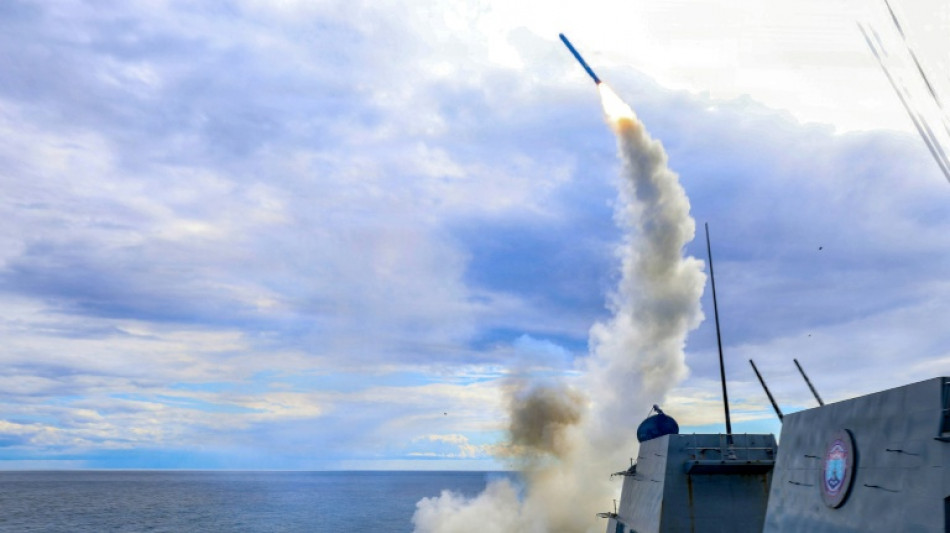
Mideast war risks sending global economy into stagflation / Photo: - - US NAVY/AFP

 Hundreds arrested in French school protests as Macron summons ministers
 WADA seeks tough anti-doping stance from Kenya

 German ex-spy chief arrested for suspected espionage, treason
 Furyk vows US will 'do more' to end Ryder Cup losing streak

 Iyer hits ton as India hammer West Indies in T20 opener

 Mandhana named India women's team captain after Kaur quits
 'The sound keeps coming back': children maimed in Ethiopia's Tigray clashes
 Paris Women's Fashion Week: the key trends

 i-payout Introduces a New Approach to Payments, Closing the Beneficiary Information Gap

 New Generation of Crypto Miners Released by ASICID
 New investor forecasts LIV Golf teams could be worth $100 mn each

 Shakira, Pique return to court over children visit arrangements

 Nobel physics prize hails 'ghostly messengers' from space
 France's Mistral unveils latest model in sovereign AI push

 Stocks climb as oil prices retreat

 Vstock Transfer Names Securities Industry Veteran Erica Goodstein General Counsel and Chief Compliance Officer

 Four Indonesian seamen return home after Somali pirate ordeal

 Crisis-striken Haiti postpones elections

 Germany arrests ex-spy chief on suspicion of giving secrets to foreign powers

 Djokovic wins China Open after de Minaur retires
 IMF warns cost-of-living shocks cause 'lasting deterioration' in affordability

 Alcaraz wins Japan Open for first title since injury return
 'We're working to keep football clean', Turkish minister says

 FIFA chief Infantino hit by Norwegian double complaint

 Exiled Catalan separatist leader Puigdemont cleared to return to Spain
An extended conflict in the Middle East after the US and Israel launched strikes on Iran could trigger global stagflation -- a troublesome blend of high inflation and anaemic growth -- due to spiking oil and gas prices, economists warned.
- Will there be an oil shock ? -
The conflict has nearly halted traffic through the Strait of Hormuz, through which around 20 percent of global seaborne oil passes, with several ships attacked.
Global oil prices shot higher on Monday, with the Brent crude international reference oil contract up nearly nine percent at $79.30 per barrel at 1410 GMT.
It briefly surpassed $80 per barrel earlier in the day, and was up considerably from the $61 per barrel at the start of the year.
Economist Sylvain Bersinger said the war risks "creating a third oil shock after those in 1973 and 1979 and the 2022 gas shock".
Europe's benchmark gas price shot more than 50 percent higher on Monday.
He said the price of oil could rise to $110 per barrel, but added that was no longer exceptional as oil prices had risen over $140 in 2008 and were above $100 in the 2010s.
Adam Hetts at asset manager Janus Henderson said that while oil prices would certainly rise, the increase should remain "at reasonable levels".
- What impact on global trade? -
The conflict could act as a shock to trade "at the worst possible moment", said economists at ING bank.
The global trading system is already under stress from US President Donald Trump's tariff offensive as well as the fragmentation of supply chains since Covid and the war in Ukraine.
Moreover the closure of the Gulf airspace is disrupting aviation between European and Asia, they noted.
For Ruben Nizard, head of political risk research at Coface, a trade credit insurance company, this crisis could also "throw another wrench into the works by driving up maritime freight costs" and pushing up inflation.
"At the global level, this would open the door to an economic scenario of stagflation," he added, referring to a situation with high inflation and weak or non-existent growth.
- What impact on the global economy? -
According to economists at Natixis bank, a prolonged disruption of traffic in the Strait of Hormuz "would have major implications for markets, but also for inflation dynamics and overall economic stability".
They added that "China would be particularly affected by this war."
Cyrille Poirier-Coutansais, director of the research department at the French Navy's Centre for Strategic Studies, agreed that China is particularly dependent upon oil shipped through the Strait of Hormuz.
"The question is whether there will be enough fuel to keep the world's factory running," he told AFP.
For the economist Sylvain Bersinger the impact on Europe will likely be less than the 2022 gas shock, which would help France in particular to avoid a recession.
In a sign of declining investor confidence, the interest rate on European sovereign bonds climbed on Monday.
The yield on 10-year German government bonds, the benchmark in the eurozone, stood at 2.70 percent in afternoon trading, compared with 2.64 percent on Friday.
- What risks in a long war? -
The intensity and duration of the conflict will be key in determining its impact.
"In a prolonged conflict, the combination of higher energy costs, disrupted logistics, and a generalised confidence shock would constitute a meaningful drag on global trade volumes at precisely the moment the world economy was still digesting the inflationary and growth consequences of the tariff shock," said economists at ING bank.
Coface's Nizard said they estimated that "an increase of roughly 15 dollars in the price of Brent over a prolonged period could shave about 0.2 percentage points off global growth and add almost half a point to inflation."
These are "not insignificant" effects in a context of "fairly fragile global economic growth", he added.
A.Suleiman--SF-PST