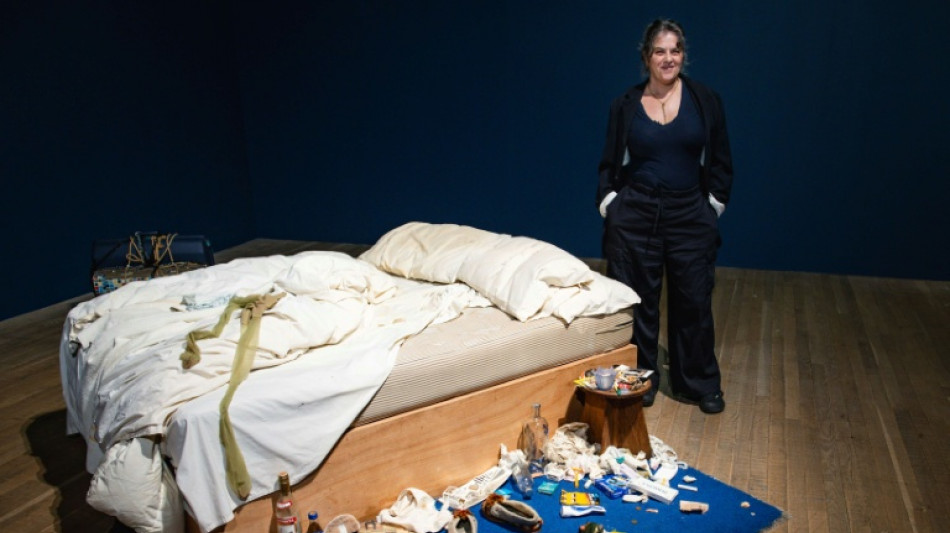
'Fearless' Tracey Emin gets major London retrospective / Photo: ADRIAN DENNIS - AFP

 Hundreds arrested in French school protests as Macron summons ministers
 WADA seeks tough anti-doping stance from Kenya
 German ex-spy chief arrested for suspected espionage, treason
 Furyk vows US will 'do more' to end Ryder Cup losing streak

 Iyer hits ton as India hammer West Indies in T20 opener

 Mandhana named India women's team captain after Kaur quits
 'The sound keeps coming back': children maimed in Ethiopia's Tigray clashes

 Paris Women's Fashion Week: the key trends

 i-payout Introduces a New Approach to Payments, Closing the Beneficiary Information Gap

 New Generation of Crypto Miners Released by ASICID

 New investor forecasts LIV Golf teams could be worth $100 mn each

 Shakira, Pique return to court over children visit arrangements

 Nobel physics prize hails 'ghostly messengers' from space
 France's Mistral unveils latest model in sovereign AI push

 Stocks climb as oil prices retreat
 Vstock Transfer Names Securities Industry Veteran Erica Goodstein General Counsel and Chief Compliance Officer

 Four Indonesian seamen return home after Somali pirate ordeal

 Crisis-striken Haiti postpones elections

 Germany arrests ex-spy chief on suspicion of giving secrets to foreign powers
 Djokovic wins China Open after de Minaur retires

 IMF warns cost-of-living shocks cause 'lasting deterioration' in affordability
 Alcaraz wins Japan Open for first title since injury return

 'We're working to keep football clean', Turkish minister says
 FIFA chief Infantino hit by Norwegian double complaint

 Exiled Catalan separatist leader Puigdemont cleared to return to Spain
The biggest exhibition ever devoted to the decades-spanning career of provocative British artist Tracey Emin opens Friday at London's Tate Modern, celebrating her ability to transform "life's trauma" into visceral art.
One of the best-known contemporary artists in the world, Emin, 62, nearly died in 2020 due to an aggressive cancer and has since undergone multiple major surgeries to treat the disease.
Those harrowing years have heavily influenced the showcase, "Tracey Emin: A Second Life", which runs at the famous London gallery on the south bank of the River Thames until August 31.
"(It) looks at Tracey's whole career from the perspective of the second life that she is now living -- a life that is very different," explained Tate director Maria Balshaw, who co-curated the exhibition.
The Tate Modern noted Emin's ability to use "the female body to explore passion, pain and healing" will be on full display in the approximately 100 works included, some showing publicly for the first time.
Emin -- who hails from a working-class background in Margate, southeast England, and left school at 13 -- called the showcase "the biggest moment of my career".
"I keep telling myself it doesn't matter how I look, it's just so good I didn't die, that I'm here to witness it, enjoy it," she posted on Instagram earlier this week.
- 'Fearless' -
The retrospective takes visitors, piece by piece, through the highs and lows that have shaped Emin's life and remarkable career -- from sexual violence in her teens to abortions and illness in later life.
"She is known internationally for her unapologetic, fearless use of everything from her personal experience, from life's trauma to love to heartbreak, as the very raw material of art," co-curator Alvin Li told AFP.
Recent photographs hanging along a gallery corridor show her body after the myriad operations she has undergone to remove, among other things, her bladder, uterus, fallopian tubes, ovaries and urethra.
Some picture the urostomy bag Emin now wears daily.
Photos on the opposite wall, dating back to 2001, are jarring, depicting her healthier body from that period.
Meanwhile, the 1995 short film "Why I Never Became a Dancer" provides a further contrast, capturing her dancing joyfully.
The film was made in response to "a vile and misogynistic experience that she had, being sex-shamed and taunted in Margate when she was a teenager", Balshaw explained.
- 'Progressive' -
A leading figure in the provocative late 1980s and 1990s Young British Artists movement alongside figures like Damien Hirst and Chris Ofili, the exhibition reveals the full range of mediums Emin has used.
They include everything from embroidery on gigantic blankets and neon creations to sculptures and installations.
Her best-known, "My Bed" -- an unmade bed surrounded by intimate debris including empty vodka bottles, cigarette packets and condoms, which caused a sensation when it was unveiled in 1998 -- takes centre-stage at the Tate Modern.
Despite her troubled upbringing in Margate, Emin returned to live there after her mother's death in 2016 and while she was sick herself, beginning what she has called her "second life".
The artist, who was honoured by King Charles III with a damehood last year, now focuses on large-scale paintings, has given up smoking and alcohol, and also devotes her time to mentoring and financially supporting young artists.
Her recent canvases have a more spiritual, poetic dimension, spotlighting how art can prove regenerative for its practitioners, although the works also remain dark in tone.
"Tracey has always been fearless in engaging a lot of subjects from her personal experience, such as rape, abortion," Li reiterated.
"She received criticism for it back then when she was doing it, but from the standpoint of today, we can see how progressive Tracey has been in pushing contemporary art and engaging with these subjects."
F.Qawasmeh--SF-PST