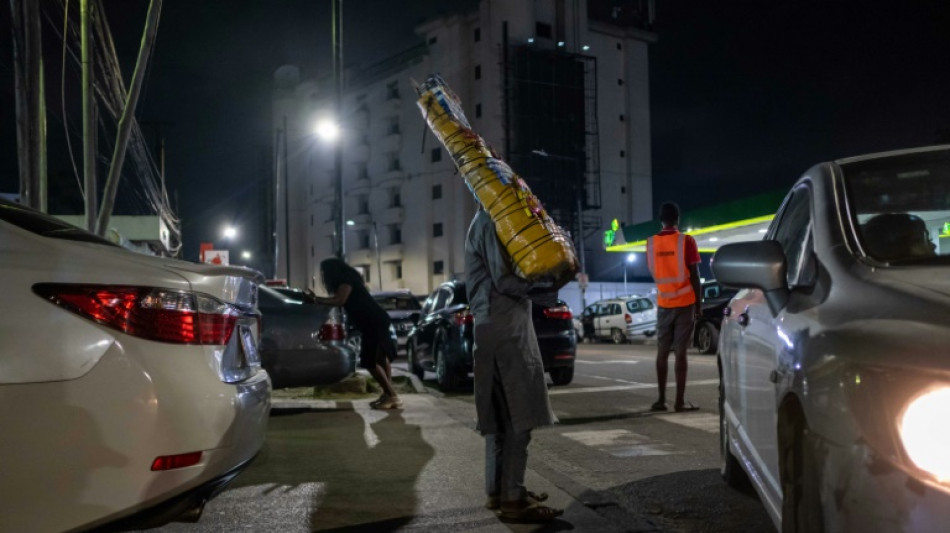
Hustling in Lagos to 'survive in hell' / Photo: Benson Ibeabuchi - AFP

 Arsenal stunned by fourth-tier Fleetwood in League Cup

 افتتاح وقف المحميد في دبي لدعم الأسر محدودة الدخل والحالات الإنسانية

 Brazil's Flavio Bolsonaro flees to US after election loss
 صقر غباش يدعو بريكس إلى تعميق أثرها في التوازن والتنمية الدوليين

 Flavio Bolsonaro headed to US after Brazil election defeat: US media

 American woman convicted of getting military training from Islamic State

 Alcaraz and Zverev win Vienna openers

 Israel opposition holds narrow edge over Netanyahu in first projections

 جائزة الأمير ألبرت الثاني تكرم ابتكار مبادرات محمد بن راشد في العمل الخيري

 ماسا الرفاعي تمثل أصغر المشاركات في نهائيات تحدي القراءة العربي

 Syria condemns deadly Jordan strikes as 'unacceptable violation'
 England's Fin Smith in race against time to face Australia

 Storied Paris department store seeks bankruptcy protection

 UN nuclear watchdog chief urges Iran to grant access

 الأسهم الأوروبية تتراجع تحت ضغط اضطرابات فرنسا ونتائج الشركات

 Boeing shares tumble after it releases cautious growth forecast

 Allegri suspended for two Serie A games after red card

 مصر تعمل على أدوات تمويل لتقليص مخاطر الاستثمار الصناعي
 قفزة بنسبة 58% في أسعار الكهرباء الفورية بألمانيا

 Carney moves to remake Canada alliances as US ties strained

 Serbia's students demand state media chiefs resign after poll win

 أسهم التكنولوجيا تدفع الأسواق الصينية إلى أدنى إغلاق في 14 شهراً

 Boeing releases cautious growth plan as shares fall sharply

 منع وفد دولي من دخول الضفة للمشاركة في مؤتمر بجامعة بيرزيت

 Exiled Russian dissident Navalnaya warns dictators becoming 'more cunning'
It's midnight. Luxury cars arrive outside Cocoon, a nightclub in Lagos, Nigeria's largest and most vibrant city. In minutes, dozens of people surround the vehicles, hoping to make a buck.
In the wealthy Ikoyi neighbourhood, the flow of people chasing money never stops. All survive on informal jobs they find daily on the streets.
For a handful of dollars, they help people park in front of expensive restaurants, bars and clubs, and help manage traffic during the day.
In the megacity of some 20 million people, for the poorest a good day is when you have enough to eat. A bad day is when you don't -- and those days are increasingly frequent as high fuel and food costs bite into earnings.
"In Nigeria, it's simple. Either you hustle or you die. So even 100 naira (25 cents), we take it," says Musa Omar, standing opposite the Cocoon nightclub.
Africa's most populous country has some 80 million people living below the national poverty line, earning less than 1.90 dollars a day.
And in rural Nigeria, millions live in areas where insecurity is rife, making living conditions even harsher.
Many are now being pushed to a tipping point, after cost of living and food prices increased following the coronavirus pandemic and then again after Russia declared war in Ukraine.
Nigeria's official year-on-year inflation is now 18 percent, with food inflation at 20 percent -- a five-year high.
In Lagos, hustlers -- people living and working by the day -- can be seen at every corner.
They embody one of the city's mottos often seen painted in colourful letters on trucks: "No food for lazy man."
The street is like a river, and they hope desperately to catch a passing fish.
"I'm willing to work anywhere, to do anything, to make a decent living," said Omar, 36.
"Before, it was not like this... prices have gone up, everything is expensive and everybody is suffering."
- God, only 'hope' -
Every day, thousands of people, mostly young, trickle into the cities and in particular Lagos, hoping to capture a small fraction of the immense wealth concentrated in the hands of a select few.
It's the case of Kasheem Sadiq who left Kaduna, in the north, after the death of his baby son, Yusuf, who "got sick".
"I had to find 9,000 naira (about $20) to pay the treatment but I couldn’t because price of food is up. And there is no job anywhere," said the 44-year-old, standing under the only functioning light of a dark street of Lagos.
Now working in Lagos, he says he earns about 2,500 naira ($6) a day -- almost three times more than what half of the population earns -- but, "every night, I’m crying, away from my family," he said.
It's now 2.20 am outside the Cocoon nightclub. Someone in a Porsche is trying to park while a group of hustlers guide the driver so that he doesn't crash the luxury car in a ditch full of trash.
"The rich are getting so rich and nobody cares about the poor," says Abdul Musa, 35, who seems to be the hustlers' informal chief. "Only God can help us."
- Drugs, prostitution -
From Benue, in the east, Musa has been working the streets of Ikoyi for the past five years. He says he sleeps in a stable at night with donkeys.
"I don't want to have children," he says. In this country, "we are surviving in hell."
Five a.m. Clubbers are streaming out, heading back to their cars.
It's late, or early, but someone shouting the following three syllables is enough to arouse the crowd: "Bu-ha-ri", in reference to President Muhammadu Buhari.
The 79-year-old former army general is stepping down next year after his two terms in office allowed by the constitution.
For many including for those waiting outside Cocoon, the government is "corrupt" and "does nothing for the people".
Anita Obasi, the only woman in the group of hustlers, is looking at the stream of cars driving away, smoking a joint.
In Nigeria, drugs are widely consumed among the street hustlers as a way to escape reality.
Wearing a black cap, the 24-year-old smiles. She says smoking "eases the pain away".
For the past two years, she has been working as a prostitute, charging the equivalent of $9 a client or $11 when she travels to them.
After two decades of growth, Nigeria entered a recession in 2016, after a fall in oil prices. The economy was just starting to recover in 2020 when the pandemic hit. And the war in Ukraine has made everything much worse.
Obasi lives in constant anguish: will she be able to feed her daughter at the end of the day?
"I try thinking about the bright side of things, but everything around me is going down."
T.Samara--SF-PST