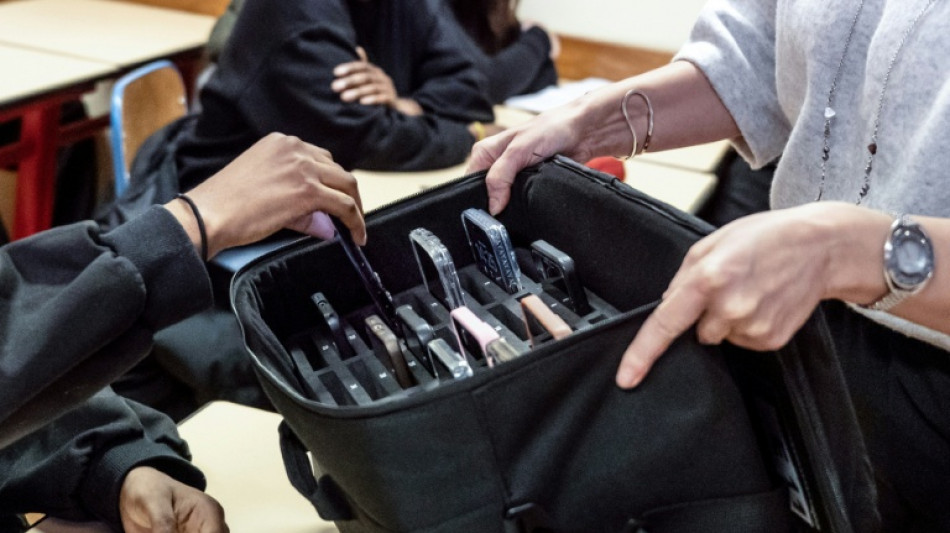
Sweden plans to ban mobile phones in schools / Photo: BERTRAND GUAY - AFP/File

 Indonesian court hears 'negligence' complaint against state over fires, haze

 Rubio in Greece to urge against Western civilisation 'decline'

 Micron workers at Taiwan plant vote in favour of strike

 In 'The Social Reckoning,' Jeremy Allen White takes on Facebook's 'frightening' ambition

 Chip industry activists call for South Korea to recognise cancer cases

 Famine-scarred southern Madagascar braces for El Nino

 How the EU regulates lobbyists

 I.Coast refuge offers lifelong care for youngsters scorned as 'sorcerers'

 Indian central bank hikes rates for first time in more than 3 years

 Hotel Blacklist Launches New Accommodation Industry Risk Assessment Tool

 Bangladesh nuclear plant draws hope -- and worry

 US beat Canada 1-0 to wrap up four-win international break

 Turkey, Australia's joint COP31 leadership raises doubts

 For Turkish NGOs, COP31 offers rare space for action

 Sleep, appetite, gene-editing experts contend for Nobel chemistry prize

 Nobel Peace Prize haunted by the 'spectre' of Trump

 Africa launches own credit agency in bid for cheaper borrowing

 US, China, EU: three paths to regulating AI

 Australia's High Court rules against coal mine in landmark climate case

 Australia touts new funds for Pacific infrastructure at Fiji 'pre-COP'

 Eva Marie Saint, Oscar winner of Hollywood classics, dies at 102

 Australia probes app used in cheap smart glasses over privacy fears

 England needed to 'move on' from World Cup pain, says Tuchel

 O'Neill to stay at Celtic after period of "reflection"

 Kane marks 125th England cap with Wembley Nations League double

Sweden plans to ban mobile phones from primary and middle schools in order to ensure that children can focus on learning in the classroom, the government said on Wednesday.
The ban would mean that pupils in classes up to grade nine, or aged 15-16, would hand in their phones in the morning and get them back at the end of the school day.
"Studies show that Swedish students are distracted by digital tools in the classroom to a greater extent than students in the OECD on average," the government said in a statement.
"The government is therefore proposing a ban on mobile phones throughout the school day."
Around 80 percent of Swedish primary and middle schools already have bans on mobile phones in the classroom, introduced at the principals' discretion, according to Swedish news agency TT.
But Education Minister Simona Mohamsson told a press conference a nationwide ban was needed to ensure that all schools were mobile-free zones.
"It will decrease distractions in the classroom," she said, describing it as "a win for both teaching and mental health."
She said the ban could also "help many parents in their struggle at home" to reduce screen time.
Mohamsson said data showed that Swedish middle school students spend an average of almost seven hours a day on screens, not including screen time during school hours.
If adopted by parliament, the ban would go into force in time for the start of the autumn term in August 2026, and would also apply to after-school care facilities.
The Scandinavian country launched a national "digitalisation" strategy for nursery, primary and middle schools in 2017 that saw tablets and laptops replace many textbooks and handwriting.
But it began rolling back that policy in 2023 amid criticism over declining school performances.
I.Saadi--SF-PST