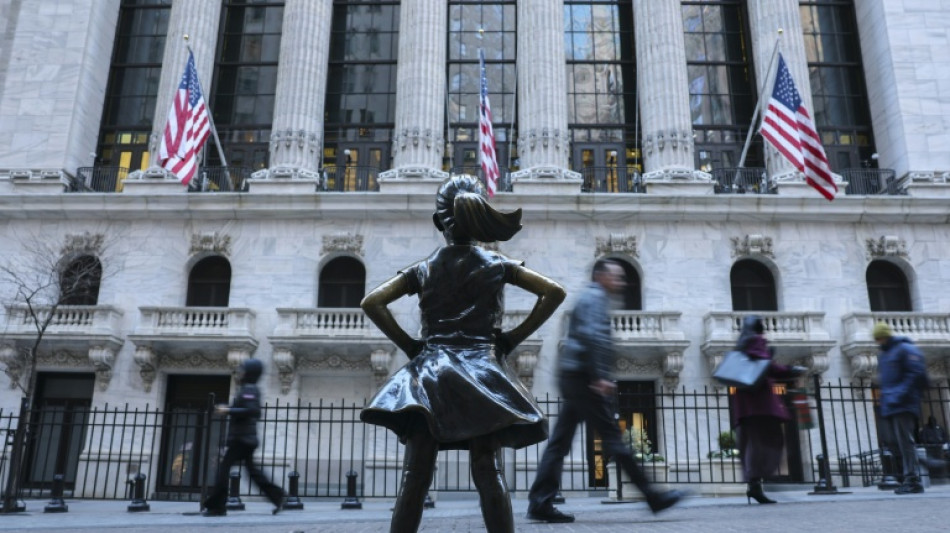
Wall Street intends to stay open around the clock / Photo: ANGELA WEISS - AFP/File

 Gauff says online abuse was 'draining' after China Open exit

 As sector struggles, Porsche puts luxury ahead of volume

 'It's personal': Fiji minister pushes better climate finance at pre-COP

 Russia glosses over dark Soviet past in reinvented museum

 UK tax body opened probe into Man City in 2018: FT

 Yemen's Houthis claim new attacks on Saudi airports as conflict deepens

 Germany factory production at highest level for 18 months

 Thailand floods death toll rises to 60 since mid-September

 US pushes Russia for information on plague reports

 Myanmar leader lands in Malaysia for migrant return talks

 Indian central bank hikes rates for first time since 2023

 US military on Okinawa face curfew, alcohol ban after murder case

 Fierce lobbying in EU over 'forever chemicals'

 Dodgers beat Braves and Padres avoid sweep in MLB playoffs
 Mourning, war and elections as Israel marks October 7

 Messi says Argentina retirement is 'saddest day of my career'

 Oil rises and stocks fall as Hormuz worries flare

 Pacific presses world for help 'surviving' climate change at pre-COP summit

 Verstappen revival to be put to the test in steamy Singapore

 US woman who survived botched execution is conscious, speaking: lawyers

 Climate champion Australia digging more coal

 Emotion, tears as Messi retires from Argentina national team

 Dodgers push Braves to the brink of MLB playoff exit

 Crisis-stricken Haiti postpones elections

 N. Korea's Kim pledges 'invariable support' in Putin birthday letter

The closing and opening bells of the New York Stock Exchange (NYSE) may become a ringing ritual of yesteryear, as the market moves toward nonstop trading.
This week, the Intercontinental Exchange announced it is developing a platform for 24/7 operations that offers "instant settlement."
The around-the-clock operations would rely on digital tokens mirroring the shares of listed companies, the NYSE's parent company said in a statement.
NASDAQ, another New York-based trading exchange, could follow suit as early as this year.
The move is pending approval by federal regulators at the US Securities and Exchange Commission (SEC), and would amount to a minor revolution for the way money moves in US stock markets.
- 'Waste of time' -
In the early days of the exchange, investors had to be physically present in markets on Wall Street to "stand and yell at each other and wave pieces of paper, and then they would have to write down what everybody bought and sold," Sam Burns, chief strategist at Mill Street Research, told AFP.
That meant "having trading go on all day every day would sort of be impossible to keep up with," Burns said.
Digitized transactions can change all that.
Off-hours trading has already been on the rise since 2019, exploding since 2024 when the daily average topped $61 billion, according to a NYSE report in early 2025.
But the appeal remains limited, according to Steve Hanke, a professor of applied economics at Johns Hopkins University.
"Historically, there is little evidence that supports the idea that the benefits of 24-hour trading outweigh the costs," he said, adding that there "are few market-moving events that occur outside of normal business hours in New York City."
"Night trading proved to be a waste of time," he said.
Hanke said the real advantage in the NYSE's announcement lies in the time needed to finalize a trade -- a process that usually occurs the next day in most stock markets.
"Narrowing the settlement window may prove to be a significant competitive advantage," Hanke said.
- Attracting the young and foreigners -
As host to immense market caps, the US market remains the largest in the world, but competition is growing.
Last year, many European indexes generated returns that outpaced their US counterparts.
With extended hours, Wall Street may be able to attract smaller investors and those outside the Americas.
Nearly 18 percent of US shares belonged to non-US holders in 2024, according to the US Treasury's most recent available figures.
And fans of cryptocurrency trading may jump into stocks, said Burns, the Mill Street Research strategist.
"A lot of retail investors nowadays, particularly younger ones, seem to like the idea of being able to trade stocks all the time the way they do cryptocurrencies and other digital assets, whether it's nights or weekends," Burns said.
It is unlikely that the change would move traditional investors from banker's hours because the impacts of any change are likely to be limited," Burns added.
"Most institutional investors that trade the real money aren't really interested in working or trading on the weekends, and the fact (is) that banks are mostly still closed on the weekends," Burns said.
T.Ibrahim--SF-PST