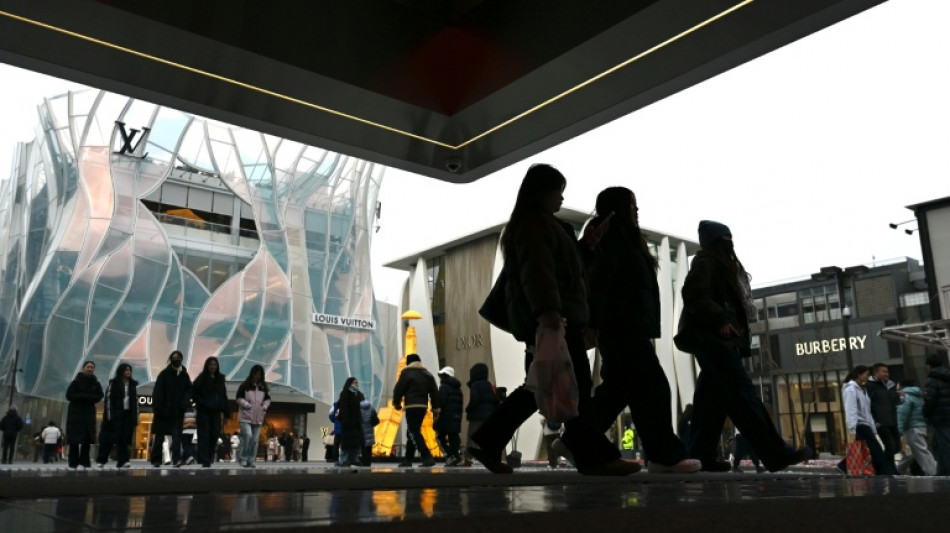
China's 2025 economic growth among slowest in decades / Photo: WANG Zhao - AFP

 West must embrace 'national power' or face decline: Rubio

 Shell refining margins reach record highs as wars hit supply

 Former Spain, Barca winger Pedro retires from football

 Arteta signs new Arsenal deal until 2030

 Stocks decline as oil climbs on Mideast flareup

 Gauff says online abuse was 'draining' after China Open exit

 As sector struggles, Porsche puts luxury ahead of volume
 'It's personal': Fiji minister pushes better climate finance at pre-COP

 Russia glosses over dark Soviet past in reinvented museum

 UK tax body opened probe into Man City in 2018: FT

 Yemen's Houthis claim new attacks on Saudi airports as conflict deepens

 Germany factory production at highest level for 18 months
 Thailand floods death toll rises to 60 since mid-September

 US pushes Russia for information on plague reports

 Myanmar leader lands in Malaysia for migrant return talks

 Indian central bank hikes rates for first time since 2023

 US military on Okinawa face curfew, alcohol ban after murder case

 Fierce lobbying in EU over 'forever chemicals'

 Dodgers beat Braves and Padres avoid sweep in MLB playoffs
 Mourning, war and elections as Israel marks October 7

 Messi says Argentina retirement is 'saddest day of my career'
 Oil rises and stocks fall as Hormuz worries flare

 Pacific presses world for help 'surviving' climate change at pre-COP summit

 Verstappen revival to be put to the test in steamy Singapore

 US woman who survived botched execution is conscious, speaking: lawyers

China's economy grew at one of the slowest rates in decades last year, according to official data released Monday, as officials struggle to overcome persistently low consumer spending and a debt crisis in the country's property sector.
While the five percent expansion was in line with Beijing's annual target -- a low-ball figure analysts have likened to a political comfort blanket -- observers warned it was driven largely by exports and masked weak sentiment on the ground.
And in a sign of the work ahead for leaders, the data also showed a significant slowdown in the last quarter of the year, growing at 4.5 percent as expected.
"The impact of changes in the external environment has deepened," admitted National Bureau of Statistics (NBS) official Kang Yi.
"The domestic contradiction of strong supply and weak demand is prominent, and there are still many old problems and new challenges in economic development," he told a news briefing.
While the reading was in line with the government's target of "around five percent" -- allowing officials to declare victory, Chinese consumers remain jittery about the wider economy and high unemployment.
That is despite officials relaxing fiscal policy and subsidising the replacement of household items in a sputtering bid to boost spending.
Policies and measures to boost consumption would continue into 2026, Kang noted, including a trade-in scheme for old household appliances.
"The gradual implementation of policies to clear unreasonable restrictions in the consumption sector will support consumption growth," he said.
- Overstated strength -
Figures on Monday also showed growth in retail sales, a key indicator of consumption, slowed to 3.7 percent last year from four percent in 2024.
And for December, the reading came in at 0.9 percent on-year -- the weakest pace since the end of 2022, when stringent zero-Covid measures ended.
The decline in sales likely reflects the waning impact of consumer subsidies, Zichun Huang of Capital Economics wrote in a note.
But overall figures likely "overstate the strength of the economy", she said.
Meanwhile, industrial output expanded 5.9 percent in 2025, a slight slowdown from the previous year, while the 5.2 percent increase seen in December was an improvement on November's pace.
"The December activity data suggest that output growth gained some momentum at the end of the year, but that's largely driven by resilient exports," Huang said.
"We expect growth this year to be at least slightly softer than in 2025," she added.
Officials were keen to point to China's factory activity, which ticked up slightly in December to provide an unexpected silver lining to an otherwise lacklustre year's end.
A key measure of industrial health, the manufacturing purchasing managers' index, ticked up to 50.1 last month, according to NBS data, just above the 50-point mark separating contractions from expansions. The figure had not been positive since March.
But China's crucial property sector, once a major indicator of the country's economic strength, has failed to overcome a debt crisis despite interest rate cuts and loosened restrictions on homebuying.
Fixed-asset investments in China shrunk 3.8 percent in 2025, reflecting a rebalancing following decades of heavy spending on property and infrastructure.
The broader housing market remains sluggish, with real estate investment down 17.2 percent last year.
- Trillion-dollar surplus -
The return of Donald Trump to the White House last January and the revival of a fierce trade war between the world's two largest economies added to Beijing's problems.
Chinese President Xi Jinping and Trump reached a tentative truce when they met in late October, agreeing a pause to painful measures that included lofty tit-for-tat tariffs.
Official data showed Chinese exports to the United States plunged 20 percent in 2025, but that had little impact on demand for Chinese products elsewhere.
Robust exports remained a bright spot in the cloudy economic picture despite the bruising trade war.
China's trade surplus hit a record $1.2 trillion last year, with officials lauding a "new historical high" filled by other trade partners.
Shipments to the Association of Southeast Asian Nations rose 13.4 percent year-on-year, while exports to Africa surged 25.8 percent.
Exports to the European Union were also up 8.4 percent, though imports from the bloc dipped.
K.AbuDahab--SF-PST