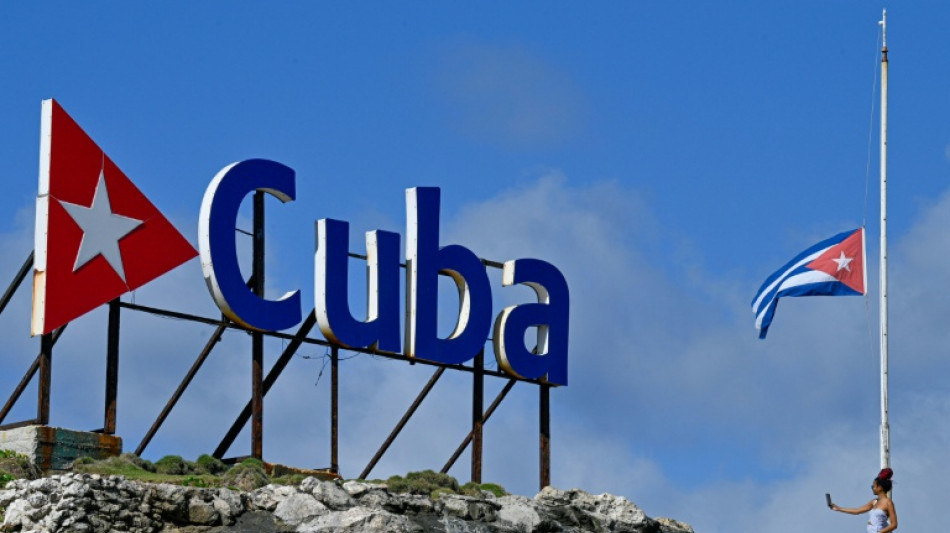
Toppling of Venezuela's Maduro stirs fear in Cubans / Photo: Adalberto ROQUE - AFP

 US woman who survived botched execution is awake and speaking
 From 1800s to modern pharma: a Nobel-winning chemistry quest

 Southampton boss Eckert given suspended ban over 'Spygate'
 Russia warns of 'false' information as second plague case reported
 IEA ready to release more oil reserves if necessary
 HSBC 'consults' over UK unit job cuts amid AI adoption
 UK court quashes five ex-traders' Libor rate rigging convictions
 XM Receives “Global Customer Experience Leader Award 2026” at the TrustFinance Performance Awards
 Stocks slide as oil climbs on Mideast flareup
 Heavy casualties in Ukraine after Russian strikes
 French wine harvest set to hit historic low
 Kyiv 'cannot agree' to EU membership limiting food exports: minister
 Arteta targets more Arsenal glory after signing new deal until 2030

 Russell hit with Singapore grid penalty for taking new power unit
 Spotify expands audiobooks to more than 180 markets
 French-Japanese duo wins chemistry Nobel for solving molecular 'mystery'
 England's Nations League surge helps heal World Cup wounds
 Mayor of opposition stronghold Izmir defects to Erdogan party
 Mertens beats Gauff to set up Swiatek clash at China Open
 Benin full of pride at role in Messi's last dance

 France suspends stun grenade use at student protests ahead of PM speech
 Indonesian court hears 'negligence' complaint against state over fires, haze
 Rubio in Greece to urge against Western civilisation 'decline'
 Micron workers at Taiwan plant vote in favour of strike
 In 'The Social Reckoning,' Jeremy Allen White takes on Facebook's 'frightening' ambition
Cubans weary from years of economic crisis, shortages of basic supplies and regular power blackouts, fear the US attack on Venezuela, a leftist ideological ally and its main oil supplier, will see life get even tougher.
After American forces seized Venezuela's leader Nicolas Maduro in an early-morning raid, US President Donald Trump over the weekend issued threats to other leftist leaders in the region and said he thought Cuba was "ready to fall."
He played down the need for US military action on the island, saying it would be hard for Havana to "hold out" without Venezuelan oil, and "it looks like it's going down."
"2026 is going to be tough, very tough," Axel Alfonso, a 53-year-old working as a driver for a state enterprise, told AFP in the capital Havana on Monday.
"If Venezuela is the main supplier, at least of oil, it's going to get a bit complicated," said Alfonso who, like the vast majority of Cubans, has lived his whole life under a bruising US trade embargo in place since 1962.
The communist-run island has seen 13 US administrations come and go, some more punishing than others.
"We've been fighting for 60 years, and we have to keep going," Alfonso said.
- 'Uncertainty' -
Located roughly 90 miles (about 145 kilometers) from the coast of Florida, Cuba's last major economic test followed the implosion in 1991 of the Soviet Union, a major trade partner and source of credit.
It survived by opening up to tourism and foreign investment.
Since 2000, Havana has increasingly relied on Venezuelan oil under a deal struck with Maduro's predecessor Hugo Chavez, in exchange for Cuban doctors, teachers, and sports coaches.
In the last quarter of 2025, Venezuela sent Cuba an average of 30,000 – 35,000 barrels a day, "which represents 50 percent of the island's oil deficit," Jorge Pinon, an energy expert and researcher at the University of Texas, told AFP.
The number was much higher 10 years ago, slashed by the global oil price crash that sent Venezuela's own economy into turmoil.
For the past six years, Cuba has been mired in an ever-deepening crisis caused by a toxic combination of tighter US sanctions, poor domestic management of the economy and the collapse of tourism due to the Covid-19 pandemic.
GDP has fallen by 11 percent in five years and the government faces a severe shortage of currency to pay for basic social services: electricity, healthcare and supplying subsidized food and other basic goods that many Cubans have learned to rely on.
Economic hardship was a trigger for the unprecedented anti-government demonstrations of July 11, 2021, when thousands of Cubans took to the streets shouting "We are hungry" and "Freedom!"
Since then, ever more frequent and longer power cuts and shortages of food and medicine have deepened discontent and led to sporadic, smaller protests, quickly contained by the government.
Now, many fear that the loss of Venezuelan oil will make matters even worse.
"We're living in a moment of uncertainty," attorney Daira Perez, 30, told AFP.
- No bailout -
Pinon said it was "not clear whether shipments of Venezuelan oil to Cuba will continue," especially in the context of the recent US seizure of oil tankers in the Caribbean.
And he highlighted that "Cuba doesn't have the resources to buy that volume on international markets, nor a political partner to bail it out."
Despite concerns for the future, long-suffering Cubans put on a brave face.
"He (Trump) keeps making tough threats," said Havana resident Roberto Brown, 80, who was a young man during the 1962 Cuban Missile Crisis that brought the world to the brink of nuclear war.
"We already told him once: we're 90 miles away, and a long-range missile from over there reaches here, but the one from here reaches there too," said Brown.
I.Saadi--SF-PST