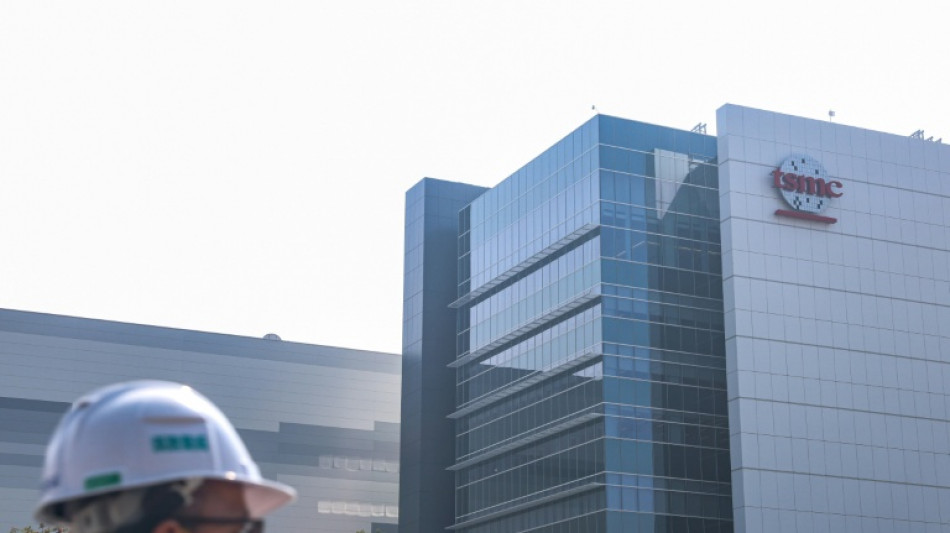
TSMC says started mass production of 'most advanced' 2nm chips / Photo: I-Hwa Cheng - AFP/File

 US woman who survived botched execution is awake and speaking

 From 1800s to modern pharma: a Nobel-winning chemistry quest
 Southampton boss Eckert given suspended ban over 'Spygate'
 Russia warns of 'false' information as second plague case reported
 IEA ready to release more oil reserves if necessary

 HSBC 'consults' over UK unit job cuts amid AI adoption
 UK court quashes five ex-traders' Libor rate rigging convictions
 XM Receives “Global Customer Experience Leader Award 2026” at the TrustFinance Performance Awards
 Stocks slide as oil climbs on Mideast flareup
 Heavy casualties in Ukraine after Russian strikes
 French wine harvest set to hit historic low

 Kyiv 'cannot agree' to EU membership limiting food exports: minister

 Arteta targets more Arsenal glory after signing new deal until 2030

 Russell hit with Singapore grid penalty for taking new power unit

 Spotify expands audiobooks to more than 180 markets
 French-Japanese duo wins chemistry Nobel for solving molecular 'mystery'

 England's Nations League surge helps heal World Cup wounds

 Mayor of opposition stronghold Izmir defects to Erdogan party
 Mertens beats Gauff to set up Swiatek clash at China Open

 Benin full of pride at role in Messi's last dance

 France suspends stun grenade use at student protests ahead of PM speech

 Indonesian court hears 'negligence' complaint against state over fires, haze
 Rubio in Greece to urge against Western civilisation 'decline'
 Micron workers at Taiwan plant vote in favour of strike

 In 'The Social Reckoning,' Jeremy Allen White takes on Facebook's 'frightening' ambition
Taiwanese tech titan TSMC has started mass producing its cutting-edge 2-nanometre semiconductor chips, the company said in a statement seen by AFP on Wednesday.
TSMC is the world's largest contract maker of chips, used in everything from smartphones to missiles, and counts Nvidia and Apple among its clients.
"TSMC's 2nm (N2) technology has started volume production in 4Q25 as planned," TSMC said in an undated statement on its website.
The chips will be the "most advanced technology in the semiconductor industry in terms of both density and energy efficiency", the company said.
"N2 technology, with leading nanosheet transistor structure, will deliver full-node performance and power benefits to address the increasing need for energy-efficient computing."
The chips will be produced at TSMC's "Fab 22" facility in the southern port city of Kaohsiung.
More than half of the world's semiconductors, and nearly all of the most advanced ones used to power artificial intelligence technology, are made in Taiwan.
TSMC has been a massive beneficiary of the frenzy in AI investment. Nvidia and Apple are among firms pouring many billions of dollars into chips, servers and data centres.
AI-related spending is soaring worldwide, and is expected to reach approximately $1.5 trillion by 2025, according to US research firm Gartner, and over $2 trillion in 2026 -- nearly two percent of global GDP.
Taiwan's dominance of the chip industry has long been seen as a "silicon shield" protecting it from an invasion or blockade by China -- which claims the island is part of its sovereign territory -- and an incentive for the United States to defend it.
But the threat of a Chinese attack has fuelled concerns about potential disruptions to global supply chains and has increased pressure for more chip production beyond Taiwan's shores.
Chinese fighter jets and warships encircled Taiwan during live-fire drills this week aimed at simulating a blockade of the democratic island's key ports and assaults on maritime targets.
Taipei, which slammed the two-day war games as "highly provocative and reckless", said the manoeuvre failed to impose a blockade on the island.
TSMC has invested in chip fabrication facilities in the United States, Japan and Germany to meet soaring demand for semiconductors, which have become the lifeblood of the global economy.
But in an interview with AFP this month, Taiwanese Deputy Foreign Minister Francois Chih-chung Wu said the island planned to keep making the "most advanced" chips on home soil and remain "indispensable" to the global semiconductor industry.
W.Mansour--SF-PST