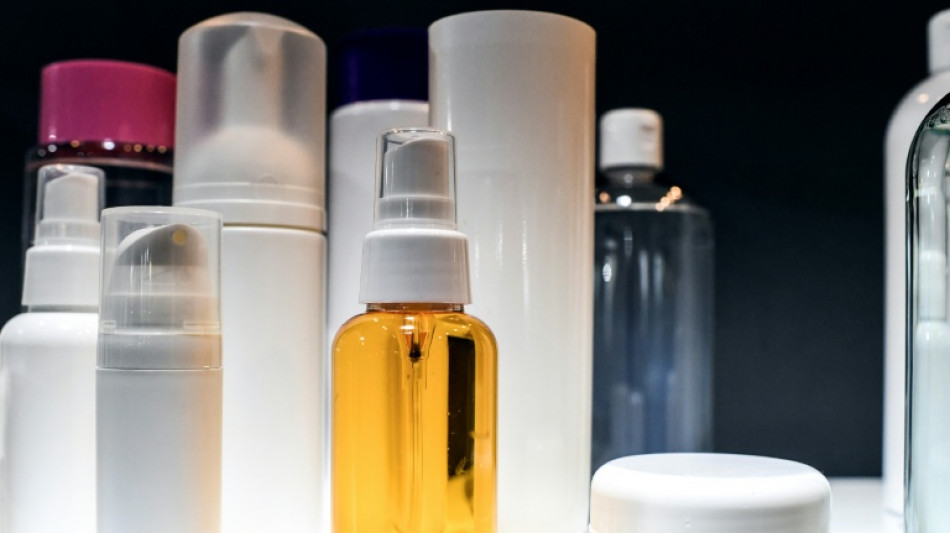
French ban on 'forever chemicals' in cosmetics, clothing to enter force / Photo: ALAIN JOCARD - AFP/File

 US woman who survived botched execution is awake and speaking

 From 1800s to modern pharma: a Nobel-winning chemistry quest

 Southampton boss Eckert given suspended ban over 'Spygate'

 Russia warns of 'false' information as second plague case reported

 IEA ready to release more oil reserves if necessary

 HSBC 'consults' over UK unit job cuts amid AI adoption

 UK court quashes five ex-traders' Libor rate rigging convictions
 XM Receives “Global Customer Experience Leader Award 2026” at the TrustFinance Performance Awards

 Stocks slide as oil climbs on Mideast flareup

 Heavy casualties in Ukraine after Russian strikes

 French wine harvest set to hit historic low

 Kyiv 'cannot agree' to EU membership limiting food exports: minister

 Arteta targets more Arsenal glory after signing new deal until 2030

 Russell hit with Singapore grid penalty for taking new power unit

 Spotify expands audiobooks to more than 180 markets

 French-Japanese duo wins chemistry Nobel for solving molecular 'mystery'

 England's Nations League surge helps heal World Cup wounds

 Mayor of opposition stronghold Izmir defects to Erdogan party

 Mertens beats Gauff to set up Swiatek clash at China Open

 Benin full of pride at role in Messi's last dance

 France suspends stun grenade use at student protests ahead of PM speech

 Indonesian court hears 'negligence' complaint against state over fires, haze

 Rubio in Greece to urge against Western civilisation 'decline'

 Micron workers at Taiwan plant vote in favour of strike

 In 'The Social Reckoning,' Jeremy Allen White takes on Facebook's 'frightening' ambition

A French ban on the production and sale of cosmetics and most clothing containing polluting and health-threatening "forever chemicals" goes into force on Thursday.
Per- and polyfluoroalkyl substances (PFAS) are human-made chemicals used since the late 1940s to mass produce the non-stick, waterproof and stain-resistant treatments that coat everything from frying pans to umbrellas, carpets and dental floss.
Because PFAS take an extremely long time to break down -- earning them their "forever" nickname -- they have seeped into the soil and groundwater, and from there into the food chain and drinking water.
These chemicals have been detected virtually everywhere on Earth, from the top of Mount Everest to inside human blood and brains.
Chronic exposure to even low levels of the chemicals has been linked to liver damage, high cholesterol, reduced immune responses, low birthweights and several kinds of cancer.
The French law, approved by lawmakers in February, bans the production, import or sale from January 2026 of any product for which an alternative to PFAS already exists.
These include cosmetics and ski wax, as well as clothing containing the chemicals, except certain "essential" industrial textiles.
A ban on non-stick saucepans was removed from the draft law after intense lobbying from the owners of French manufacturer Tefal.
It will also make French authorities regularly test drinking water for all kinds of PFAS.
There are thousands of different PFAS and certain ones have been banned since 2019 under the Stockholm Convention on Persistent Organic Pollutants, but China and the United States are not among the more than 150 signatories.
This includes perfluorooctanoic acid (PFOA), used since the 1950s by US company DuPont to manufacture its non-stick Teflon coating for textiles and other everyday consumer products.
The Stockholm Convention also bans perfluorooctane sulfonic acid (PFOS), known for its use as a waterproofing agent by the US group 3M, which has been heavily restricted since 2009.
A handful of US states, including California, implemented a ban on the intentional use of PFAS in cosmetics beginning in 2025, and several other states are slated to follow in 2026.
Denmark will ban the use of PFAS in clothing, footwear and certain consumer products with waterproofing agents beginning on July 1, 2026.
Denmark has banned the use of PFAS in food packaging since 2020.
The European Union has been studying a possible ban on the use of PFAS in consumer products, but has not yet presented or implemented such a regulation.
S.Abdullah--SF-PST