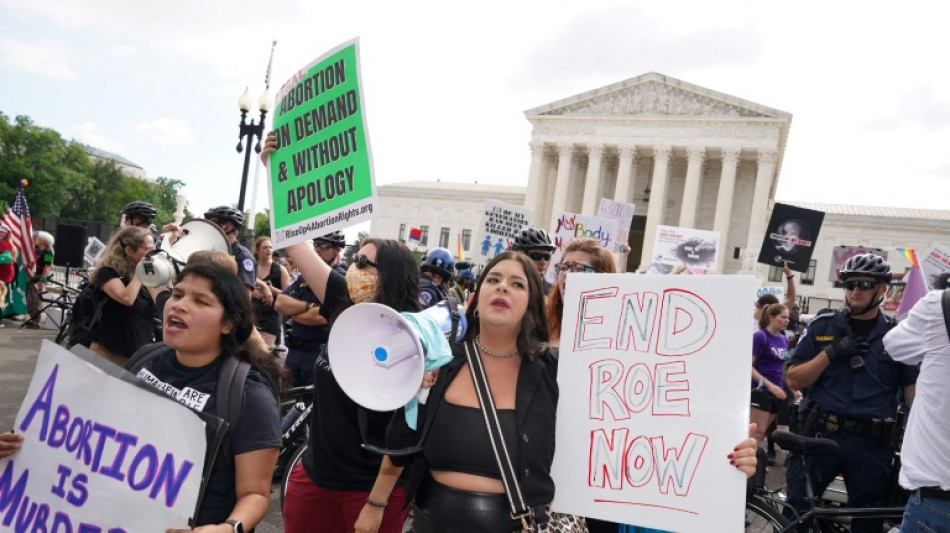
Abortion access threatened in half of US states / Photo: MANDEL NGAN - AFP

 India vows action after first cheetah shot dead

 'Now or Never': Ethiopia influencers push for Eritrea invasion
 Mbappe furore rages on in China, but Mao comments censored

 Billionaire Ambani's Jio jumps 21% in market debut after record India IPO

 Rays win thriller to thwart Brewers in World Series
 Reigning champ Knicks earn first win against Pistons

 Runners swap streets for shopping malls as haze chokes Singapore

 Billionaire Ambani's Jio to debut after record India IPO
 UK set for cautious budget as borrowing costs climb

 Anthropic's record IPO faces some big questions

 US Fed expected to hold rates steady ahead of key midterm elections

 Can this Latin Grammy-winner help Democrats win back Congress?

 Tuvalu has 'limited' power to halt its fossil fuel investments: NZ govt papers seen by AFP
 Palestinian activist Khalil returns to Columbia after US detention

 Trump drastically loosens oil and gas methane rules

 French Senate weighs bill to make protesters pay for unrest damage
 الأردن يعلن القبض على ثلاثة متهمين بهجوم كنيسة الكرك

 استقالة رئيس ونائب رئيس وعضوين من مجلس إدارة يونيكاي للأغذية

 Charles tackles thorny legacy of slavery on Caribbean trip

 Arsenal stunned by fourth-tier Fleetwood in League Cup

 افتتاح وقف المحميد في دبي لدعم الأسر محدودة الدخل والحالات الإنسانية

 Brazil's Flavio Bolsonaro flees to US after election loss

 صقر غباش يدعو بريكس إلى تعميق أثرها في التوازن والتنمية الدوليين

 Flavio Bolsonaro headed to US after Brazil election defeat: US media

 American woman convicted of getting military training from Islamic State

The US Supreme Court's overturning of America's constitutional right to abortion gives all 50 states the freedom to ban the procedure, with nearly half expected to do so in some form.
- Automatic bans -
Thirteen states, mostly in the conservative and religious south of the country, have in recent years adopted so-called "trigger" laws to come into force virtually automatically after the decision was handed down.
They differ in how they ban abortions. Idaho provides exceptions for rape or incest but Kentucky only does so if the pregnant woman's life is in danger.
Laws in Louisiana could see health professionals jailed for up to ten years for carrying out abortions. In Missouri, it's 15 years.
In some states, such as South Dakota, the ban went into effect the day of the Supreme Court's ruling. South Dakota does allow for exceptions when the mother is at risk.
Missouri's attorney general Eric Schmitt tweeted a photo of himself signing an opinion banning abortion in the Midwestern state less than two hours after the Supreme Court's decision was announced. Arkansas and Oklahoma quickly followed with similar moves.
Other states, such as Mississippi, also require the attorney general to first confirm that the court has changed the legal framework.
Texas and Tennessee have set a period of 30 days between the release of the judgment and a new ban coming into force.
- Restrictions -
Iowa, Georgia, Ohio and South Carolina are among states that have passed laws restricting abortion after six weeks, before many people even know they are pregnant.
While currently blocked by the courts, those laws could take effect now that the Supreme Court has changed the legal landscape.
- Complex patchwork -
Ten states, including Arizona and Michigan, have pre-1973 laws banning abortion on the books that they could theoretically revive, though their path forward is uncertain.
In Wisconsin -- where the Democratic governor supports abortion rights, but the majority Republican lawmakers do not -- Planned Parenthood has said it does not plan to carry out abortions from the end of June, citing a legal risk.
In Michigan, Democratic Attorney General Dana Nessel has added to the confusion by promising not to prosecute people who violate its 1931 law banning abortion.
But local prosecutors will still be able to do so, and the state risks becoming a complex patchwork of laws.
In Arizona, Republican Governor Doug Ducey believes that a law passed this year to ban abortions after 15 weeks of pregnancy will override previous rules.
Senators in his party do not see it that way and Ducey is expected to go to court to get clarity.
- Others to watch -
According to the Guttmacher Institute, four states have signaled that they are unfavorable to abortion but do not currently have laws prohibiting them.
Lawmakers in Nebraska and Indiana have failed to pass abortion bans. Officials in Montana and Florida have reduced deadlines for terminating a pregnancy, but supreme courts in those states have protected the right to abortion.
- Liberal states -
Twenty-two states -- mostly in the northeast and on the West Coast -- will retain the right to abortion and are preparing for an influx of women seeking abortions.
Connecticut and Delaware, for example, have expanded the categories of professionals who are authorized to carry out abortions to include nurses and midwives.
Lawmakers in California have allocated $152 million to assist access to abortion and the governor of New York has pledged $35 million.
S.AbuJamous--SF-PST