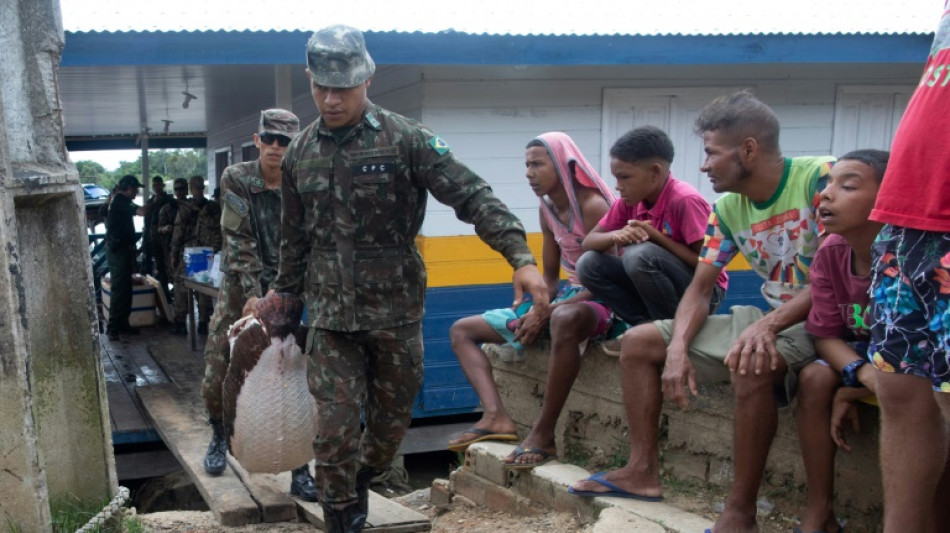
Fish trade's murky waters cloud double murder in Amazon / Photo: JOAO LAET - AFP/File

 China says takes Mbappe apology 'seriously' after Mao remark
 Flavio Bolsonaro on way to Ecuador from Argentina after fleeing Brazil

 Netanyahu bloc leads after half of Israeli votes counted but no majority
 India vows action after first cheetah shot dead

 'Now or Never': Ethiopia influencers push for Eritrea invasion
 Mbappe furore rages on in China, but Mao comments censored

 Billionaire Ambani's Jio jumps 21% in market debut after record India IPO
 Rays win thriller to thwart Brewers in World Series
 Reigning champ Knicks earn first win against Pistons

 Runners swap streets for shopping malls as haze chokes Singapore

 Billionaire Ambani's Jio to debut after record India IPO
 UK set for cautious budget as borrowing costs climb
 Anthropic's record IPO faces some big questions

 US Fed expected to hold rates steady ahead of key midterm elections

 Can this Latin Grammy-winner help Democrats win back Congress?
 Tuvalu has 'limited' power to halt its fossil fuel investments: NZ govt papers seen by AFP
 Palestinian activist Khalil returns to Columbia after US detention

 Trump drastically loosens oil and gas methane rules

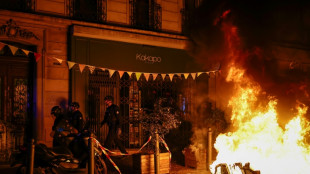 French Senate weighs bill to make protesters pay for unrest damage
 الأردن يعلن القبض على ثلاثة متهمين بهجوم كنيسة الكرك

 استقالة رئيس ونائب رئيس وعضوين من مجلس إدارة يونيكاي للأغذية
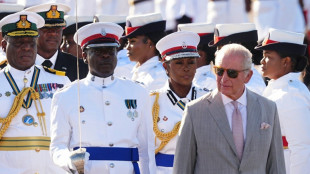 Charles tackles thorny legacy of slavery on Caribbean trip

 Arsenal stunned by fourth-tier Fleetwood in League Cup
 افتتاح وقف المحميد في دبي لدعم الأسر محدودة الدخل والحالات الإنسانية

 Brazil's Flavio Bolsonaro flees to US after election loss
The pirarucu is one impressive fish: a huge, thrashing Amazonian monster with red-and-black scales the size of serving spoons.
Still, it's just a fish. How is it possible it could have gotten British journalist Dom Phillips and Brazilian Indigenous expert Bruno Pereira murdered?
Police say Phillips, 57, and Pereira, 41, were shot dead on June 5 returning from a research trip in Brazil's far-flung Javari Valley.
At first glance, the jungle-covered region near the Peruvian and Colombian borders seems like one of the last untouched wildernesses, home to a sprawling Indigenous reservation with the biggest concentration of uncontacted tribes on Earth.
But the double murder lay bare growing violence in the region fueled by illegal fishing, logging, mining and drug trafficking.
Pereira had received death threats for his work fighting poaching on the reservation, where non-natives are banned from hunting and fishing.
"He waged a major crackdown on illegal fishing. All those guys (the poachers in the region) knew Bruno," says Orlando Possuelo, 37, who worked with Pereira coordinating Indigenous anti-poaching patrols -- a job that has earned him death threats, too.
Investigators say Pereira and Phillips were motoring down the meandering Itaquai river in a small boat when a group sped up from behind and shot them.
Police have identified eight suspects, and arrested three so far.
Locals in Atalaia do Norte, a sleepy river town near the northeastern edge of the reservation, say all three are poachers who illegally fish in Indigenous territory for pirarucu, a protected species that is the biggest freshwater fish in South America.
- 'Everyone here knows' -
Fishermen in Atalaia say poaching pirarucu -- a tasty, coveted fish that can reach 4.5 meters (nearly 15 feet) and weigh up to 200 kilograms (440 pounds) -- is a big-money business linked to drug traffickers operating in Peru and Colombia.
The traffickers allegedly use the black-market fish trade to launder drug money -- part of what the Brazilian Forum for Public Security recently called the "complex national and transnational criminal chains that operate across different economies" in the Amazon.
"What happened to Bruno and Dom is the result of an increase in organized crime, which is in turn explained by the absence of the state," said Antenor Vaz, ex-chief of Brazilian indigenous affairs agency FUNAI's operations in the Javari Valley.
The alleged drug-trafficking link has raised the question of whether the suspects acted alone.
Federal police said Friday they did, ruling out the involvement of a "mastermind or criminal organization."
The statement infuriated the Indigenous-rights group where Pereira worked, UNIVAJA, which accused the police of ignoring "considerable" evidence a "powerful criminal organization" was behind the killings.
"Everyone here knows organized crime was involved," UNIVAJA head Paulo Marubo told AFP.
- Pirarucu taboo -
At Atalaia's fish market, a noisy hangar with concrete floors and white-tile stalls, pirarucu has disappeared since Phillips and Pereira went missing.
Some pirarucu sales are in fact legal -- there are six local lakes outside the Indigenous reservation where restricted fishing is allowed.
But much of the pirarucu on the market is likely illegal.
A report by the International Union for the Conservation of Nature found 83 percent of the illegal fish seized in Brazil from 2012 to 2019 was pirarucu.
With the army, federal police and world media in town to investigate the men's disappearance, fishermen are taking no chances on pirarucu these days, even if landing one of the giants can bring in hundreds of dollars -- badly needed cash for most families in the region, one of the poorest in Brazil.
"Legal fishermen are afraid to even go out right now, with the army here and everyone blaming us for this atrocity," says Roberto Pereira da Costa, 49, president of the local fishermen's association.
Legal fishermen are being unfairly villainized, he says.
"You can see the difference between the illegal fishermen and us. They've got big boats, fast motors, they're not just catching 15 kilos of fish to feed their families, they're trying to take out everything they can."
- 'A bigger story' -
In December, journalist Monica Yanakiew of Al Jazeera English joined Pereira on an expedition like the one Phillips accompanied.
Her crew even captured him warning the fisherman who is now the lead suspect in the case not to fish on Indigenous land.
Poachers got "infuriated" when Pereira's patrols seized their fish, says Yanakiew.
But "it's a bigger story than that," she says.
Pereira would not have needed to mount independent patrols if President Jair Bolsonaro's administration had not dramatically cut enforcement operations by FUNAI and environmental authorities, critics say.
"The fact that the government has turned a blind eye to everything that is going on has empowered" criminals, says Yanakiew.
"They think they can get away with murder."
K.AbuTaha--SF-PST