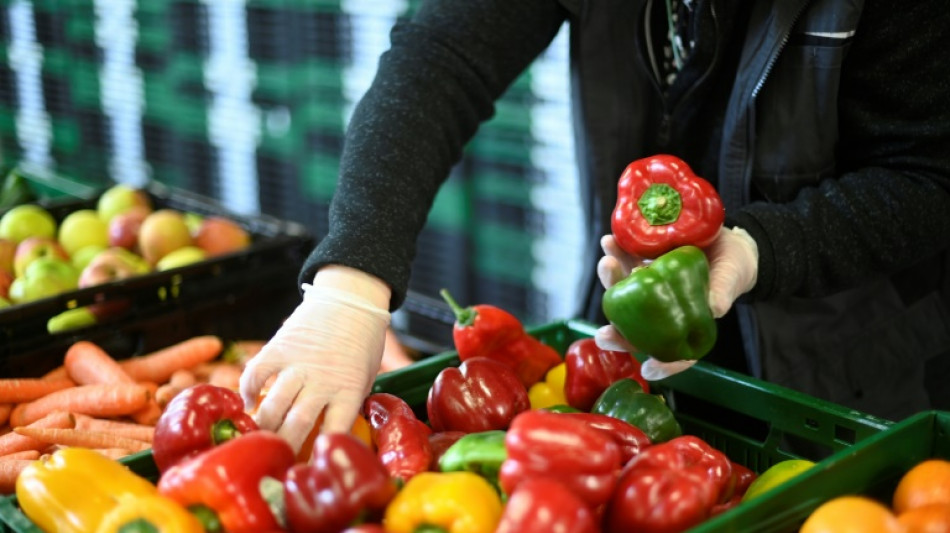
Germans turn to food banks as inflation hits / Photo: Ina FASSBENDER - AFP/File

 China says takes Mbappe apology 'seriously' after Mao remark
 Flavio Bolsonaro on way to Ecuador from Argentina after fleeing Brazil

 Netanyahu bloc leads after half of Israeli votes counted but no majority

 India vows action after first cheetah shot dead

 'Now or Never': Ethiopia influencers push for Eritrea invasion
 Mbappe furore rages on in China, but Mao comments censored

 Billionaire Ambani's Jio jumps 21% in market debut after record India IPO

 Rays win thriller to thwart Brewers in World Series
 Reigning champ Knicks earn first win against Pistons

 Runners swap streets for shopping malls as haze chokes Singapore
 Billionaire Ambani's Jio to debut after record India IPO
 UK set for cautious budget as borrowing costs climb
 Anthropic's record IPO faces some big questions
 US Fed expected to hold rates steady ahead of key midterm elections

 Can this Latin Grammy-winner help Democrats win back Congress?

 Tuvalu has 'limited' power to halt its fossil fuel investments: NZ govt papers seen by AFP
 Palestinian activist Khalil returns to Columbia after US detention

 Trump drastically loosens oil and gas methane rules

 French Senate weighs bill to make protesters pay for unrest damage
 الأردن يعلن القبض على ثلاثة متهمين بهجوم كنيسة الكرك

 استقالة رئيس ونائب رئيس وعضوين من مجلس إدارة يونيكاي للأغذية

 Charles tackles thorny legacy of slavery on Caribbean trip

 Arsenal stunned by fourth-tier Fleetwood in League Cup

 افتتاح وقف المحميد في دبي لدعم الأسر محدودة الدخل والحالات الإنسانية

 Brazil's Flavio Bolsonaro flees to US after election loss
German pensioner Gabriele Washah waits in line to fill her trolley with bags of carrots for 50 cents, yoghurts just past their sell-by date and bunches of wilting flowers.
With the cost of living soaring across Europe, the 65-year-old retired shop assistant is one of many Germans turning to food banks to make ends meet.
"Sometimes I go home from the shop almost crying because I can't afford it any more," she told AFP outside the row of stalls in Bernau, near Berlin.
Nestled in an alleyway behind a big chain supermarket, the food bank sells at greatly reduced prices groceries donated by supermarkets, as well as cheap prepared meals.
Here, customers can pick up a full trolley of food for around 30 euros (around $32).
For Washah, that means bread, butter and her favourite sandwich filling, sausage -- "which used to cost 99 cents ($1.02) but now sometimes costs more than two euros".
Driven by the war in Ukraine, inflation in Germany soared to 7.9 percent in May -- its highest level since reunification in 1990, with food prices among those worst affected.
Demand for food banks across the country has increased "significantly" since the start of the year and doubled in some areas, according to a spokeswoman for the Tafel food bank network.
There are around 1,000 such schemes in Germany, run by volunteers and available to customers on a means-tested basis.
Groceries, while donated, are still sold rather than given away free to the customers as the Tafel has to cover running costs, including rents and electricity. The organisation too has had to put up prices because their running costs have risen.
"It's not just one product," said 69-year-old pensioner Peter Behme. "All the prices are going up."
- Poverty line -
In a bid to ease the pressure on squeezed finances, the government has lowered taxes on fuel, drastically slashed the cost of public transport and promised all taxpayers a one-off payment of 300 euros.
But Behme remains unimpressed. "I don't know where the government help is going," he said.
Even the food banks themselves are feeling the effects of the massive inflation.
"We have had to raise some prices by 20 or 50 cents because we need money to replenish our stocks," said Malina Jankow, manager of the Bernau food bank.
Along with pensioners and unemployed people, the queues are now also filling up with Ukrainian refugees.
Anna Dec, a 35-year-old hospital worker, has come to Bernau with two Ukrainian women who are staying in her home and currently each receiving 449 euros a month in benefits.
"They have to pay for water, energy, food, hygiene products... That's almost nothing," she said.
Overwhelmed by the influx of customers, some food banks in Germany have had to turn away new arrivals or ration the food they distribute.
"We have been asking the government for a long time for a law to force supermarkets to give away their unsold food," said Norbert Weich, 72, chairman of the food bank.
Some 16 percent of Germans, or more than 13 million people, were living below the poverty line in 2020, according to a study by the charity Deutscher Paritaetische Gesamtverband, published in December 2021.
"The federation of food banks has a resolution: as soon as we are no longer needed, we will disband," said Weich. "But I don't think it will be in my lifetime."
D.AbuRida--SF-PST