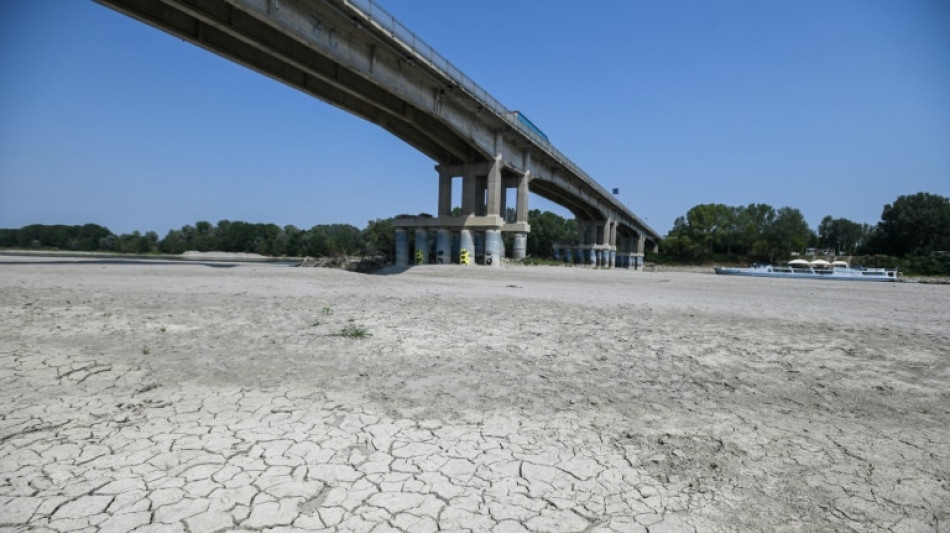
Deadly heatwaves threaten economies too / Photo: Piero CRUCIATTI - AFP

 India take control of Galle Test as Sri Lanka slump to 99-5
 Australia's mushroom murderer appeals conviction

 The Nigerian fishing community being eaten up by the Atlantic

 Kushner to meet Netanyahu after talks with Hamas on Gaza plan
 Photos, memories all that remain for Colombia's bereaved after quake

 Sabalenka squeezes out win on sixth match point in Cincinnati

 Trump says US scaling back military drills with South Korea hours before start

 Jason Arday: UK academic who died amid plagiarism storm

 Sabbath cafe clash lays bare Israel faultlines

 Top-ranked Scheffler powers to PGA St. Jude Championship victory

 Jacquet scores on Liverpool debut in friendly win over Como

 Hawaii's Big Island begins recovery efforts as Hurricane Lala downgrades, moves west

 Spidey swings high for third weekend in N. American box office

 Eagle and late birdie lift Jeeno to LPGA Portland Classic win

 Duplantis masterclass for fourth Euro pole vault title

 Records for Asher-Smith, Hunt as Britain win 4x100m mixed relay

 Barcelona reach deal with Man City to sign Rodri

 Misery for Maresca as Man City make dismal start to life after Guardiola

 Strikes kill 19 in Russia and Ukraine

 Lula and Bolsonaro court women voters as Brazil election campaign kicks off

 Belgium races to tame huge wildfire creeping towards Germany

 Two dead, hundreds evacuated from fires on island near Athens

 Real Madrid crush Schalke in friendly as Diomande debuts

 Calls for UK inquiry into 'hounding' of ex-Cambridge academic

 Strikes kill 16 in Russia and Ukraine

More frequent and intense heatwaves are the most deadly form of extreme weather made worse by global warming, with death tolls sometimes in the thousands, but they can also have devastating economic impacts too, experts say.
The prolonged and unseasonable scorchers gripping the central United States and rolling northward across western Europe, sending the thermometer above 40 degrees Celsius (104 degrees Fahrenheit), are likely to cause both.
Deadly and costly
Very high temperatures caused nearly 10 percent of the two million deaths attributed to extreme weather events from 1970 to 2019, according to the World Meteorological Organization.
Virtually all that heat-related mortality, moreover, has been since 2000, especially the last decade: from 2010 to 2019 scorching heat was responsible for half of 185,000 extreme weather deaths registered.
In Europe, heatwaves accounted for about 90 percent of weather-related mortality between 1980 and 2022, the European Environment Agency (EEA) has reported.
Heatwaves rack up economic costs as well, but they are harder to quantify than damage from a storm or flood, and more difficult to insure.
But extended bouts of great heat can result in more hospital visits, a sharp loss of productivity in construction and agriculture, reduced agricultural yields, and even direct damage to infrastructure. Excess mortality has an economic cost too.
The EAA estimates that heatwaves in 32 European countries between 1980 and 2000 cost 27 to 70 billion euros. The damages over the last 20 years -- which included the deadly heatwave of 2003, with 30,000 excess deaths -- would almost certainly be higher.
Premature death
The national public health agency in France, which will be blanketed by extreme conditions over the coming days, has called heatwaves "a mostly invisible and underestimated social burden."
In France alone, heatwaves from 2015 to 2020 cost 22 to 37 billion euros due to health expenses, loss of well-being and especially "intangible costs stemming from premature deaths".
Reduced productivity
The heatwaves of 2003, 2010, 2015 and 2018 in Europe caused damages totalling 0.3 to 0.5 percent of GDP across the continent, and up to two percent of GDP in southern regions, according to a peer-reviewed study in Nature.
This level of impact could be multiplied by five by 2060 compared to a 1981-2010 baseline without a sharp reduction in greenhouse gas emissions and measures to adapt to high temperatures, the study warned.
At sustained temperatures of around 33C or 34C, the average worker "loses 50 percent of his or her work capacity", according to the International Labor Organization (ILO).
The ICO estimates by 2030 heatwaves could reduce the total number of hours worked globally by more than two percent -- equivalent to 80 million fulltime jobs -- at a cost of 2.4 trillion dollars, nearly 10 times the figure for 1995.
"Climate change-related heat stress will reduce outdoor physical work capacity on a global scale," The UN's Intergovernmental Panel on Climate Change (IPCC) said in its most recent synthesis report, noting that in some tropical regions outdoor work may become impossible by the end of the century for 200 to 250 days each year.
Drought and agriculture
Both heatwaves and drought are a major threat to agriculture, and thus food security.
Long-term drought is agriculture's worst enemy when it comes to extreme weather, but heatwaves can provoke major damage as well.
In 2019, a heatwave caused a nine percent drop in drop in maize yields across France, and a 10 percent decline in wheat, according to the French agricultural ministry.
A 2012 scorcher in the United States led to a 13 percent drop in maize production, and a sharp jump in global prices.
Heatwaves also have a negative impact on livestock production and on milk production, according to the IPCC.
T.Samara--SF-PST