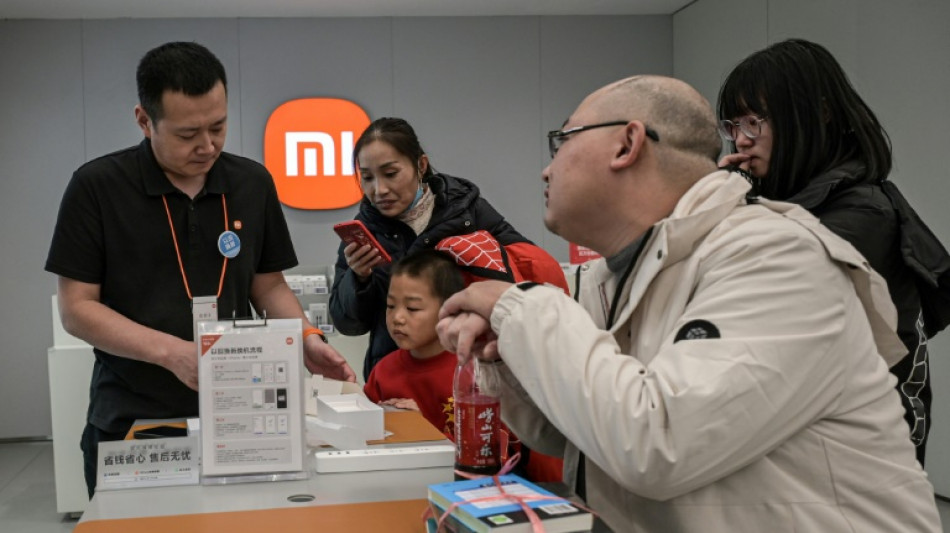
Chinese give guarded welcome to spending subsidies / Photo: Jade GAO - AFP

 Hungary cuts anti-LGBTQ measures from Orban-era law

 Tech stocks slump on AI jitters; oil falls

 ePlanet Brokers Publishes H1 2026 Transparency Report and Highlights Best Broker 2026 Award

 Van Gogh work unseen in public for 60 years on show in Hong Kong

 Prosecutors drop most impeachment charges against Philippine VP Duterte

 Hypersonic weapons highlight arms race on the Korean peninsula

 Fiji appoint ex-Springboks boss White as coach ahead of World Cup

 Hungary to reverse Orban-era anti-LGBTQ legislation

 Allen rushes Bills to thrilling 37-34 win over Rams

 India youth shift tactics as police clamp down on election protest

 Malaysia's Firefly extends flight cancellations due to haze

 IMF upgrades 2026 growth forecast but warns of 'split' outlook

 Infantino could pull off 'Houdini' act as critics struggle for candidate

 France braces for fresh nationwide student demonstrations

 Ahead of Israel vote, desert town becomes frontline against ultra-Orthodox expansion

 El Nino Watch: the impacts around the world this week

 Man City, PSG clash at contrasting time for state-backed projects

 Melbourne imam denies links to suspected flydubai hijacker

 Coventry crush Newcastle to climb out of relegation zone

 'Devastating' waves leave California beach homes on brink of collapse

 Meta says its new AI models on par with OpenAI, Anthropic

 Talarico rejects mental health conspiracy theory after return from flu

 Brazil presidential candidate Flavio Bolsonaro to visit jailed father

 Brazil's patron saint reappears in polarized election campaign

 US Open champ Zverev to become tennis world number one

Beijing is hoping subsidies for rice cookers, microwave ovens and smartphones can boost sluggish spending and help the country weather an economic storm from incoming US president Donald Trump.
Policymakers have struggled to get China's billion-strong army of consumers to inject cash into the economy as a prolonged real estate crisis weighs on confidence.
And last week, they expanded a subsidy scheme for common household items, from water purifiers and refrigerators to laptops and electric vehicles.
Outside a bustling shopping centre in Sanlitun, one of the capital's most popular commercial districts, 25-year-old Li Ling told AFP the policy could work as an "incentive".
"If someone's budget is not very abundant, such policies can support them in their consideration about buying things," she said.
"I think the policy can just be regarded as an incentive," she said.
Beijing is nervously looking to the second administration of Donald Trump, who has vowed brutal tariffs on Chinese goods in retaliation for Beijing's allegedly unfair trade practices -- fuelling fears of another trade war.
And experts say the country may need to shift towards a growth model driven largely by domestic consumption as those pressures mount.
Under the broadened subsidy scheme, people can get 20 percent off microwave ovens, water purifiers, dishwashers and rice cookers, among other things -- with the state covering the discount of up to 2,000 yuan ($275).
Gadgets such as smartphones, tablets and smartwatches also now receive subsidies of up to 15 percent.
- 'Saving is meaningless' -
Shopper Yang Boyun told AFP that he recently took advantage of the new deal.
"I bought three Xiaomi air conditioners," he said, referring to one of China's leading consumer goods brands. "They all only cost 8,000-9,000 yuan. Normally each one would cost more than 4,000 yuan," he said.
But Yang, a worker in the crisis-hit property sector, said much stronger action was needed for the country to reverse its economic malaise.
"Only after some changes to the macroeconomic regulation of the country will individuals feel the effects," he said.
Beijing is set to release a tranche of economic data Friday and analysts expect the country to report its weakest growth in decades.
In bustling Sanlitun, student Wang Jiaxin said she was prioritising spending on things she enjoyed.
"If it's on food and drinks and buying more beautiful clothes then I'll spend a bit more," she said.
Next year Wang said she planned to enter China's job market -- beset in recent years with high youth unemployment -- rather than continue studying.
But she expressed cautious optimism about her chances.
"I can definitely find a job. But what kind of job it is really depends," she said. "I'm not sure I'll be able to find a good one, but I'll definitely be able to support myself."
Meanwhile, Yang told AFP his thinking on personal spending had shifted.
"In the past I may have saved some money, but now I feel that one small thing may cause debt -- like if you get sick, you will be in debt," he said.
"But money is something that should be used to enjoy the present," he added. "Saving money is meaningless. The most important thing for us now is to be happy."
B.AbuZeid--SF-PST