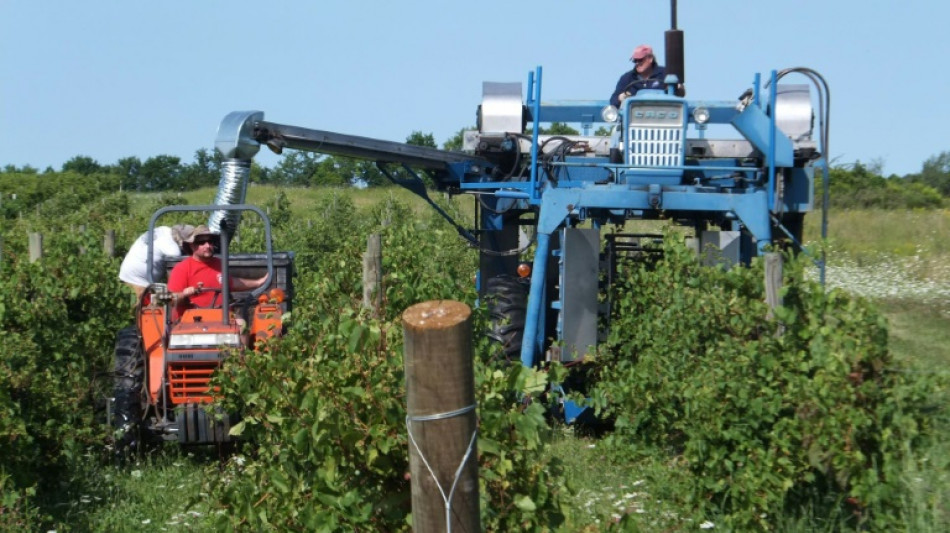
Herbicide under US scrutiny over potential Parkinson's link / Photo: Handout - David Jilbert/AFP

 Hungary cuts anti-LGBTQ measures from Orban-era law

 Tech stocks slump on AI jitters; oil falls

 ePlanet Brokers Publishes H1 2026 Transparency Report and Highlights Best Broker 2026 Award

 Van Gogh work unseen in public for 60 years on show in Hong Kong

 Prosecutors drop most impeachment charges against Philippine VP Duterte

 Hypersonic weapons highlight arms race on the Korean peninsula

 Fiji appoint ex-Springboks boss White as coach ahead of World Cup

 Hungary to reverse Orban-era anti-LGBTQ legislation

 Allen rushes Bills to thrilling 37-34 win over Rams

 India youth shift tactics as police clamp down on election protest

 Malaysia's Firefly extends flight cancellations due to haze

 IMF upgrades 2026 growth forecast but warns of 'split' outlook
 Infantino could pull off 'Houdini' act as critics struggle for candidate

 France braces for fresh nationwide student demonstrations

 Ahead of Israel vote, desert town becomes frontline against ultra-Orthodox expansion

 El Nino Watch: the impacts around the world this week

 Man City, PSG clash at contrasting time for state-backed projects

 Melbourne imam denies links to suspected flydubai hijacker

 Coventry crush Newcastle to climb out of relegation zone

 'Devastating' waves leave California beach homes on brink of collapse

 Meta says its new AI models on par with OpenAI, Anthropic

 Talarico rejects mental health conspiracy theory after return from flu

 Brazil presidential candidate Flavio Bolsonaro to visit jailed father

 Brazil's patron saint reappears in polarized election campaign

 US Open champ Zverev to become tennis world number one

First came the slow hand movements, then the tremor, and now the looming fear of what lies ahead.
David Jilbert's devastating diagnosis of Parkinson's disease three years ago changed his life irrevocably -- and it's a condition the 65-year-old farmer believes he wouldn't have if it weren't for paraquat, a herbicide he once relied on to control weeds in his vineyard in the midwestern US state of Ohio.
"Now it's not just about me, I'm part of this community -- let's get something going," Jilbert said during a recent hearing in the US Congress on the issue.
Banned in more than 70 countries -- including Britain, where it is manufactured; Switzerland, home to the Syngenta company that owns the brand; and China, where the state-run conglomerate that owns Syngenta is based -- paraquat remains available in the United States.
The US Environmental Protection Agency (EPA) has long maintained that the herbicide is safe for use under strict regulations -- something Parkinson's advocates are hoping to change.
The agency is set to issue a final report on the issue by January 17, 2025, a date mandated by a court in response to 90 new scientific studies submitted by the Michael J. Fox Foundation and other groups.
- Industry denies causation -
"We have great sympathy for those suffering from the debilitating effects of Parkinson's disease," a spokesperson for Syngenta said in a statement to AFP.
"However, it is important to note that the scientific evidence simply does not support a causal link between paraquat and Parkinson's disease, and that paraquat is safe when used as directed."
Multiple credible studies have found that agricultural workers who handle paraquat -- or live near areas where it is applied -- face a higher incidence of Parkinson's disease, which can eventually turn even the simplest movements into daunting challenges.
Animal research further underscores paraquat's toxic effects on nerve cells, although proving direct causation for individuals remains difficult.
"I find it extraordinarily frustrating that the chemical companies have hidden behind the concept of being able to show causation, and they've used that as an excuse, because we haven't been able to come out and definitively say that," Australia-based neurologist David Blacker said in interview with Pesticide Action UK, an advocacy group.
"That's where the precautionary principle comes in," he added. "If there is a doubt, especially if there are alternatives, it then becomes, in my mind, ethically and even morally unsound to continue to pursue."
- 'It's scary' -
Jilbert, a longtime environmental engineer and environmental safety inspector, dreamed of becoming a farmer after retirement.
In 2011, he purchased his land and, over the following years, began using paraquat -- often sold as Gramoxone -- to manage his weeds. By the end of the decade, he noticed his hands moving slowly and his gait turning into a shuffle.
When his Parkinson's diagnosis finally came, he was horrified and wondered if he'd been condemned to a "death sentence." His condition is more manageable for now, thanks to medications, but he says he feels disappointed in his own government for not looking out for him.
"You think if you use the stuff in the way the label tells me to use it, then I'm not going to get sick," he said.
Like Jilbert, 85-year-old Charlene Tenbrink -- who owns a 250-acre farm in Dixon, California -- also trusted that the chemicals available to farmers were safe when handled properly.
She sprayed paraquat on her prune trees in the 1990s and was diagnosed with Parkinson's in 2020.
Tenbrink, Jilbert and thousands of others are now suing Syngenta in federal and California state courts.
Sarah Doles, a lawyer and co-lead for that federal litigation, compared it to the cases against Big Tobacco. She contends Syngenta had a legal duty to disclose harms its own teams knew about paraquat from research going back decades, but hid from consumers.
"It's a legal duty of what they knew and then failed to do -- they concealed the information," she told AFP.
Regardless of which direction the EPA rules, these legal cases will continue.
Tenbrink says it's vital to get the product off the market, and admits she's terrified for her own future.
"This is a terrible disease and we know there's no cure, we know it's going to get worse. It's scary," she says.
T.Khatib--SF-PST