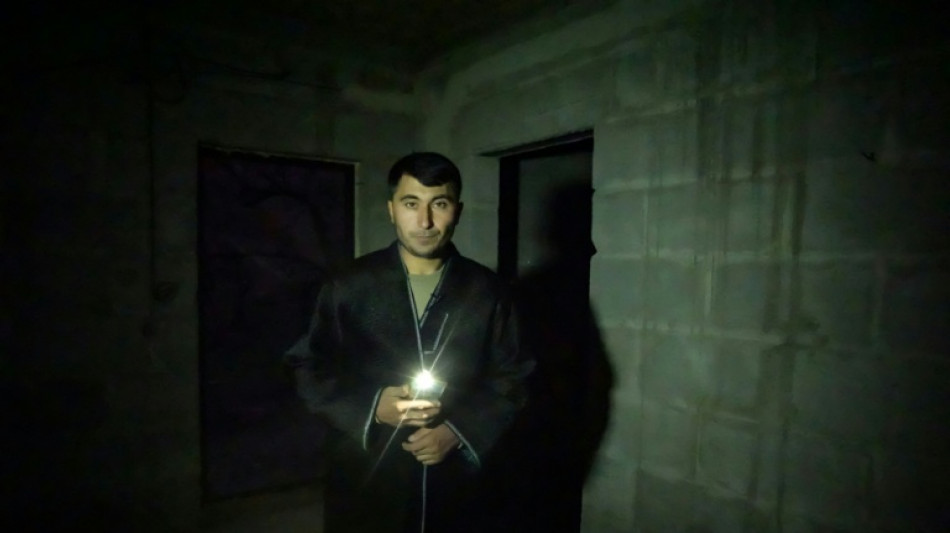
Tajikistan bets on giant dam to solve electricity crisis / Photo: STRINGER - AFP

 Sweden centre-left leader fails to form government

 EU economy chief doubtful Russian diesel exports will affect prices

 Capital International Highlights Multilingual Access to Its Platform as European Economic Conditions Diverge

 Hazlewood takes six as Australia win first Test

 Pope Leo admitted to hospital for lung operation

 Hungary cuts anti-LGBTQ measures from Orban-era law

 Tech stocks slump on AI jitters; oil falls

 ePlanet Brokers Publishes H1 2026 Transparency Report and Highlights Best Broker 2026 Award

 Van Gogh work unseen in public for 60 years on show in Hong Kong

 Prosecutors drop most impeachment charges against Philippine VP Duterte

 Hypersonic weapons highlight arms race on the Korean peninsula

 Fiji appoint ex-Springboks boss White as coach ahead of World Cup

 Hungary to reverse Orban-era anti-LGBTQ legislation

 Allen rushes Bills to thrilling 37-34 win over Rams

 India youth shift tactics as police clamp down on election protest
 Malaysia's Firefly extends flight cancellations due to haze

 IMF upgrades 2026 growth forecast but warns of 'split' outlook

 Infantino could pull off 'Houdini' act as critics struggle for candidate

 France braces for fresh nationwide student demonstrations

 Ahead of Israel vote, desert town becomes frontline against ultra-Orthodox expansion

 El Nino Watch: the impacts around the world this week

 Man City, PSG clash at contrasting time for state-backed projects

 Digi Power X Announces $200 Million Debt Financing Commitment to Support Completion of Alabama AI Data Center and Provides Expansion Update

 'Breaking Bad' actor RJ Mitte dead: representatives

 Former DR Congo president Kabila forms new force with M23 armed group
In a remote village in Tajikistan's soaring mountains, Muslikhiddin Makhmudzoda relies on a mobile phone to light his modest home as his family spends another winter without electricity.
Makhmudzoda's three children and wife were sitting huddled together to share the phone's flashlight in their modest brick home.
A shortage of water needed to fuel hydroelectric plants has led to serious power outages in Tajikistan, a poor former Soviet republic nestled in the Central Asian mountains and surrounded by Afghanistan, China, and fellow ex-Soviet states Uzbekistan and Kyrgyzstan.
The power crisis is only set to worsen, as Central Asia is hard-hit by climate change.
Amid chronic shortages, Tajikistan has promised it will end the power outages and has revived a Soviet-era mega-project to build the world's highest dam.
Makhmudzoda's family spend much of their day without power.
"We have electricity from 5:00 am to 8:00 am and then from 5:00 pm until 11:00 pm", the 28-year-old said.
To cope with intermittent power supplies, the family resorts to using a charcoal stove for heating -- a risky choice, since many Tajiks die from carbon monoxide poisoning each year caused by such appliances.
Every year, the impoverished country's state electricity company Barqi Tojik restricts power supplies starting in September to prevent the system's collapse during the coldest months.
It says this is an "inevitable measure" as demand has skyrocketed.
Since the fall of the Soviet Union in 1991, the small country's population has doubled to 10 million, with economic growth steady at around eight percent after decades of stagnation.
- 'Every centimetre counts' -
The rationing is also due to falling water levels in reservoirs used to drive turbines in hydroelectric power plants, which provide 95 percent of Tajikistan's electricity.
Authorities say "feeble rainfall" means that water levels in the country's biggest river -- the Vakhsh -- are low.
"Every centimetre of water counts," Barqi Tojik has warned, urging Tajiks to pay their bills to renovate ageing infrastructure.
The average salary in Tajikistan hovers around $190 (180 euros) a month.
But the government is now promising that all these inconveniences will soon be a thing of the past thanks to the construction of a massive dam and plant.
Tajikistan has placed its bets on Rogun, planned to become the most powerful hydropower plant in Central Asia. It is set to have the highest dam in the world at 335 metres (1,100 feet).
When completed, the plant is intended to produce some 3,600 megawatts -- the equivalent of three nuclear power stations.
- 'Palace of light' -
Tajikistan is reviving the colossal project, first planned by the Soviet authorities in 1976, before being abandoned due to the end of communist rule and then the Tajik civil war.
At the site, dozens of bulldozers go up and down the mountains and dozens of kilometres of underground tunnels are equipped with giant turbines.
Some 17,000 people are working on the site which lies west of the capital Dushanbe, in the foothills of the Pamir Mountains.
The site is already partially functioning but it is not known when construction will be finished.
Giant banners showing President Emomali Rahmon -- in power for 32 years -- hang over the construction site.
Rahmon has stressed the importance of the dam, calling it a "palace of light", the "pride of the Tajik nation" and the "construction project of the century".
- 'Altitude 1,100 metres' -
Surrounded by giant machinery, engineer Zafar Buriyev said he was certain the dam would end power cuts.
"Once the construction at Rogun is finished, Tajikistan will completely come out of its electricity crisis," he told AFP.
He stood in what he called "the heart of the dam" in between giant peaks.
"By next summer, this area will be submerged and the water will reach an altitude of 1,100 metres and then eventually 1,300."
Authorities have said the plant will not only generate enough electricity to use domestically, but could supply other Central Asian countries -- and even nearby Afghanistan and Pakistan.
Water resources have long been a source of tension between Central Asian countries as they suffer shortages.
The plant's technical director Murod Sadulloyev told AFP it will help "reinforce the unified energy system" in Central Asia -- a concept dating back to the USSR that enables the former Soviet republics to exchange water and electricity.
Tajikistan's neighbours are also working to revive Soviet-era energy projects.
Kyrgyzstan and Uzbekistan have pledged to build the Kambar-Ata hydroelectric power plant jointly in a mountainous area of Kyrgyzstan.
Tajikistan's Rogun project has been criticised for its constantly rising cost -- currently more than $6 billion -- and its environmental impact, while information on Kambar-Ata has been classified as secret.
The Central Asian power plants are being built in the context of dire climatic realities.
According to the UN, Central Asia is "warming more rapidly than the global average".
C.Hamad--SF-PST
