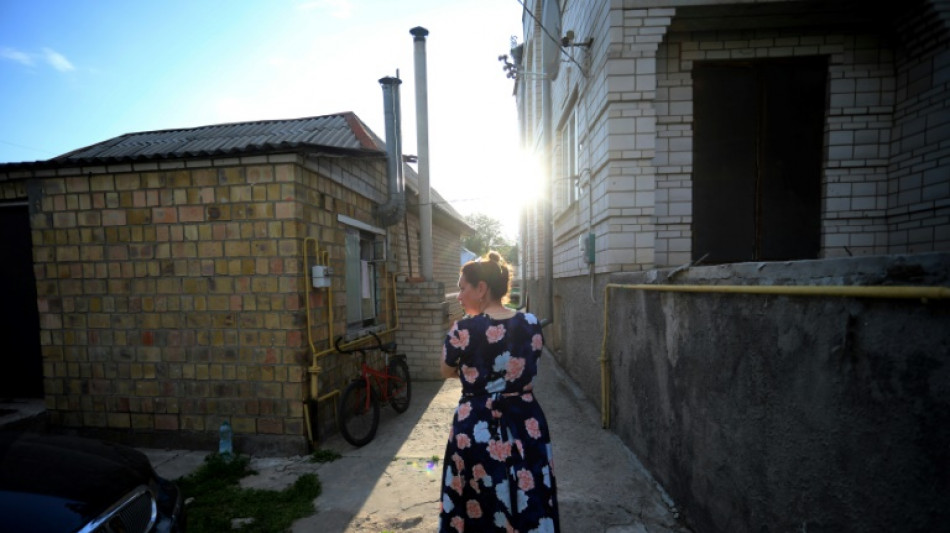
For Ukraine's Roma, discrimination adds to agonies of war / Photo: Aleksey Filippov - AFP

 As machinery removes rubble, hopes for survivors from Colombian quake dwindle

 Trump says US scaling back military drills with South Korea

 Zambia's Hichilema takes early lead in reelection bid
 Sabalenka squeezes out a win on sixth match point in Cincinnati

 Duplantis dominant, Hunt hits four and Asher-Smith makes history

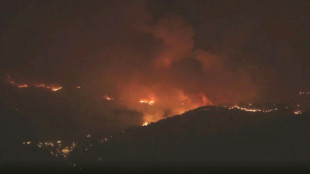 Spanish soldier dies in Aragon wildfire
 PSG beaten by Lens in French Champions' Trophy

 Rybakina, Andreeva race into Cincinnati third round

 Amy Hunt bags fourth Euro gold as Britain win 4x100m mixed relay

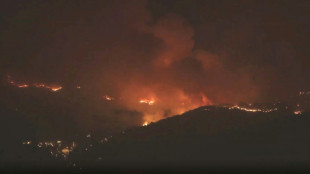 Spanish soldier dies in Aragon wildfire: regional leader
 Belgium's Pocognoli appointed new Scotland manager

 Marchand storms to second gold of European championships
 Kushner meets with Hamas in push to revive Gaza plan
 Villarreal battle back to earn draw at promoted Racing

 Odegaard says Arsenal 'want to win everything' after Community Shield success
 Arsenal rout Man City in Community Shield masterclass
 Southampton mocked over Spygate during Watford defeat

 Hamas expects meeting with Kushner as US pushes Gaza plan
 Farmers, helicopters help battle record Belgian wildfire

 Air support kicks in as record Belgian wildfire jumps in size
 Firefighters battle second day of blaze on Greek island

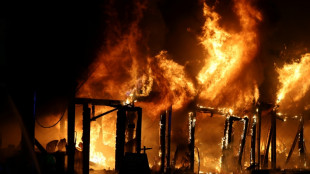 Strikes kill 12 in Russia and Ukraine

 India's Sindhu backs monkey measures as badminton worlds set to open

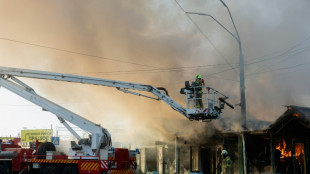 Mass drone attack on Moscow as Russian strikes kill three in Ukraine

 Djokovic feels the heat in Cincinnati defeat, Zverev wins all-nighter
Forced to flee fighting, Lyudmyla was assured the authorities would rehouse her in a town in western Ukraine. But when she arrived, they took one look at her and turned her away.
"On the phone, it was OK. We agreed on the room. But when I arrived, they saw my dark skin and refused to give me shelter," she said.
A member of the Roma minority, this 59-year-old -- who prefers not to give her family name -- is by her own admission "a success story", being one of the few members of her community to have had an education.
And the same is true of her daughter, Ilona, who is a lawyer.
Together, they refused to be turned away, threatening to file a complaint, and only after a full day of haggling obtained the keys to the room where they spent one month along with Ilona's mother-in-law and three children.
"If I hadn't been educated, we would have had to sleep on the street or in the railway station," explained Lyudmyla, who has now returned to her home in Trebukhiv just to the west of Kyiv after Russian troops pulled back from the area to focus on southern and eastern Ukraine.
Like her, many of Ukraine's Roma population say they have struggled to access shelter and the aid that has poured in to the country since the Russians invaded on February 24.
- Rare complaints -
Census figures suggest there are some 50,000 Roma people in Ukraine, but rights groups say the figure is closer to 400,000.
"The biggest problem is housing: People don't want to host Roma families," says Julian Kondur of Chiricli, an international Ukraine-based charity that supports Roma women.
Like in many countries, long-held prejudices about the Roma people have fuelled a fear of them, he says.
On Wednesday, Human Rights Watch accused neighbouring Moldova of "deliberately housing most Roma refugees separately from others fleeing the war in Ukraine", denouncing the move as "unequal and discriminatory treatment".
Through its hotline, Chiricli has collected many testimonies about what happened during evacuations.
"A bus was about to leave (the northeastern city of) Kharkiv and the driver said 'no' to a Roma family," says Kondur, citing just one example.
"Sometimes, Roma themselves are so used to discrimination that they accept it as normal" and rarely complain, he says.
Lyudmyla initially told AFP she did not experience any discrimination, before then relating her experience.
Though she struggled to find shelter in western Ukraine, during the first two weeks of the war, Lyudmyla had offered refuge to around 50 other Roma in her basement.
Dressed in a long flowery dress, she recalled the fear and winter chill of those early days.
"Ten kilometres from here, there were Russian tanks and very heavy explosions. It was really scary," she said.
And it was so cold that one of her grandchildren became seriously ill.
- 'We're suffering too' -
Aside from the lack of solidarity shown towards their community, the Roma have also struggled to access certain types of aid because they do not have the right papers.
To avoid repression under the Soviet regime, the Roma did not register with the local authorities, and many do not have identity documents, birth certificates or passports to prove citizenship.
"At the time, there was a saying: If you don't have a passport, you don't have problems," Kondur says.
Since Ukraine became independent in 1991, many Roma people have moved to register, but around 30,000 still have not, putting them at a further disadvantage in wartime.
"Inevitably, you need to have identity documents to get food packages, to get financial support both from the government and the UN," he explains.
For all these reasons, Roma tend "to find help within their own community", says Valentina Zolotarenko, who works as a mediator to help her people access public services.
"On television, you see only Ukrainians, but we're suffering too," says the 59-year-old, who was born in Russia.
But "despite the bombs, I prefer being a Ukrainian Roma than a Russian one," she adds.
"It's far worse there for my community."
J.AbuHassan--SF-PST