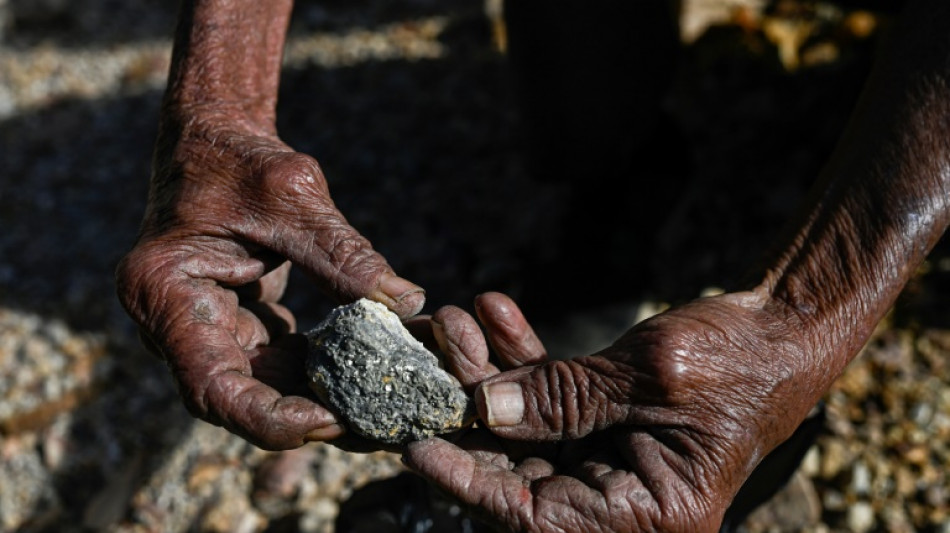
El Salvador Congress votes to end ban on metal mining / Photo: Daniela RODRIGUEZ - AFP/File

 Demonstrations backing France's protesting students gather strength

 Trump says US Senate as hard to defend as House in midterms

 Suspected Russian drones hit two ships off Bulgaria, 11 missing

 Tech stocks slide on AI jitters

 Trump asks Greece ambassador to resign amid ethics scandal

 New White House spokeswoman heavy on Trump praise, light on questions in debut

 Emery urges Villa to make most of reduced home comfort

 Flavio Bolsonaro visits father under house arrest ahead of Brazil runoff

 France, Eq. Guinea in standoff over luxury Paris mansion

 'Holding our ground': Israel demolishes dozens of Bedouin homes
 Hazlewood takes six as Australia beat South Africa in 1st Test

 Saudi coalition tells Sanaa residents to flee site before operation
 Zverev defies 'physical issues' to reach Shanghai Masters quarter-finals
 'We're not giving up': Activist Thunberg joins France student protests

 Man City captain Dias defends celebrations after Liverpool win
 B2PRIME Expands Tier-1 Access and Liquidity Architecture for Sophisticated Institutional Flow

 STARTRADER Adds 48 US Stock CFDs with 24-Hour Weekday Trading

 'Ink' director Danny Boyle slams Trump's Truth Social 'lies'
 Coach Kovac extends contract at Dortmund until 2029

 Activist Thunberg joins France student rally after violence at protests

 Archer and Bethell in England squad for Australia ODI series
 Formula One to return to Africa in 'early 2030s' in Rwanda

 US actor Selma Blair charged with assault after alleged flight altercation

 Hungary cuts anti-LGBTQ legislation from Orban-era law
 'Our future is being robbed': Greta Thunberg joins France student protests

El Salvador's Congress on Monday approved a bill promoted by President Nayib Bukele to roll back a ban on the mining of gold and other metals, dismaying environmentalists.
The small Central American nation became the world's first country to outlaw metal mining in 2017, warning of the harmful effects of the chemicals used, like cyanide and mercury.
The move by Bukele's predecessor, former left-wing rebel Salvador Sanchez Ceren, reflected a growing rejection of mining by rural communities in the region.
But last month, Bukele, who is popular at home for his crackdown on street gangs, signaled that he wanted to change course.
The bill to bring back metal mining was approved by 57 deputies out of a total of 60, said Ernesto Castro, head of the legislature -- which is dominated by the ruling party -- as environmental campaigners protested nearby.
Critics fear that mining will pollute the Lempa River, which runs through a potential mining zone proposed by Bukele and supplies water to 70 percent of the inhabitants of the capital and surrounding areas.
"This wretched mining will punish the people, it will contaminate our waters and rivers and that's an attack on life," activist Vidalina Morales told reporters.
Bukele said last month that El Salvador, a country of 6.6 million people, had "potentially" the largest gold deposits per square kilometer in the world.
"God placed a gigantic treasure underneath our feet," he wrote on social media, arguing that the mining ban was "absurd."
"If we make responsible use of our natural resources, we can change the economy of El Salvador overnight," he said.
The new law stipulates that the state will be the only entity authorized to search for, extract and process mined metals.
However, the government may do so through companies in which it is a shareholder.
The bill prohibits the use of mercury in mining operations, which may not be carried out in protected natural areas or places with important water sources.
A survey by Central American University published on Monday revealed that 59 percent of respondents do not consider El Salvador "an appropriate country for metal mining."
Since El Salvador dollarized its remittances-reliant economy in 2001, it has registered average annual growth of 2.1 percent.
Twenty-seven percent of Salvadorans live in poverty, according to the United Nations Economic Commission for Latin America and the Caribbean, and 70 percent of the workforce operates in the informal sector.
Elsewhere in the region, Costa Rica and Honduras have banned open-pit mining, and Panama declared a moratorium on new mining concessions last year after mass protests over plans for a huge copper mine.
R.AbuNasser--SF-PST
