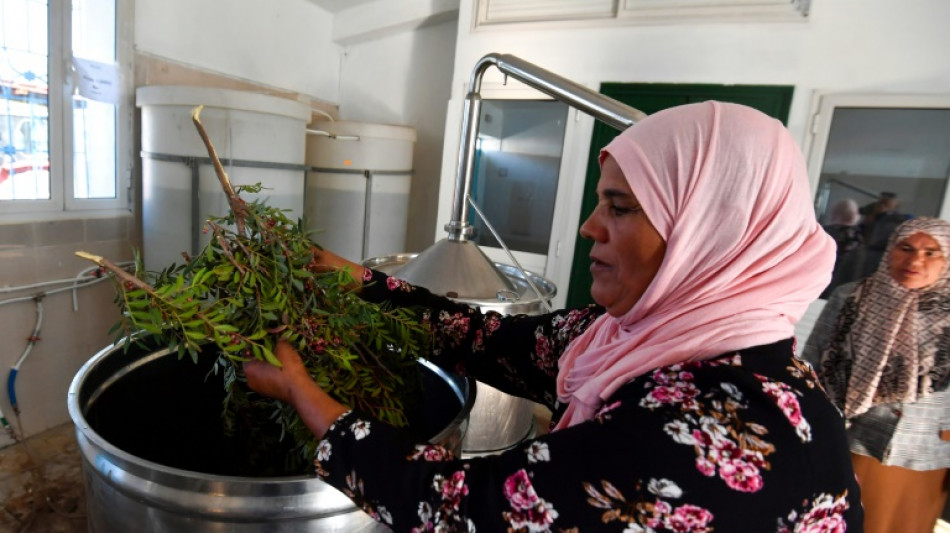
Tunisia women herb harvesters struggle with drought and heat / Photo: FETHI BELAID - AFP

 Demonstrations backing France's protesting students gather strength

 Trump says US Senate as hard to defend as House in midterms

 Suspected Russian drones hit two ships off Bulgaria, 11 missing

 Tech stocks slide on AI jitters

 Trump asks Greece ambassador to resign amid ethics scandal

 New White House spokeswoman heavy on Trump praise, light on questions in debut

 Emery urges Villa to make most of reduced home comfort

 Flavio Bolsonaro visits father under house arrest ahead of Brazil runoff

 France, Eq. Guinea in standoff over luxury Paris mansion

 'Holding our ground': Israel demolishes dozens of Bedouin homes

 Hazlewood takes six as Australia beat South Africa in 1st Test

 Saudi coalition tells Sanaa residents to flee site before operation

 Zverev defies 'physical issues' to reach Shanghai Masters quarter-finals

 'We're not giving up': Activist Thunberg joins France student protests

 Man City captain Dias defends celebrations after Liverpool win

 B2PRIME Expands Tier-1 Access and Liquidity Architecture for Sophisticated Institutional Flow

 STARTRADER Adds 48 US Stock CFDs with 24-Hour Weekday Trading

 'Ink' director Danny Boyle slams Trump's Truth Social 'lies'

 Coach Kovac extends contract at Dortmund until 2029

 Activist Thunberg joins France student rally after violence at protests

 Archer and Bethell in England squad for Australia ODI series

 Formula One to return to Africa in 'early 2030s' in Rwanda

 US actor Selma Blair charged with assault after alleged flight altercation

 Hungary cuts anti-LGBTQ legislation from Orban-era law

 'Our future is being robbed': Greta Thunberg joins France student protests

On a hillside in Tunisia's northwestern highlands, women scour a sun-scorched field for the wild herbs they rely on for their livelihoods, but droughts and rising temperatures are making it ever harder to find the precious plants.
Yet the harvesters say they have little choice but to struggle on, as there are few opportunities in a country hit hard by unemployment, inflation and high living costs.
"There is a huge difference between the situation in the past and what we are living now," said Mabrouka Athimni, who heads a local collective of women herb harvesters named "Al Baraka" ("Blessing").
"We're earning half, sometimes just a third, of what we used to."
Tunisia produces around 10,000 tonnes of aromatic and medicinal herbs each year, according to official figures.
Rosemary accounts for more than 40 percent of essential oil exports, mainly destined for French and American markets.
For the past 20 years, Athimni's collective has supported numerous families in Tbainia, a village near the city of Ain Draham in a region with much higher poverty rates than the national average.
Women, who make up around 70 percent of the agricultural workforce, are the main breadwinners for their households in Tbainia.
- 'Yield less' -
Tunisia is in its sixth year of drought and has seen its water reserves dwindle, as temperatures have soared past 50 degrees Celsius (122 degrees Fahrenheit) in some areas during the summer.
The country has 36 dams mostly in the northwest, but they are currently just 20 percent full -- a record low in recent decades.
The Tbainia women said they usually harvested plants like eucalyptus, rosemary and mastic year-round, but shrinking water resources and rare rainfall have siphoned oil output.
"The mountain springs are drying up, and without snow or rain to replenish them, the herbs yield less oil," said Athimni.
Mongia Soudani, a 58-year-old harvester and mother of three, said her work was her household's only income. She joined the collective five years ago.
"We used to gather three or four large sacks of herbs per harvest," she said. "Now, we're lucky to fill just one."
Forests in Tunisia cover 1.25 million hectares, about 10 percent of them in the northwestern region.
Wildfires fuelled by drought and rising temperatures have ravaged these woodlands, further diminishing the natural resources that women like Soudani depend on.
In the summer of last year, wildfires destroyed around 1,120 hectares near Tbainia.
"Parts of the mountain were consumed by flames, and other women lost everything," Soudani recalled.
To adapt to some climate-driven challenges, the women received training from international organisations, such as the Food and Agriculture Organization (FAO), to preserve forest resources.
Still, Athimni struggles to secure a viable income.
"I can't fulfil my clients' orders anymore because the harvest has been insufficient," she said.
The collective has lost a number of its customers as a result, she said.
- 'No longer sustainable' -
A recent study by the Tunisian Forum for Economic and Social Rights (FTDES) highlighted how climate-induced damage to forests had severely impacted local communities.
"Women in particular suffer the consequences as their activities become more difficult and arduous," the study said.
Tunisia has ratified key international environmental agreements, including the 2015 Paris Climate Accord.
But environmental justice researcher Ines Labiadh, who oversaw the FTDES study, said implementation "remains incomplete".
In the face of these woes, the Tbainia harvesters, like many women working in the sector, will be forced to seek alternative livelihoods, said Labiadh.
"They have no choice but to diversify their activities," she said. "Relying solely on natural resources is no longer sustainable."
Back in the field, Bachra Ben Salah strives to collect whatever herbs she can lay her hands on.
"There's nothing we can do but wait for God's mercy," she said.
L.Hussein--SF-PST
