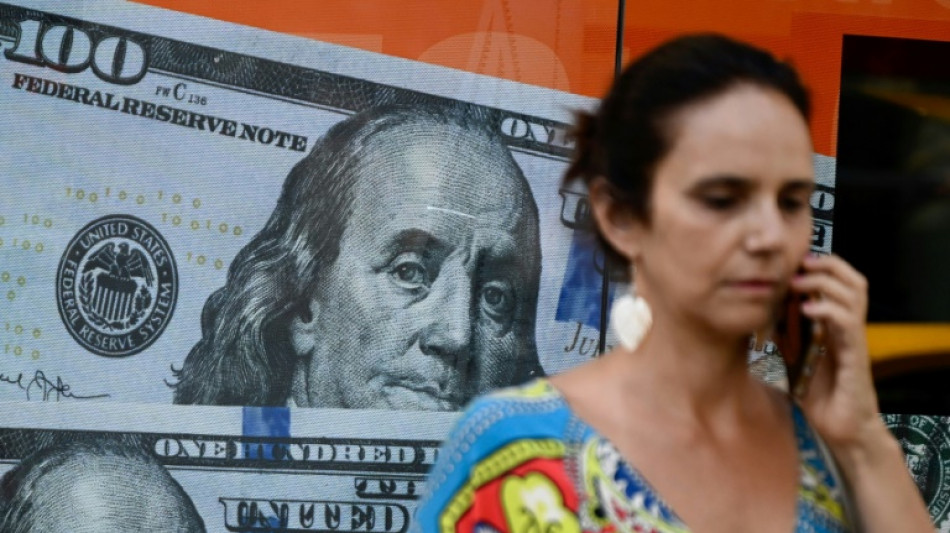
Argentina's dollar craze cools under greenback-loving Milei / Photo: Luis ROBAYO - AFP/File

 Judge extends halt to Trump's golf course tree-cutting

 Milan's Saelemaekers set for lenghty spell out after ankle surgery

 Nvidia says to invest in French medical website

 Real Madrid's Mourinho has 'trust' in referees despite complaints

 Mendis, Shanaka star in Sri Lanka consolation T20I win

 Demonstrations backing France's protesting students gather strength

 Trump says US Senate as hard to defend as House in midterms

 Suspected Russian drones hit two ships off Bulgaria, 11 missing

 Tech stocks slide on AI jitters

 Trump asks Greece ambassador to resign amid ethics scandal

 New White House spokeswoman heavy on Trump praise, light on questions in debut

 Emery urges Villa to make most of reduced home comfort

 Flavio Bolsonaro visits father under house arrest ahead of Brazil runoff

 France, Eq. Guinea in standoff over luxury Paris mansion

 'Holding our ground': Israel demolishes dozens of Bedouin homes

 Hazlewood takes six as Australia beat South Africa in 1st Test

 Saudi coalition tells Sanaa residents to flee site before operation
 Zverev defies 'physical issues' to reach Shanghai Masters quarter-finals
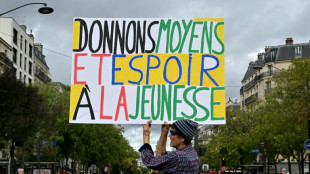 'We're not giving up': Activist Thunberg joins France student protests

 Man City captain Dias defends celebrations after Liverpool win

 B2PRIME Expands Tier-1 Access and Liquidity Architecture for Sophisticated Institutional Flow

 STARTRADER Adds 48 US Stock CFDs with 24-Hour Weekday Trading

 'Ink' director Danny Boyle slams Trump's Truth Social 'lies'
 Coach Kovac extends contract at Dortmund until 2029

 Activist Thunberg joins France student rally after violence at protests

"Dollars, selling dollars!" a money changer shouts to people streaming past in Buenos Aires' financial district.
But there are no takers as Argentina's decades-long dollar craze finally shows signs of cooling.
Over years of high inflation and currency controls, Argentines lined up to trade their increasingly worthless pesos for dollars, propelling the US currency to a record 1,500 pesos on the black market on July 12.
But as the inflation rate slows under cost-cutting President Javier Milei -- from 25.5 percent in December 2023 to 2.4 percent in November 2024 -- the clamor for dollars has quieted, even after Milei pledged on the campaign trail last year to swap the peso for the greenback.
- Amnesty brings in billions -
Experts cite several reasons for the fall in demand for dollars. Milei's biting austerity measures have cratered Argentines' purchasing power, shattering their ability to save in hard American cash -- the preferred way to create a nest egg.
The experts also point to a tax amnesty launched by the government in July to encourage Argentines to deposit dollars that have been stashed under mattresses and floorboards, or tucked in safety-deposit boxes and offshore accounts.
The scheme has brought in $20 billion in deposits so far, helping ease a dollar shortage.
Meanwhile, the central bank has taken advantage of a stronger peso to build up its dollar reserves from $21 billion when Milei took power a year ago to $32 billion.
In a sign of how times have changed, the black market dollar rate, which at one point was double the official rate, is now nearly aligned with the official rate, at a little over 1,000 pesos to the greenback.
- Under the mattress -
Oscar, one of Buenos Aires' many black-market money changers -- they are dubbed "arbolitos,"or little trees, because they plant themselves in the street offering green notes -- told AFP that business has slowed dramatically.
"Up to a year ago I was conducting around 40 transactions in a six-hour period; now I have four, at most, in 10 hours," said Oscar, who works openly near the presidential palace but declined to give his full name due to the illegal nature of his work.
These days, his only customers for dollars are Bolivian and Peruvian migrant workers, who change small amounts to send home.
In scenes unthinkable just months ago, most of his Argentine customers are now offloading dollars -- because they need more pesos to pay bills that have soared since Milei took office and slashed energy and transport subsidies.
Retirees "walk the whole city center looking for the best deal" for pesos, Oscar said.
In the back room of her estate agency in the middle-class Caballito neighborhood, where she trades dollars on the black market, Fabiana is also struggling.
To compete, she offers home delivery service for well-off Argentines buying dollars to go on holiday abroad or for people cashing in savings in dollars, some of them "stained from having been kept under the mattress."
Money-changing is merely a source of "petty cash" these days, Fabiana said.
Most of her business comes from property sales, which are booming thanks to the amnesty, which also covers investments in real estate projects and certain property purchases.
- Impact on exports -
Experts warn the peso's strengthening against the dollar may be temporary if, as expected, the effects of the tax amnesty soon wear off or if Milei fails to secure a new cash injection from the International Monetary Fund.
The IMF said Thursday it was in talks with Argentina on a new program to replace a $44 billion loan agreement set to expire on December 31.
Economist Hernan Letcher credited the tax amnesty with helping stabilize demand for dollars, but said that program and any new IMF cash injection are one-off measures that do not resolve Argentina's currency woes.
"The amnesty dollars aren't yours (don't belong to the state) and you have to pay back the IMF dollars," he said.
Meanwhile, the strengthening of the peso risks hurting exports to Brazil, Argentina's biggest trading partner.
Brazil's currency, the real, fell to a record low against the dollar last week over concerns about its economy.
F.AbuZaid--SF-PST