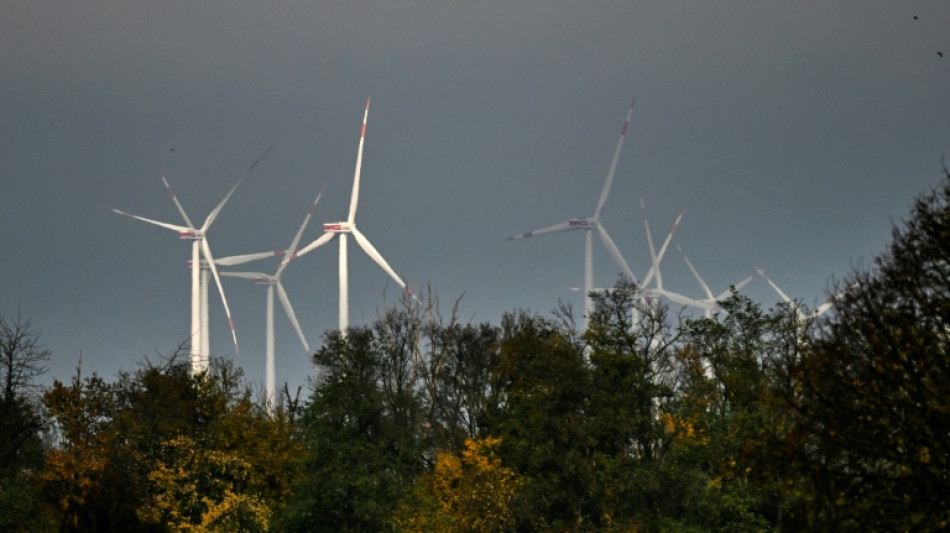
'Dark lull' in German energy transition sparks political debate / Photo: Ina FASSBENDER - AFP/File

 Judge extends halt to Trump's golf course tree-cutting
 Milan's Saelemaekers set for lenghty spell out after ankle surgery
 Nvidia says to invest in French medical website
 Real Madrid's Mourinho has 'trust' in referees despite complaints
 Mendis, Shanaka star in Sri Lanka consolation T20I win
 Demonstrations backing France's protesting students gather strength

 Trump says US Senate as hard to defend as House in midterms
 Suspected Russian drones hit two ships off Bulgaria, 11 missing
 Tech stocks slide on AI jitters

 Trump asks Greece ambassador to resign amid ethics scandal
 New White House spokeswoman heavy on Trump praise, light on questions in debut
 Emery urges Villa to make most of reduced home comfort
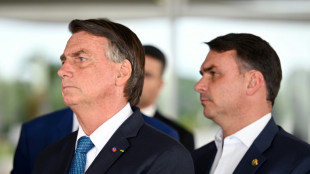 Flavio Bolsonaro visits father under house arrest ahead of Brazil runoff
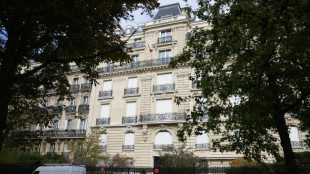 France, Eq. Guinea in standoff over luxury Paris mansion
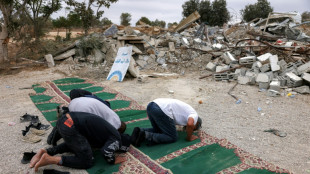 'Holding our ground': Israel demolishes dozens of Bedouin homes
 Hazlewood takes six as Australia beat South Africa in 1st Test
 Saudi coalition tells Sanaa residents to flee site before operation
 Zverev defies 'physical issues' to reach Shanghai Masters quarter-finals
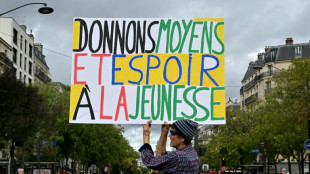 'We're not giving up': Activist Thunberg joins France student protests
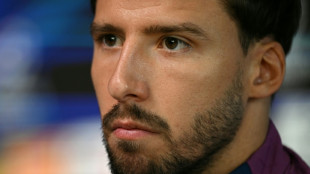 Man City captain Dias defends celebrations after Liverpool win
 B2PRIME Expands Tier-1 Access and Liquidity Architecture for Sophisticated Institutional Flow

 STARTRADER Adds 48 US Stock CFDs with 24-Hour Weekday Trading

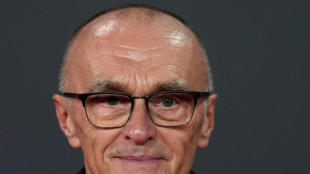 'Ink' director Danny Boyle slams Trump's Truth Social 'lies'
 Coach Kovac extends contract at Dortmund until 2029
 Activist Thunberg joins France student rally after violence at protests

As Germany heads for February 23 elections the grey winter weather has become a hot campaign topic because of its impact on the country's shaky green energy transition.
Twice in recent months electricity prices temporarily spiked in Europe's top economy because of a lack of both sunlight and wind to power its solar panels and turbines.
The phenomenon -- dubbed a "dark lull" -- briefly sent the price soaring to 936 euros ($972) per megawatt hour on December 12, twelve times the average for the preceding weeks.
Conservative opposition leader Friedrich Merz, whose CSU/CDU is widely expected to win the elections, seized on the issue to attack centre-left Chancellor Olaf Scholz.
In Europe's interconnected energy market, Merz told Scholz that "your energy policies are setting teeth on edge across the European Union, which is very angry with Germany".
The comment was rejected by the Greens, who have long been the political driving force behind Germany's transition away from fossil fuel and nuclear power and toward clean renewables.
The Greens' Vice Chancellor and Economy Minister Robert Habeck hit back that previous CDU/CSU-led governments under Angela Merkel had been "blind" to Germany's energy challenges.
To help fight climate change, Germany has pledged to phase out fossil fuels and reduce greenhouse gas emissions by 55 percent by 2030 from 1990 levels, and become carbon-neutral by mid-century.
- 'At the limit' -
The recent price spikes prompted some of Germany's most energy-intensive firms to temporarily limit or even halt production.
In the December 12 incident, Germany bought electricity at the European Energy Exchange in Leipzig, causing a spike in prices in neighbouring countries.
Meanwhile the German energy sector is ringing alarm bells.
Markus Kreber, head of the biggest energy supplier RWE, said the recent dips in renewable supply "would not have been manageable on another day with a higher peak load, for example in January".
He warned that the system is currently operating "at its limits".
The situation after the most recent dip soon stabilised as renewables production picked up again, and households and most businesses remain shielded from day-to-day price fluctuations by fixed tariffs.
The Scholz government defended the green energy transition despite the occasional "temporary phenomenon" of a dark lull that can drive up prices on the spot market.
"There are phases in which the sun shines a lot, the wind blows a lot, and electricity is produced very cheaply in Germany, which is then gladly exported and supplies our neighbouring countries with electricity," said spokesman Steffen Hebestreit.
Renewables have become an ever more important part of Germany's energy mix, accounting for an average 60 percent of its electricity production so far this year.
Traditional sources of energy are being wound down, with coal power stations gradually shutting down after the last three nuclear power stations were taken off the grid last year.
- Political paralysis -
But many experts say the world's third biggest economy can ill afford such supply fluctuations when it's already struggling with a lack of competitiveness in other areas.
Analysts say Germany needs to scale up energy storage capacity and also develop other sources of production, such as gas and hydrogen, to pick up the slack when necessary.
"If the state establishes a good regulatory framework, then it should be possible to avoid shortages through investing in storage and having flexibility in supply," Georg Zachmann, energy and climate specialist at the Bruegel think tank, told AFP.
However, he said there was "a big concern that the framework will not be sufficient to quickly develop" the necessary infrastructure.
"It takes on average seven years to construct a wind power facility but just seven months to build a liquified natural gas terminal," said Claudia Kemfert, energy expert at the DIW institute. "It ought to be the other way around."
For now, Germany faces months of political paralysis after the collapse of Scholz's three-way coalition government.
The coalition's demise also means the scrapping of a key draft law for a project to build a network of gas and hydrogen power stations as part of the transition away from coal.
A new government will likely take several months to emerge after February's election and then set out its own energy policy.
The frontrunner Merz has already pledged to study a return to nuclear power.
J.AbuShaban--SF-PST