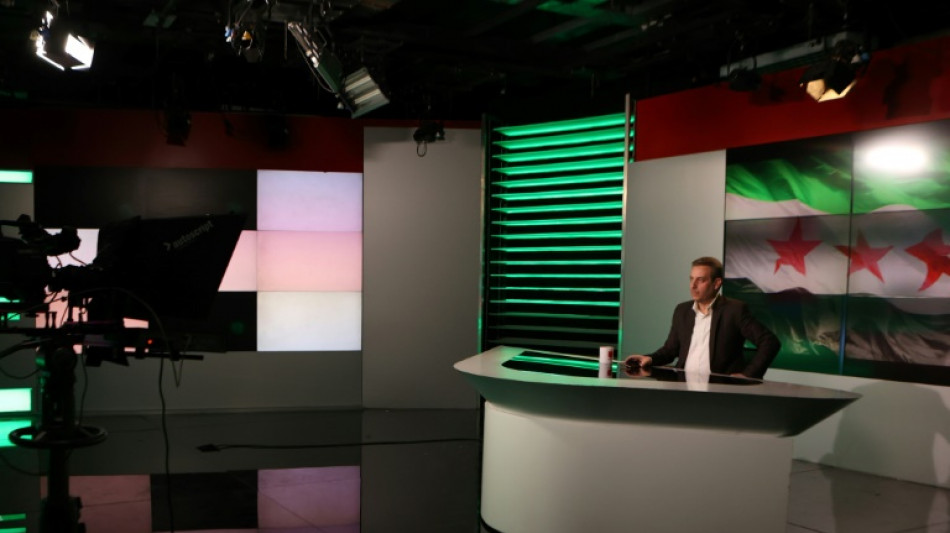
No longer Assad's mouthpiece, Syrian media face uncertainty / Photo: AAREF WATAD - AFP/File

 Judge extends halt to Trump's golf course tree-cutting

 Milan's Saelemaekers set for lenghty spell out after ankle surgery

 Nvidia says to invest in French medical website

 Real Madrid's Mourinho has 'trust' in referees despite complaints

 Mendis, Shanaka star in Sri Lanka consolation T20I win

 Demonstrations backing France's protesting students gather strength

 Trump says US Senate as hard to defend as House in midterms

 Suspected Russian drones hit two ships off Bulgaria, 11 missing

 Tech stocks slide on AI jitters

 Trump asks Greece ambassador to resign amid ethics scandal

 New White House spokeswoman heavy on Trump praise, light on questions in debut

 Emery urges Villa to make most of reduced home comfort

 Flavio Bolsonaro visits father under house arrest ahead of Brazil runoff

 France, Eq. Guinea in standoff over luxury Paris mansion
 'Holding our ground': Israel demolishes dozens of Bedouin homes
 Hazlewood takes six as Australia beat South Africa in 1st Test

 Saudi coalition tells Sanaa residents to flee site before operation
 Zverev defies 'physical issues' to reach Shanghai Masters quarter-finals
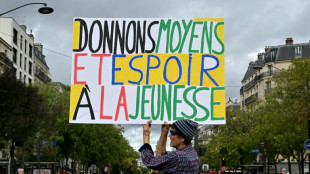 'We're not giving up': Activist Thunberg joins France student protests

 Man City captain Dias defends celebrations after Liverpool win
 B2PRIME Expands Tier-1 Access and Liquidity Architecture for Sophisticated Institutional Flow

 STARTRADER Adds 48 US Stock CFDs with 24-Hour Weekday Trading
 'Ink' director Danny Boyle slams Trump's Truth Social 'lies'
 Coach Kovac extends contract at Dortmund until 2029
 Activist Thunberg joins France student rally after violence at protests

Syrian media outlets which trumpeted the glories of Bashar al-Assad's oppressive rule quickly adopted revolutionary fervour after his ouster, but uncertainty shadows the sector.
For decades, Syria's ruling Baath party and the Assad family dynasty heavily curtailed all aspects of daily life, including freedom of the press and expression.
The media became a tool of those in power.
When a rebel alliance led by Islamist group Hayat Tahrir al-Sham (HTS) took Damascus on December 8, announcing Assad's overthrow after an 11-day offensive, confusion reigned and state news agency SANA, the government mouthpiece, went silent for more than 24 hours.
State television broadcast old programmes instead of the fast-evolving events. Then a group of men in the news studio read a statement from the "Damascus Conquest operations room". They announced "the liberation of the city of Damascus and the fall of the tyrant Bashar al-Assad".
Those words would have been unimaginable two weeks earlier.
For hours, the channel then broadcast a full-screen message on a red background announcing the "victory of the great Syrian revolution".
Foreign media -- whose entry to the country was heavily restricted under Assad -- flooded in as soon as he was toppled, rushing to notorious prisons and other sites that were out of reach under his paranoid rule.
- 'Not guilty' -
After Syria's war erupted in 2011 with the government's brutal repression of pro-democracy protests, Assad tightened restrictions on independent journalism. He expected adherence to the government narrative.
Few reports of the fast-moving rebel offensive initially appeared on official media, and no military comment was allowed except from the army as rebels swept up government-held territory.
Upon Assad's ouster, journalists -- particularly in state media -- quickly changed their online profile photos to pro-revolutionary images and removed anything demonstrating their involvement with the former authorities.
SANA the following day changed its cover picture on messaging app Telegram to match the three-star flag symbolic of Syria's uprising. The agency began publishing news including announcements from the rebels' military operations room.
Private pro-government publication Al-Watan -- relatively critical compared to other outlets -- on the day the rebels took Damascus published a statement defending itself.
"Syrian media and media workers are not guilty," it said.
Like other outlets, the daily was "only carrying out instructions and publishing the news (the government) sent us. Quickly it became clear it was false", wrote editor-in-chief Waddah Abd Rabbo.
Al-Watan, established in 2006, has since published news from the new administration, and Abd Rabbo said officials from the information ministry "told us our team could continue working".
"We hope in future that we can return to print, particularly because Syria is the only country that doesn't print a single newspaper," he told AFP by telephone.
All Syrian newspapers halted print publication during the Covid-19 pandemic.
- 'Unknown future' -
Some other local media platforms have been gradually returning to work or relaunching, including private television channel Sama, which was funded by Syrian businessman and lawmaker Mohammed Hamsho.
One employee, requesting anonymity due to security concerns, said civilian members of HTS -- accompanied by armed rebels -- entered the station and told employees to return.
Other outlets have not, including private radio station Sham FM, which initially said it was suspending news and information programming "until the general situation becomes stable".
Two days later the station, which launched in Damascus in 2007, announced it was ceasing production "following a decision from the Ministry of Information in the transitional government."
"I have around 70 employees" who in turn have families, said founder and general manager Samer Youssef, adding that "thousands of people worked in the media" under Assad.
"An unknown future awaits us and all media who worked under the control of the old regime," he told AFP.
Reporters Without Borders, a freedom of information watchdog, ranked Syria second-last on its World Press Freedom Index this year, ahead of Eritrea, and behind Afghanistan.
The new administration in Syria has not necessarily reassured the media.
On December 13, the Information Ministry released a statement saying "media workers who were part of the war and propaganda machine of the fallen Assad regime, and contributed directly or indirectly to promoting its crimes," would be "held to account".
Bassam Safar, head of the Damascus branch of the anti-Assad Syrian journalists' union, which was previously based abroad, said no media worker can be held to account "unless it is proven that they took part in the bloodshed."
That, he said, "is the business of the courts."
For him, the Syrian people should reconcile with their journalists, to establish "a new media environment built on freedom" and human rights.
T.Khatib--SF-PST