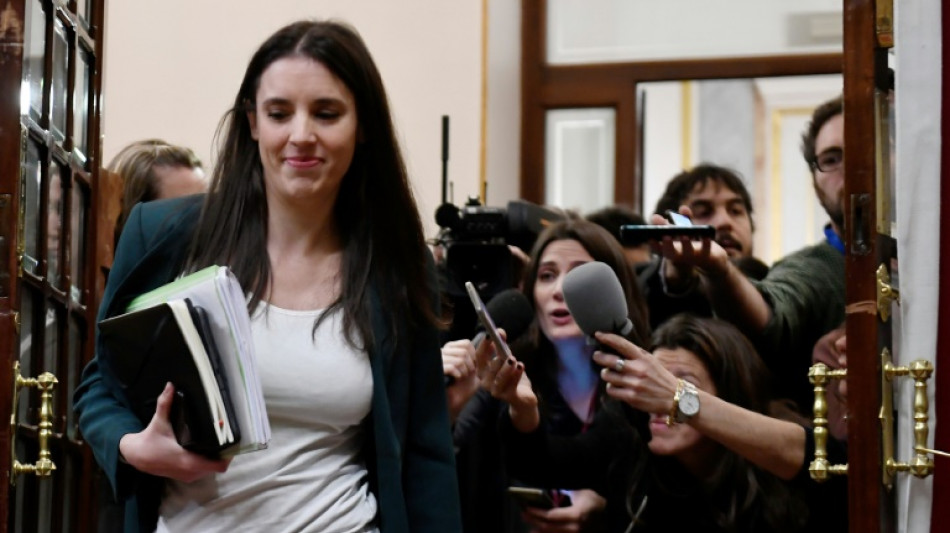
Debate in Spain over 'menstrual leave' plan / Photo: PIERRE-PHILIPPE MARCOU - AFP

 Spanish soldier dies in Aragon wildfire

 PSG beaten by Lens in French Champions' Trophy

 Rybakina, Andreeva race into Cincinnati third round

 Amy Hunt bags fourth Euro gold as Britain win 4x100m mixed relay

 Spanish soldier dies in Aragon wildfire: regional leader

 Belgium's Pocognoli appointed new Scotland manager

 Marchand storms to second gold of European championships

 Kushner meets with Hamas in push to revive Gaza plan

 Villarreal battle back to earn draw at promoted Racing

 Odegaard says Arsenal 'want to win everything' after Community Shield success

 Arsenal rout Man City in Community Shield masterclass

 Southampton mocked over Spygate during Watford defeat

 Hamas expects meeting with Kushner as US pushes Gaza plan

 Farmers, helicopters help battle record Belgian wildfire

 Air support kicks in as record Belgian wildfire jumps in size

 Firefighters battle second day of blaze on Greek island

 Strikes kill 12 in Russia and Ukraine

 India's Sindhu backs monkey measures as badminton worlds set to open

 Mass drone attack on Moscow as Russian strikes kill three in Ukraine

 Djokovic feels the heat in Cincinnati defeat, Zverev wins all-nighter

 Pallister stuns Ledecky in Pan Pacs 800m free as two world records carry Douglass to gold

 Rampant Bangladesh make history with first-ever Test win in Australia

 UK's media-savvy PM Burnham shifts messaging to TikTok, podcasts

 Gay badminton star Gilmour urges progress on LGBTQ rights in Asia
 Pallister takes down Ledecky in Pan Pacs 800m freestyle

Spain's plan to become the first European nation to allow women to take "menstrual leave" from work has sparked a debate that has split the country's leftist coalition government and unions.
Socialist Prime Minister Pedro Sanchez's government is expected to include the menstrual leave as part of a draft bill on reproductive health that is set to be approved at a cabinet meeting on Tuesday.
"We will recognise in the law the right to leave for women who have painful periods that will be financed by the state," Equality Minister Irene Montero tweeted Friday.
She belongs to far-left party Podemos, Sanchez's junior coalition partners.
The proposed law would introduce at least three days' sick pay each month for women who suffer from severe period pains, daily newspaper El Pais and other media which have seen the draft bill reported.
The work leave could be extended to five days for women with particularly disabling periods if they have a medical certificate, the reports said.
"There are women who cannot work and live normally because they have really painful periods," Montero said.
Menstrual leave is currently offered only in a small number of countries including South Korea and Indonesia, none of them in Europe.
But the issue is proving controversial in Spain with some politicians and unions saying it could stigmatise women in the workplace and favour the recruitment of men.
"You have to be careful with this type of decision," said Cristina Antonanzas, deputy secretary of one of trade union UGT, adding this could indirectly impact "women's access to the labour market".
But Spain's other major trade union, the CCOO, welcomed the proposed measure and called it a major "legislative advance" that will recognise a health problem that has been "ignored" until now.
Economy Minister Nadia Calvino, a former general director for budget at the European Commission who belongs to the Socialist party, said work was being done on several drafts.
"The government will never adopt a measure that stigmatises women," she told reporters on Thursday when asked about the controversy.
- Abortion reform -
The head of the main opposition conservative Popular Party (PP), Alberto Nunez Feijoo, said it was up to doctors to decide when sick leave is warranted.
He accused the government of seeking to distract attention from a mobile phone spying scandal with the measure.
Ana Ferrer, of the Association of Victims of Endometriosis, a condition which can lead to more severe menstrual symptoms, said she feared the measure of will lead to "discrimination" against women even though it intends to protect their rights.
"What we need, more than leave, is recognition of our disability," she told AFP.
The draft bill reproductive health also calls for the elimination of the value-added tax (VAT) on some feminine sanitary products such as tampons.
It will also include measures to boost access to abortion at private hospitals and change the law to allow minors of 16 and 17 to terminate a pregnancy without their parents' consent.
Spain decriminalised abortion in 1985 in cases of rape, if a foetus is malformed or if a birth poses a serious physical or psychological risk to the mother.
The scope of the law was broadened in 2010 to allow abortion on demand in the first 14 weeks of pregnancy but access to the procedure is complicated by the fact that many doctors in public hospitals refuse to perform abortions.
O.Mousa--SF-PST