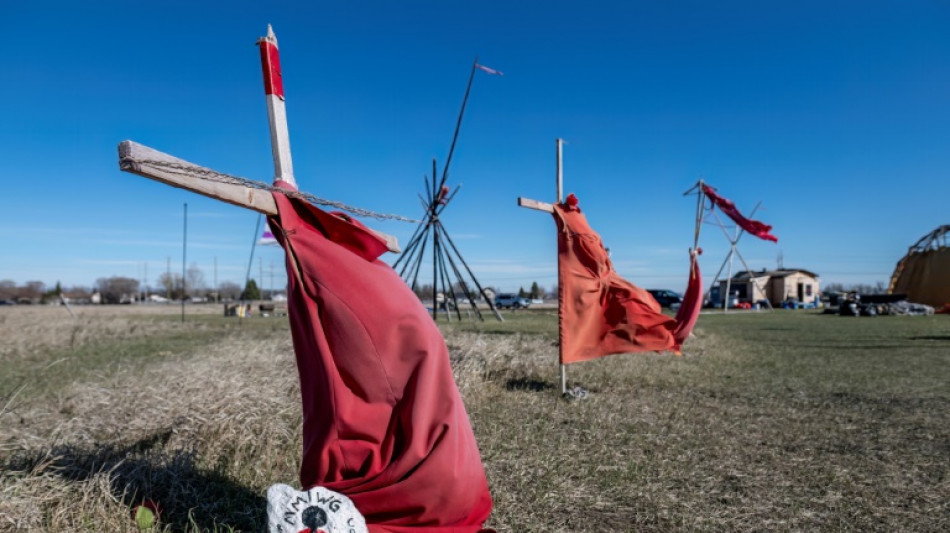
'We are not trash': Horrors suffered by Canada's Indigenous women / Photo: Sebastien ST-JEAN - AFP

 US influence, AI and mistrust cloud Alberta independence vote

 Pant, Bumrah named in India Test squad for New Zealand tour

 Coen brothers say they plan to make film together again

 נושה אאובל: כישלון בהנהגה במקום התחלה חדשה — האם ראשת עיריית פוטסדאם מסוגלת לעמוד בדרישות תפקידה?

 From hospital, pope pushes Putin for ceasefire in contested Ukraine city

 تأسيس تم العالمية لتصدير خبرات أبوظبي في الخدمات الرقمية

 موعد مباراة الزمالك والجيش الرواندي والقنوات الناقلة

 تسلا تكشف تفاصيل جديدة عن رودستر وسط حديث عن قدرات طيران قصيرة
 أحمد التويزي يتولى رئاسة مجلس النواب المغربي في مرحلة سياسية جديدة

 مجلس الشعب السوري يستعد للانتقال من التنظيم الداخلي إلى التشريع
 مصر تحتج على افتتاح كولومبيا سفارة في القدس وتستدعي القائم بالأعمال
 اتحاد موظفي أونروا يطلب ضمانات رسمية لوقف تقليصات غزة
 تقرير فلسطيني يرصد أكثر من 1400 انتهاك في الضفة خلال أسبوع
 حماس في لبنان تنظم فعالية في الذكرى الثانية لمقتل السنوار
 أسعار الواردات الأميركية ترتفع بأسرع وتيرة في أكثر من أربع سنوات
 قائد الناتو في أوروبا يستبعد هجوماً روسياً مباشراً على الحلف

 إي إف جي هيرميس الإمارات تبدأ خدمات صناعة السوق في سوق أبوظبي

 الإمارات تعرض جهودها لتعزيز الأمن الصحي واستئصال شلل الأطفال

 جهات دولية تشيد بمرونة الأنظمة المالية في الإمارات

 بلدية دبي وإعمار تتعاونان لتوسيع العروض التجارية وفرص الاستثمار

 إنتاج أوبك النفطي يسجل ارتفاعاً خلال سبتمبر

 مصر وتايلاند تبحثان توسيع الاستثمارات والتعاون الصناعي المشترك

 بريطانيا تسعى لجذب المقر الرئيسي لمجموعة يو بي إس إلى لندن

 مصر تستهدف تأهيل 100 مليون متعلم ضمن خطتها حتى 2030

 بكين تدعو متحدثة البيت الأبيض إلى زيارة الصين بعد تصريحات مثيرة للجدل

A mountain of windswept garbage. Beneath it, bodies. For years, the remains discarded by a serial killer have languished in a landfill -- the latest chapter in a long history of violence against Canada's Indigenous women.
Morgan Harris and Marcedes Myran were raped, killed, dismembered and thrown out with the trash in Winnipeg, Manitoba. Police believe their remains are buried deep inside the Prairie Green landfill.
The partial remains of another victim, Rebecca Contois, were found in two places -- a garbage bin in the city and in a separate landfill. The body of a fourth, unidentified woman in her 20s -- dubbed Buffalo Woman -- is still missing.
Their murderer, Jeremy Skibicki, now 37 and linked to white supremacists, confessed in 2022 and has been tried. A verdict is expected next month.
But their relatives have been unable to lay them to rest, as the excavations to find their remains have not yet begun.
Indigenous women are disproportionately targeted by violence in Canada, and often poorly protected by authorities accused of paying little attention to their plight.
Instead, they are thrown "into the trash," says Elle Harris, the 19-year-old daughter of Morgan Harris.
A member of the Long Plain nation, Elle is dressed in a traditional skirt, her hair twisted into a long braid.
She says her mother had a difficult life, spending years homeless after losing custody of her five children due to a drug addiction.
"My mom was taken just like that, just like nothing. And I wish I could see her one more time, to talk to her again," she tells AFP.
Instead, she and her family are keeping vigil near the Prairie Green landfill, where they have set up teepees, a sacred fire, red dresses and a banner demanding empathy: "What if it was your daughter?"
For months -- through the wind-blasted Winnipeg winter -- they have taken turns staying in the makeshift camp, seeking, says Elle, "to prove that we are something, we are not trash, we can't just be thrown into the garbage."
It has also formed part of their campaign to pressure authorities to excavate the site, which has remained in use since Skibicki's confession, with new truckloads of debris regularly arriving to be piled on top of what is already there.
The go-ahead for the digging was finally given at the end of 2023, shortly after Winnipeg elected Canada's first Indigenous provincial leader, Wab Kinew.
But the searchers must sift through tons of garbage and construction rubble, and such an operation involves considerable risks due to the presence of toxic materials such as asbestos, according to independent experts.
Ultimately, it could take years and cost tens of millions of dollars.
Morgan Harris' family has vowed to maintain their vigil until her remains are recovered.
- 'Devastating history' -
Skibicki targeted Indigenous women he met in homeless shelters, prosecutors told his trial, which began in late April. A judge is expected to issue a verdict on July 11.
At the time of his arrest, the then-Minister of Crown-Indigenous Relations Marc Miller said the case was part of "a legacy of a devastating history" of Canada's treatment of Indigenous women "that has reverberations today."
"No one can stand in front of you with confidence to say that this won't happen again and I think that's kind of shameful," he said.
Indigenous women are wildly overrepresented among the victims of femicide in Canada.
They represent about one-fifth of all the women killed in gender-related homicides in the country -- even though they are just five percent of the female population, according to official figures documenting an 11-year period up to 2021.
In that year in particular, the rate of gender-related homicide of Indigenous victims was more than triple that of such killings of girls and women overall, the report said.
"Canada is looked at as a country that upholds rights," said Hilda Anderson-Pyrz, an activist who has championed Indigenous women for years.
But when "we're being disposed of like garbage in landfills, that clearly says something is very wrong in this country."
In 2019, a national commission went so far as to describe the thousands of murders and disappearances of First Nations women over the years as a "genocide."
Isolated, marginalized, and heavily impacted by intergenerational trauma, they face disproportionate violence due to "state actions and inactions rooted in colonialism and colonial ideologies, built on the presumption of superiority," the commission concluded.
It is a conclusion shared by some of the families of Skibicki's victims.
The young children of Marcedes Myran do not understand why she is in a landfill, admits their great-grandmother Donna Bartlett, who is raising them in her small, cluttered house in an outlying neighborhood of Winnipeg.
Marcedes was a kind, happy girl who loved to play jokes, the 66-year-old recalls.
She laments authorities' reluctance to search the landfill.
"If (the women) were white, they would have done it right away," she says.
- 'Highway of Tears' -
Further west, in British Columbia, is a stretch of road hundreds of miles long known as the "Highway of Tears" -- a stark monument, activists say, to the many ways Canada has failed Indigenous women.
Here, nature is spectacular -- the snow-capped mountains, the immense trees, the meandering Skeena River, waterfalls and abundant wildlife such as foxes, bears and eagles.
But on the side of the highway is an incongruous sight: red dresses nailed to posts symbolizing vanished women, faded photos of young girls with dazzling smiles, messages promising rewards for any clues to where they have gone.
Since the 1960s, as many as 50 women -- and a few men -- have vanished along this 450-mile (725-kilometer) highway linking Prince Rupert, on the Pacific Coast near Alaska, to Prince George.
All are believed to have been young and Indigenous. Many vanished while hitchhiking or walking home along Highway 16. No community in the region was spared.
Tamara Chipman, who was a member of the Wet'suwet'en First Nation, was heading to Prince Rupert to see friends when she was last seen hitchhiking on September 21, 2005. She was 22, the mother of a little boy.
Her aunt, Gladys Radek, described a feisty young woman who "loved fast boats and fishing and also life," in a region marked by social disintegration and drugs.
In these isolated and impoverished communities, connected only by this single highway flanked by deep forests, without proper telephone networks or public transportation, many young people are forced to hitchhike to get around.
They often encounter temporary workers who have come for jobs at local mines: mainly well-paid, single men.
The case of Chipman, like the majority of disappearances on the route, has never been explained.
- Neglected -
When Lana Derrick went missing in the area 25 years ago, "we had some challenges in the beginning getting support from the RCMP to take the case seriously," says her cousin Wanda Good, referring to the Royal Canadian Mounted Police.
It is an observation made by many of the families -- that efforts to find women stigmatized as drug addicts, prostitutes or alcoholics can be middling at best.
In several cases the families say they have organized the first searches themselves -- both for their missing loved ones, and for any witnesses.
The head of the RCMP admitted to the national commission in 2018 that, for too many Indigenous families, "the RCMP was not the police service that it needed to be during this terrible time of your life."
Studies show a deep-rooted distrust between police and Indigenous people. It dates back to decades when police were used as the armed wing of Canadian governments, as they imposed a policy of forced assimilation on the country's First Peoples.
At the RCMP's British Columbia headquarters on the outskirts of Vancouver, Constable Wayne Clary, a veteran homicide investigator, tries to explain the tragedy of the Highway of Tears.
"The northern areas are very, very isolated. Some of the activities that these women engage in, and not just Indigenous, but other women, they make themselves available for men who prey on women," he says.
He rejects accusations of botched investigations, but acknowledges: "In the past, communication may not have been there."
- 'Never stop looking' -
Clary is part of the E-Pana unit, created in 2005 -- more than 30 years after the disappearances began -- to "determine if a serial killer, or killers, is responsible."
Eighteen women are on the unit's list -- 13 homicides and five disappearances spanning from 1969 to 2006. No connection has been established between the cases so far.
The investigations remain open, but new homicides are not handled by the special unit. The last -- that of Chelsey Quaw, a 29-year-old Indigenous woman reported missing after leaving home from Saik'uz First Nation -- dates back to last November.
In recent years, there has been progress, notes Good: the police listen more to families, and new relay antennas have been installed for mobile communications on the road.
"We are moving forward, but at a very, very slow, snail's pace," she says.
But it is a collective tragedy which the country refuses to confront, believes Radek, 69.
Speaking slowly and gravely, her voice at times rising in anger, she describes how she began traveling the country "to tell the stories of all these women with broken destinies, to be the voice of these families, because they were silenced."
Her fight now takes her outside of Canada to conferences and demonstrations seeking to raise awareness of the women's plight.
"I'll never stop looking," she says.
G.AbuHamad--SF-PST