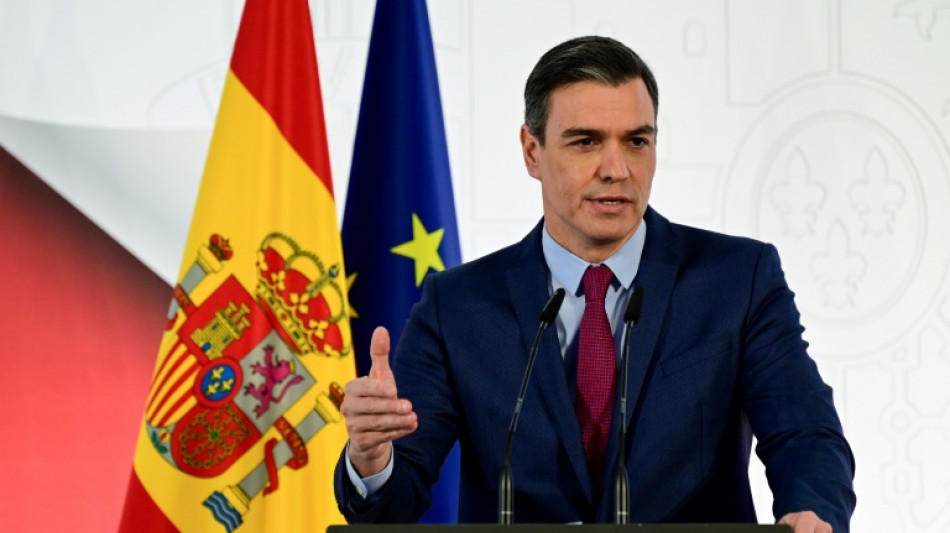
Tension in Spain over use of EU recovery funds

 Split loyalties for Indian football fans at Brazil friendly
 India-Pakistan blockbuster brings cricket fever to Japan baseball field

 Wong waiting on Rafa after winning Asian Games tennis gold
 With Russia next door and rising costs, Latvia goes to the polls

 Penalty hero rues empty seats as Games hosts Japan win football gold

 North Korea fires ballistic missile after Seoul's apology demand

 US regulator finds Boeing 737 MAX software bug 'not a safety concern'

 Ohtani 'managing' injuries as Dodgers launch MLB post-season

 Botched US execution leaves murderer unconscious on ventilator: lawyers
 Cornell rape case exposes sexual violence at US colleges
 France held by Italy in Zidane's homecoming after Olise stunner
 Ethiopian pro-government militia claims Tigray airport as regional tensions spike
 Ohtani shaking off injuries as Dodgers launch MLB post-season
 Sea levels to rise in California as coastal wave surges up west coast
 New rallies urged in France as protests disrupt over 730 schools
 Djokovic survives China Open scare, Sabalenka starts strong
 King Charles to evoke colonial 'darkest days' on Caribbean tour
 Tesla shares jump after global car sales top estimates

 DR Congo Ebola outbreak killed more than 4,000: official figures
 Djokovic survives China Open scare against wildcard world no. 104
 Lula, Bolsonaro trade blows in final scramble for votes in Brazil
 New clashes erupt as protests disrupt over 560 French schools
 NY governor vows to close loophole after alleged Cornell gang rape

 Ethiopia Tigray rebels pushed back as regional tensions spike

 Stocks rise, yields fall as US job numbers disappoint
The Spanish government is increasingly under fire over its use of the European Union's massive economic recovery funds, with critics blasting the distribution of aid as too slow and arbitrary.
Spain is due to receive 140 billion euros ($160 billion) from the fund by 2026, half of it in grants, making it the programme's second-biggest beneficiary after Italy.
The landmark 800-billion-euro recovery plan was approved by Brussels in July 2020 to help the bloc rebound from the impact of the Covid-19 pandemic, and make its economy greener and more digitalised.
"We are talking about extraordinary amounts," Socialist Prime Minister Pedro Sanchez said earlier this month, calling the funds "a historic opportunity for Spain".
Spain and Portugal were the first nations to receive money, with Madrid collecting 19 billion euros during the second half of 2021.
The funds are at the heart of the economic and political strategy of Sanchez's government after the economy contracted by a whopping 10.8 percent in 2020 under its watch as the pandemic hit.
The government faces elections by the end of 2023.
But some business leaders and opposition parties have complained about a lack of coordination between the central government and Spain's powerful regions over the deployment of the money.
- 'Lack of leadership' -
Although Spain was the first to receive aid, the money was "not injected" as fast as expected in the "real economy", the CEOE employers' association said in a report in early January.
By the end of the year, only 38 percent of the funds allocated to Spain for 2021 had been used, official figures show.
This is "very far from the targets" that were set and the delay in using the aid will hamper growth, think-tank Funcas has warned.
Aerospace giant Airbus complained of a lag in the allotment of the funds, citing a "lack of coordination and leadership" from the responsible ministries, according to an internal memo published in El Pais newspaper last month.
Critics also say that even when the money is distributed, it is often not well spent, with small amounts spread across many projects.
"The current assignment system for the funds" leads to their "dispersion" and favours "little projects", some of them "a bit odd," said the Exceltur tourism association's vice president, Jose Luis Zoreda.
He cited as an example a golf course in the rainy northern region of Asturias.
To have a "real impact", the funds should focus on "a few large projects" with a strong potential to "transform" the Spanish economy, he added.
- 'Cruising speed' -
The row has in recent days become political, with the right-wing opposition Popular Party (PP) accusing the government of favouring regions and municipalities run by the left.
"Two years ago we proposed setting up an independent agency for managing EU funds" as happened in Greece, Italy and France, PP leader Pablo Casado said.
"But Sanchez preferred to distribute aid arbitrarily," he charged.
Casado and several right-wing regional leaders have threatened to take the government to court over the distribution of the EU money, accusing it of "favouritism".
But Sanchez quickly hit back.
"Let's not turn the European funds into a partisan question... which is what the opposition wants," Sanchez said Monday during a news conference with visiting German Chancellor Olaf Scholz.
Economy Minister Nadia Calvino, who served as director general in charge of the EU budget from 2014 to 2018, dismissed the PP's criticisms as "not relevant".
The deployment of European funds will achieve its "cruising speed" in 2022, she added.
J.Saleh--SF-PST