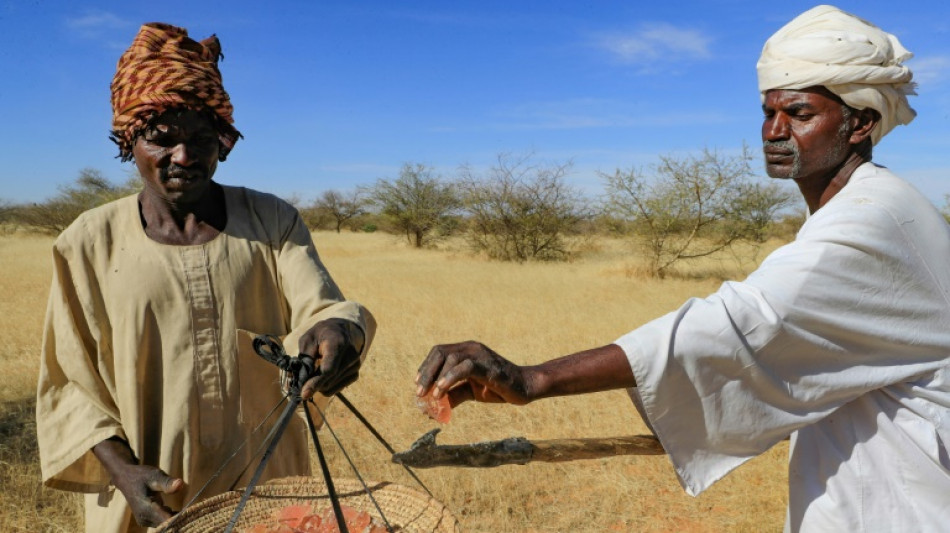
Sudan's prized gum trees ward off drought but workers wither / Photo: ASHRAF SHAZLY - AFP

 Pakistan keep England to 241 despite Duckett ton

 Ukraine war divides Bulgaria as voters elect president

 Shock and grief in a Jordanian village after church attack

 Top-ranked Rybakina crushes Fernandez to win fourth title of season

 UK PM calls for 'honest discussion' about EU free movement

 Far-right leader Le Pen kicks off tilt at French presidency amid nationwide protests

 Naomi Osaka could quit tennis if daughter asks her to

 Last MotoGP race at Phillip Island cancelled due to weather in Marquez setback

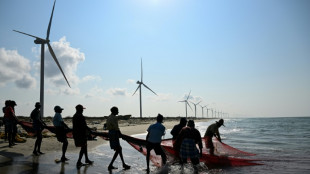
 Sri Lanka seeks faster green energy shift after oil shocks
 Riyadh airport resumes flights following Houthi attacks

 'Call of Duty' North Korea invasion edition tops sales charts in South

 Musk accuses Ukraine of violating Starlink's terms of service

 Fed expected to hold rates steady days ahead of US midterms

 More Lula, or back to the Bolsonaros? Brazil votes in cliffhanger

 Jorge Martin out of Australian MotoGP with fracture: team

 Antonelli storms to US Grand Prix pole on weekend he can take title

 Apologetic Alvarez fires Atletico to win against Deportivo

 Lens beat PFC in Ligue 1 matchday impacted by social unrest

 Valkyries hit back against Dream to level WNBA Finals

 'Fighting for our rights': Paris protesters determined to march on

 Clashes break out in Paris, other French cities amid fresh protests

 Spurs seal rare win at Chelsea as Palmer sees red

 Nearly 1,000 arrested in French protests marred by 'elevated' violence: minister

 France extends detention of suspected racist shooter

 Andrade and Nemour star as Biles cheers at world gymnastics champs

A vast belt of trees vital for global production of fizzy drinks helps Sudanese farmers adapt to climate change, but in the harsh drylands many are reluctant to take up the trade.
Gum arabic, golden blobs of resin tapped from thorny acacia trees, is an emulsifying agent virtually irreplaceable for global industry. The ingredient is used in everything from soft drinks to chewing gum and pharmaceuticals.
Sudan, in northeastern Africa, is among the countries hardest hit by climate change but is also the world's largest producer of the raw gum.
"It's an important tree to fight desertification as it is drought resistant -- and also increases the soil fertility, essential to increasing crop production," said Fatma Ramly, coordinator of the Gum Arabic Farmers' Association, which counts seven million members.
To harvest the amber-coloured resin, farmers must suffer the same climatic extremes as their trees.
"We work for hours on end under a burning sun," said Mohammed Moussa, who collects resin at the state-owned Demokaya research forest, about 30 kilometres (20 miles) from the North Kordofan state capital, El Obeid.
Moussa faces a constant struggle with the shortage of water in largely desert Sudan. His earnings from the trees barely "provide enough money to buy water to cover us until the autumn" rainy season.
- 'Laborious' -
Recorded temperatures in Sudan's Kordofan region have increased by almost two degrees Celsius in less than three decades, more than double the global average, according to the UN Food and Agriculture Organization (FAO).
"Water scarcity is one of the key challenges for people" living in the acacia zone, said Madani Ismail, of the state-run Agricultural Research Corporation.
Farmers also have to contend with wide fluctuations in the price of gum on world commodity markets.
Forty-five kilograms (100 pounds) of raw gum can fetch 22,000 to 25,000 Sudanese pounds ($43), depending on the day's price.
The return barely covers the cost of production for Abdelbaqi Ahmed, 52, who owns a 28-hectare (70-acre) plot of acacia trees in Botei, North Kordofan.
He cultivates other crops to help boost his income from the trees, whose bark he cuts with a "sunki" -- a sharp blade attached to a long wooden shaft able to reach up high in the tree.
"It is a laborious task," said Ahmed, who sometimes hires others to help with the tapping. "So it doesn't usually pay off."
Others can't be bothered at all.
Some cut down the trees for building materials or firewood. Many work in the nearby gold mines, like four of Ahmed's five sons.
For Abdallah Babiker, who also works in Demokaya, it's the same. His three sons would rather prospect for gold than tend acacia trees.
"They want work that earns more," said Babiker, 72.
- Export leader -
Since South Sudan broke away a decade ago, taking with it its large oil reserves, gum arabic has been one of Sudan's main foreign currency earners.
Exports totalled 88,000 tonnes in 2021, earning $110 million, according to central bank figures.
That income has become all the more important since international donors cut aid following a 2021 military coup led by army chief Abdel Fattah al-Burhan.
Sudanese exports account for 70 percent of global gum supplies, according to AFD, the French agency for development.
Their importance to the world economy earned them a special exemption from the US trade embargo imposed during the three-decade rule of now-ousted strongman Omar al-Bashir.
Efforts have been made to counter deforestation by boosting farmers' incomes.
"We have been trying to replant trees in areas that experienced deterioration, and to prevent the gum arabic belt from receding," Ramly said.
Sudan's gum arabic belt covers about 500,000 square kilometres (193,000 square miles) from Gedaref in the east through Kordofan to Darfur on the border with Chad.
The FAO has launched a $10 million project with Sudan's forestry authority to support farmers and protect the trees.
Acacia boosts "soil moisture retention", which helps farmers' other crops, the FAO said.
The project, which seeks to reforest 125,000 hectares (310,000 acres), is part of the wider Great Green Wall project, which aims to contain desert encroachment by planting trees from the Sahel to the Horn of Africa.
The challenge now is to persuade young people that they can make a living in gum production.
Almost "all of the people who are doing this job are over 60", Ramly said.
Ismail agreed. "Young people... often see it as unrewarding," he said.
J.AbuHassan--SF-PST