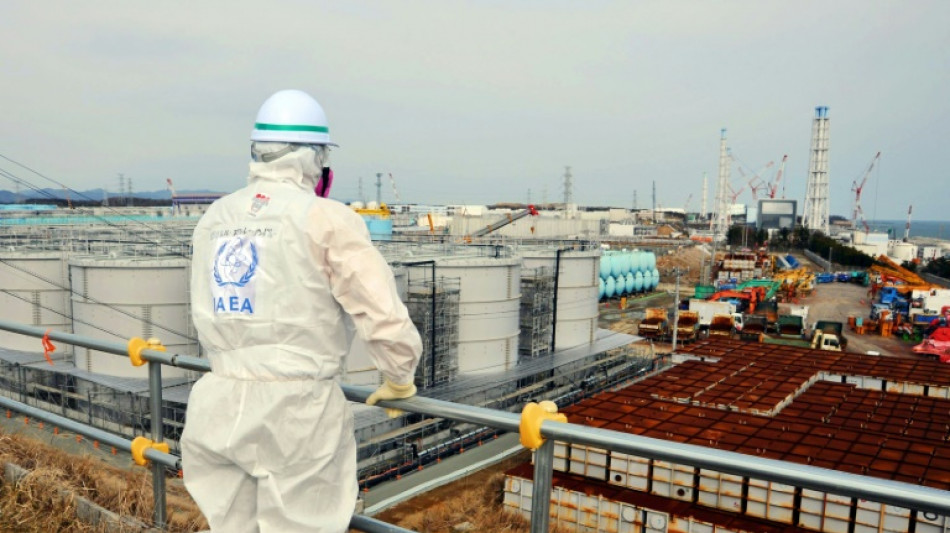
'Big challenges': choosing a nuclear career in Japan / Photo: Handout - International Atomic Energy Agency (IAEA)/AFP/File

 Serbia's student movement ousts longtime leader in parliament poll

 Antonelli wins US Grand Prix to close on world title

 اكتمال المتأهلين إلى ربع نهائي كأس الألف شهيد
 دخول خمس شاحنات غاز إلى قطاع غزة

 Falcons hand 49ers first defeat of NFL season

 Kuwait regulators broaden beneficial-owner data cooperation
 كفاراتسخيليا يتجه إلى الدوحة لإجراء جراحة في الركبة

 'Marine has to win': Le Pen supporters fear for France's future

 دراسة تحذر من مخاطر إرشادات أميركية جديدة للقاح التهاب الكبد «ب» على الرضع

 الدفاعات السعودية تحبط سلسلة هجمات حوثية استهدفت مكة والمدينة

 France's Le Pen launches presidential bid vowing to restore 'rule of law'

 Qatar Charity delivers Braille Qurans to blind readers in Kosovo and Albania

 Houthis say attacked Riyadh airport hours after flights resume

 Monaco hold Lille as Rennes go top of Ligue 1

 Thousands gather in Prague to protest licence fee plans

 Pease spins to floor gold as US tops gymnastics medal table

 Marchant back in England training squad ahead of Nations Championship fixtures

 French skater Siao Him Fa soars to victory in season-opener at home

 Embattled Albanian PM vows fines for violent protesters

 Steelers top Saints in NFL's first regular-season game in Paris

 Carrick unsure over Man Utd future after Bournemouth loss

 2027 Dakar Rally to be moved from Saudi Arabia

 Man Utd battered by Bournemouth to leave Carrick on the brink

 Storms batter Europe hitting power supplies, flights and phones

 Inter rally late to down Fiorentina and regain Serie A lead

The 2011 Fukushima disaster made working in the nuclear industry unappealing for many Japanese students, but a new government push to revive the sector could start to shift the narrative.
It's a welcome development for some young professionals, who have experienced the stigma sometimes associated with their job.
Chisato, who declined to give her family name, studied chemistry and radiation biology as a student, looking for a deeper understanding of the Fukushima disaster than what she read in anxiety-inducing media reports.
"I just wanted to know the facts, in a neutral way -- especially about the effects of nuclear radiation on the human body," the 28-year-old told AFP at a recent international conference for young nuclear professionals.
Still, when she applied for a job in 2017 at the operator of the stricken Fukushima plant, she was "surprised" when the interviewers asked what her parents thought of the role.
She later learned that other candidates had pulled out of the recruitment process because of family disapproval.
She took the job, despite the concerns of her parents.
"They asked me if I would work at Fukushima Daiichi, and I explained to them that it wouldn't affect my health," she said.
The 2011 disaster was triggered by a massive tsunami that overwhelmed generators at the Fukushima Daiichi plant.
The resulting radiation released forced the evacuation of people in a 20-kilometre radius (12-mile radius), and while no-go zones now account for around 2.4 percent of Fukushima prefecture, many people chose not to return to their former homes.
- 'We must be motivated' -
In the decade after the disaster -- the world's worst nuclear accident since Chernobyl -- the number of atomic science students in Japan fell by more than a quarter, according to the education ministry.
But now the government is hoping to revitalise the sector, aiming to reduce its reliance on imported fossil fuels, and move towards carbon neutrality.
After working in Japan for three years, Chisato moved to Europe for a new job in the nuclear industry.
She returned home for the International Youth Nuclear Congress, a biennial forum for students and early-career professionals in the sector.
The November event, the first held in Japan, convened in a symbolic location, Koriyama in northeastern Fukushima region. Several hundred Japanese and foreign attendees gathered to network and hear speeches on the industry's future.
"We must be motivated," enthused Kota Kawai, president of a Japanese youth network for the nuclear energy industry, and a co-chair of the congress.
"We have to express what we think, what we do, to others," he told AFP at the event.
"After the Fukushima accident, students got interested in how we can overcome big challenges. Many students got interested in the decommissioning field."
He insists the drop in students entering the field shouldn't be overinterpreted, as numbers vary each year, but acknowledges there are some gaps.
"The problem is there are very few people who know how to construct nuclear power plants," he said.
- Carbon neutrality -
Japan took all its nuclear reactors offline immediately after the 2011 disaster, and the majority remain out of action.
But with the nation facing sky-high costs for imported energy because of the war in Ukraine, Prime Minister Fumio Kishida has called for more plants to be restarted.
By 2030, the government wants nuclear power to account for 20-22 percent of electricity production, up from around seven percent now, as it targets carbon neutrality by 2050.
Hikari, a 28-year-old who asked to be referred to by her first name only, works in the nuclear energy research department of a large Japanese conglomerate.
Her parents and friends have never criticised her choice, she said.
However, it took "years" of discussions for her husband to come round to the idea.
"He might not agree 100 percent, but he now respects my decision, and understands that I want to do my job properly," she told AFP.
And while the government's ambitions might be a boon for those in the industry, some are cautious.
Kyohei Yoshinaga, who works on electricity and energy innovation at Mitsubishi Research Institute think-tank, fears the enthusiasm for nuclear could wane fast.
The 30-year-old, who began his university studies the same year as the Fukushima disaster, understands that "there is a need right now" for nuclear power.
But he fears public opinion could harden against the restart of nuclear reactors if energy prices fall again.
"The situation can change very easily and fast," he said.
B.Khalifa--SF-PST