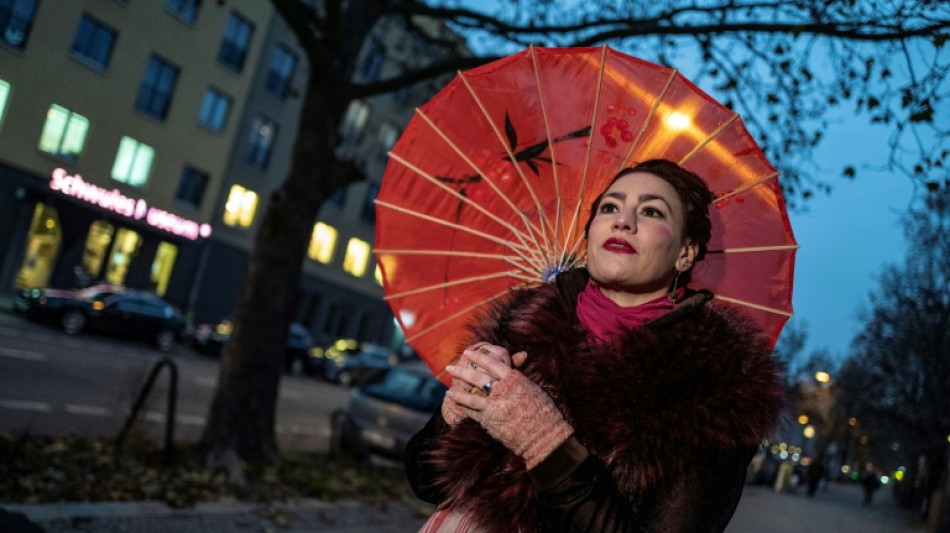
Berlin sex workers reclaim their history with audio app / Photo: John MACDOUGALL - AFP

 Eric Ries sets out how mission-driven companies can endure

 Falcons hand 49ers first defeat of NFL season, Vikings remain unbeaten

 Readers debate YES Bank bonds, climate commitments and candidate disclosure

 مباحثات لتوطين إنتاج المستحضرات الدوائية بين هيئة الدواء و«إيست فارما»
 Antonelli looks to seal title 'in style' after US Grand Prix win

 Real Madrid century 'just a detail' for Mbappe after Clasico win

 موجة بيع حادة تدفع مؤشرات البورصة المصرية إلى خسائر واسعة

 Disappointed Verstappen admits to wrong tyre strategy at US Grand Prix

 India trims weekly wheat auction volume despite strong miller demand

 Manchester United slump deepens as Liverpool climb with Brighton win

 Reus sends Bordeaux second in Top 14 with victory at La Rochelle

 الجامعة الإسلامية تنعى ثلاثة موظفين وتدين استهداف حرمها

 Real Madrid beat Barcelona in La Liga Clasico

 Antonelli wins US Grand Prix to close on world title

 اكتمال المتأهلين إلى ربع نهائي كأس الألف شهيد

 دخول خمس شاحنات غاز إلى قطاع غزة

 Falcons hand 49ers first defeat of NFL season

 Kuwait regulators broaden beneficial-owner data cooperation

 كفاراتسخيليا يتجه إلى الدوحة لإجراء جراحة في الركبة

 'Marine has to win': Le Pen supporters fear for France's future

 دراسة تحذر من مخاطر إرشادات أميركية جديدة للقاح التهاب الكبد «ب» على الرضع

 الدفاعات السعودية تحبط سلسلة هجمات حوثية استهدفت مكة والمدينة

 France's Le Pen launches presidential bid vowing to restore 'rule of law'

 Qatar Charity delivers Braille Qurans to blind readers in Kosovo and Albania

 Houthis say attacked Riyadh airport hours after flights resume

Sex workers in Berlin are emerging from the shadows to tell the history of their profession, hoping a new app will help them push back against stigma, abuse and the curse of gentrification.
The "We Have Always Been Everywhere" audio guide tells the story of the famed red-light district in the German capital's central Schoeneberg neighbourhood from the 1880s onwards.
Launched by local sex workers with support from the city government and the Schwules Museum of LGBTQ life, the project argues that prostitution is a time-honoured -- if still taboo -- part of the city's fabric.
"We've been here for generations and we belong here and we deserve to work here safely," said one of the initiators, who goes by the name Emma Pankhurst in tribute to the British suffragette Emmeline Pankhurst.
The 35-year-old emigrated from the United States three years ago to legally ply her trade without fear of arrest.
Although Germany's relatively liberal prostitution laws marked an improvement on the full criminalisation back home, she said Berlin had failed to live up to its reputation as a sexual safe haven.
Schoeneberg is "one of the gay paradises of the world", she said of the diverse district.
"That in part is due to the sex worker community being here first and the gay community following suit," she said, a common trajectory in cities around the globe.
However, Pankhurst said gentrification was now putting the squeeze on her and her colleagues.
"Real estate prices are through the roof and that means there's quite a lot of money to be made here. People don't want to see sex workers on the street."
A nine-month prostitution ban during the pandemic had also had a lasting negative impact, she said, often serving as an excuse for harassment and violence.
- Bowie's backyard -
Dressed in petticoats and carrying a red parasol, Pankhurst led a tour to introduce the audio guide looking the part of a late 19th-century prostitute.
As snow began to fall, she recounted the early days of the sex trade beneath the Buelowstrasse overground train as the city started to boom after the Franco-Prussian War.
"Because factory bosses knew that prostitution was a possibility for their female employees, they often used this as a justification to pay them far less than their male co-workers," Pankhurst said.
The tour covers the libertine Weimar Republic era through to the brutal hypocrisy of the Nazi period, when "sexual deviants" were sent to concentration camps where forced prostitution was a common practice.
West Berlin's post-war years gave rise to a bold gay rights movement and barely hidden but still illegal sex work sector.
Schoeneberg became a heady mix of middle-class Germans, prostitutes, Turkish immigrants and a vibrant LGBTQ scene, making nonconformist newcomers like David Bowie feel right at home.
The AIDS epidemic of the 1980s and 1990s, however, whipsawed through the community, and the fall of the Berlin Wall brought an influx of eastern European sex workers, pushing down prices.
- 'Written out of history' -
Pankhurst studied ballet and arrived in Germany on an arts visa. Difficulty making a living as a dancer led her to sex work and she is now employed in a brothel.
Asked whether she sympathised with local families complaining about prostitution, Pankhurst called for mutual understanding.
"Many sex workers have children too -- for a lot of us it's why we do sex work because of the need to make a relatively large amount of money to survive in a short amount of time so that we can get back to our kids."
Prostitution is legal in Germany but since 2017 all sex workers have been required to register, submit to regular health checkups and use condoms.
At the end of 2021, about 23,700 were registered -- a small fraction of the estimated 400,000 working in Germany.
Many activists would prefer decriminalisation to full legality because they say a registration requirement drove much of the sector underground again.
That fosters scourges like trafficking, which German federal police said soared 10 percent in 2021, with a third of the victims of forced sex work under 21.
Pankhurst herself was fined for not registering properly when she reported her former escort service to the police for pressuring her to perform certain sexual acts.
Decriminalisation, she said, helps eliminate "negative consequences for any person who is being trafficked -- or client who suspects trafficking -- reporting it to the police."
Birgit Bosold of the Schwules Museum said it had supported the tour due to long-standing "solidarity" between sex workers and the queer community, who "know what it means to be marginalised and written out of history."
"We've accumulated networks and know-how over the last 30 to 40 years that we can offer to our brothers and sisters," she said.
Participants said the guide, available on the berlinHistory app, offered a number of surprises.
Eugen Januschke, 55, was "particularly fascinated by the history of sex work under the Third Reich," citing stories about prostitutes who hid Jews from the Nazis.
Abigail Goldner-Morris, 22, visiting from Washington DC, found Pankhurst's case for decriminalisation persuasive.
"Because people, when given all of their options, are going to make the best choice for them," she said.
B.Khalifa--SF-PST