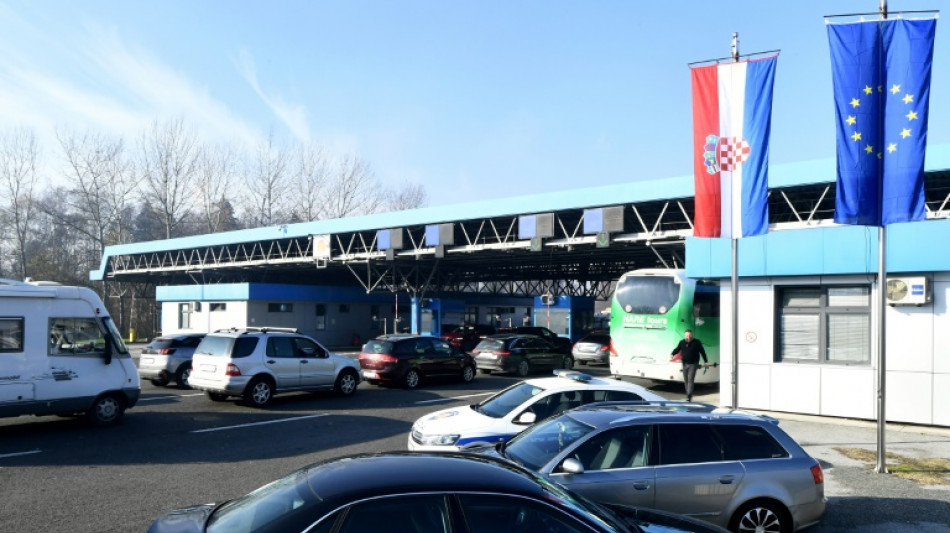
Croatia sets sights on Europe's border-free club / Photo: Denis LOVROVIC - AFP

 China's Communist Party elite hold key talks on governance
 جمارك دبي تنجز 1.36 مليون طلب لاسترداد التأمينات في ستة أشهر

 Chiefs and 49ers suffer first losses of NFL season, Vikings stay unbeaten

 حرة مطار الشارقة تجذب استثمارات دولية جديدة في الصناعات الغذائية
 مقاطع الذكاء الاصطناعي تدخل قلب الحملات الانتخابية الأميركية
 Brewers erase four-run deficit as Rays lose World Series Game 2
 Shadab century and record last-wicket stand carry Pakistan past England

 Brazil's Lula clinches poll victory, Bolsonaro seeks to annul election

 Doncic dominates for Lakers as James' Sixers fall to Pistons

 UP schools close for Valmiki Jayanti as coastal states monitor cyclone risk

 Albert Zahn’s carved birds find a lasting home in Wisconsin museums
 France's debt woes in focus as ECB meets

 US midterm political advertising crosses $10 billion
 Data center next door divides old Massachusetts mill town
 Maine logging, cross-border ties whipsawed by US-Canada tariff war

 From Carnegie to Claude: AI wealth could reshape philanthropy

 India and Russia plan 2027 pilot voyages on Northern Sea Route

 What challenges await Brazil's Lula in his fourth term?
 هيئة الدواء و«المهن الطبية» تبحثان دعم التصنيع المحلي وتوافر المستحضرات
 Eric Ries sets out how mission-driven companies can endure
 Falcons hand 49ers first defeat of NFL season, Vikings remain unbeaten

 Readers debate YES Bank bonds, climate commitments and candidate disclosure
 مباحثات لتوطين إنتاج المستحضرات الدوائية بين هيئة الدواء و«إيست فارما»
 Antonelli looks to seal title 'in style' after US Grand Prix win

 Real Madrid century 'just a detail' for Mbappe after Clasico win
If Croatia gets approval this week to join the world's largest visa-free area, the massive queues of vehicles at the borders with its European neighbours will become history.
European Union justice ministers meet on Thursday to decide whether to admit Croatia into the passport-free Schengen zone, which enables more than 400 million people to move freely around its 26 member nations.
One of the main sticking points has been questions over Croatia's ability to police what is the 27-nation EU's longest external land border, at a time when migration remains a key challenge for the country.
Zagreb's application in 2016 to join Schengen has also come at a sensitive time for Europe.
Since 2015, millions of migrants, many from conflict zones, have risked their lives to enter the EU illegally and then the Covid 19 pandemic hit in 2020.
Both prompted Schengen countries to reintroduce certain border controls.
If on Thursday Croatia gets the green light to join Schengen -- potentially alongside Bulgaria and Romania -- the kilometres-long (miles-long) vehicle queues at the Bregana border crossing with Slovenia will become a thing of the past.
Bregana is one of 73 land crossings with EU neighbours Slovenia and Hungary that would cease to exist.
"On January 1, we will raise the barriers and border traffic will be free," the head of the national border police service, Zoran Niceno, told AFP.
At airports, the change will kick in on March 26, due to technical issues.
- Tourists and trucks-
Croatia hopes joining Schengen would boost its lucrative tourism industry.
This year, the country of 3.9 million people hosted four times as many visitors, most of them from other EU states.
Removing border controls would enable holidaymakers to reach Croatian destinations faster, the head of the national tourist board, Kristjan Stanicic, said recently.
"International carriers will be delighted," said Vladimir Jurcec of the national road hauliers' association.
Removing checks at borders will save them between six and 10 hours every week.
"No more crowds and hours of queueing," noted truck driver Filip Svetlicic, whose Italy-bound lorry was stuck in a queue several kilometres long to exit Croatia via Bregana.
On January 1, Croatia will also join the EU's single currency club, the eurozone.
- Illegal migration challenge -
Ever since the former Yugoslav republic became an EU member nearly a decade ago, it has had the onerous task of policing the bloc's longest external land border.
The border -- which rubs shoulders for more than 1,350 kilometres (about 840 miles) with Bosnia, Montenegro and Serbia -- is an area notorious for trafficking in migrants, drugs and weapons.
The most challenging is the 1,011-kilometre border with Bosnia, which is not only the longest but also consists of difficult terrain dotted with rivers and craggy mountains.
At the Stara Gradiska crossing with Bosnia, police carefully scrutinise documents and waiting vehicles.
For Malik Safeta, a bus driver from Sarajevo, such strict controls are not unusual.
"It's normal. This is the last line of defence for the EU and the Schengen zone before the eastern world, which is always a bit more problematic," he said.
The situation at Croatia's borders with its non-EU neighbours is not expected to change much after January 1 because Zagreb has already introduced the Schengen area's rules for dealing with its external limits.
"Croatia has applied Schengen procedures for years and uses all the tools required for such border controls," Niceno, the border police head, said.
Police say tackling illegal migration was and will remain the most challenging task for its force of around 6,500 border officers.
NGOs and the media have repeatedly accused Croatian police of forcing migrants back over its external borders, often violently. Zagreb strongly denies the allegations.
Croatia lies on the dangerous Balkans migrant route, which was traversed by hundreds of thousands of would-be asylum seekers from Asia, the Middle East and Africa during Europe's 2015-2016 "migrant crisis".
After the route was officially shut down in 2016, migrants seeking to enter western Europe continued to use it, although in far lower numbers.
However, this year their numbers increased significantly.
Nearly 130,000 people, including women and children, have been detected on the route since the start of 2022. That is 170 percent more than in 2021, according to EU border force Frontex.
As of November, Croatia had registered some 30,000 illegal migrants, nearly 150 percent more than over the same period last year.
The Stara Gradiska region has become a hotspot for migrants trying to cross the Sava river in small boats or sometimes even swimming despite freezing temperatures.
Croatian police and their EU counterparts say two things are key to tackling the issue -- combatting the human traffickers and cooperating between the countries the migrants are trying to pass through.
"The people we apprehend are the last ones in the (trafficking) chain -- the drivers," Niceno said.
"But with cooperation and analysis, we can catch gangs and organisers."
K.AbuTaha--SF-PST