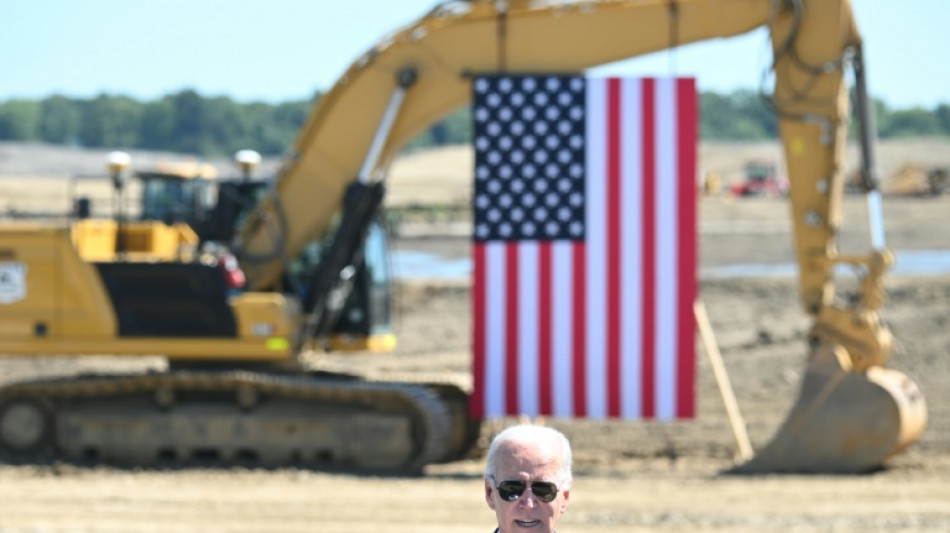
Biden celebrates giant semiconductor project / Photo: SAUL LOEB - AFP

 China's Communist Party elite hold key talks on governance

 جمارك دبي تنجز 1.36 مليون طلب لاسترداد التأمينات في ستة أشهر

 Chiefs and 49ers suffer first losses of NFL season, Vikings stay unbeaten

 حرة مطار الشارقة تجذب استثمارات دولية جديدة في الصناعات الغذائية

 مقاطع الذكاء الاصطناعي تدخل قلب الحملات الانتخابية الأميركية

 Brewers erase four-run deficit as Rays lose World Series Game 2

 Shadab century and record last-wicket stand carry Pakistan past England

 Brazil's Lula clinches poll victory, Bolsonaro seeks to annul election

 Doncic dominates for Lakers as James' Sixers fall to Pistons

 UP schools close for Valmiki Jayanti as coastal states monitor cyclone risk

 Albert Zahn’s carved birds find a lasting home in Wisconsin museums

 France's debt woes in focus as ECB meets

 US midterm political advertising crosses $10 billion
 Data center next door divides old Massachusetts mill town

 Maine logging, cross-border ties whipsawed by US-Canada tariff war

 From Carnegie to Claude: AI wealth could reshape philanthropy

 India and Russia plan 2027 pilot voyages on Northern Sea Route

 What challenges await Brazil's Lula in his fourth term?

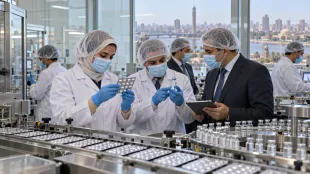 هيئة الدواء و«المهن الطبية» تبحثان دعم التصنيع المحلي وتوافر المستحضرات

 Eric Ries sets out how mission-driven companies can endure

 Falcons hand 49ers first defeat of NFL season, Vikings remain unbeaten

 Readers debate YES Bank bonds, climate commitments and candidate disclosure

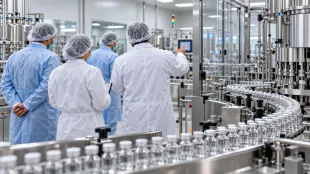 مباحثات لتوطين إنتاج المستحضرات الدوائية بين هيئة الدواء و«إيست فارما»

 Antonelli looks to seal title 'in style' after US Grand Prix win

 Real Madrid century 'just a detail' for Mbappe after Clasico win

President Joe Biden flies Tuesday to Arizona to celebrate the mammoth expansion of a Taiwanese semiconductor plant, citing the project as proof that the United States is finally breaking dangerous dependency on foreign manufacturers for the vital component.
The White House announced that TSMC is unveiling plans to build a second facility in Phoenix by 2026, ballooning its investment from $12 billion to $40 billion.
The "major milestone" adds up to "the largest foreign direct investment in Arizona history and it's one of the largest in US history," White House National Economic Council Director Brian Deese told reporters.
Biden will speak at the TSMC site, accompanied by senior political figures and titans of the corporate world, including Apple CEO Tim Cook, TSMC’s founder Morris Chang and Micron CEO Sanjay Mehrotra.
The Democrat will seek to take credit for the investment influx, pointing to the effect of his signature CHIPS Act, which sets aside almost $53 billion for subsidies and research in the semiconductors sector. It's a message he'll be especially keen to spread in Arizona, which was long a Republican dominated state but has turned into a battleground where Democrats do increasingly well.
The plant expansion -- which comes on top of other significant microchip manufacturing projects dotted around the country -- is part of an overall strategy by the Biden administration to try to end reliance on foreign suppliers.
Although much of that supply comes from reliable US allies, particularly Taiwan, the Covid pandemic shutdown demonstrated how fragile those supply lines were in case of emergency. With China threatening to take control of Taiwan -- and eyeing how to ensure its own semiconductor supplies -- Washington wants to bring the vital gadgets home.
"Virtually every large tech firm, including automotive firms and any company that uses technology is sweating bullets that something's going to happen between Taiwan and China. And so there's a massive rush to shift manufacturing out of both countries," technology analyst Rob Enderle said.
- Smaller the better -
In the high-stakes world of microchips, sheer quantity is important. The miniscule, hard-to-make gadgets are at the heart of almost every modern appliance, vehicle and advanced weapon.
But quality -- and small size -- is also increasingly important for sophisticated everyday devices like smartphones and there the White House says it has good news.
The new TSMC plant will produce tiny 3 nanometer chips, while the existing facility will start reducing the size of its current 5 nanometer chips to 4 nanometers.
Building a plant, or a "fab," takes several years. But once "at scale, these two fabs could meet the entire US demand for advanced chips when they're completed. That's the definition of supply chain resilience," Ronnie Chatterji, National Economic Council deputy director for industrial policy, told reporters.
Deese, one of Biden's most senior advisors, said the broader message from the White House is that US industrial strategy is undergoing a rebirth.
For almost four decades, the idea was "trickle down," where government would "get out the way" and cut taxes for big companies to attract investment, he said.
Instead, Biden's policy -- both through the CHIPS Act and the giant Inflation Reduction Act -- uses public money to attract, or "crowd in" private investment.
The goal is not to exclude "private companies, but in fact, encouraging private investment at historic scale," Deese said.
Y.Shaath--SF-PST