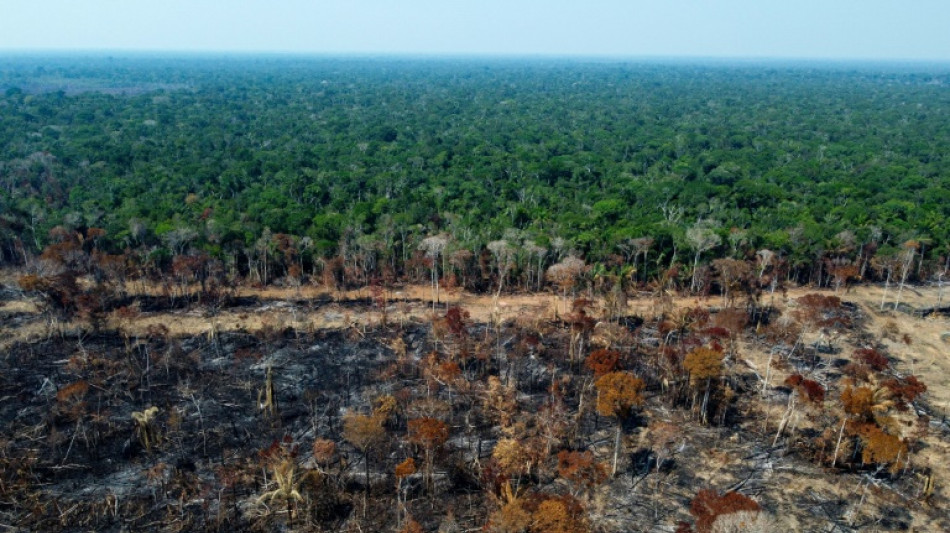
EU agrees ban on imports driving deforestation / Photo: MICHAEL DANTAS - AFP/File

 China's Communist Party elite hold key talks on governance

 جمارك دبي تنجز 1.36 مليون طلب لاسترداد التأمينات في ستة أشهر

 Chiefs and 49ers suffer first losses of NFL season, Vikings stay unbeaten

 حرة مطار الشارقة تجذب استثمارات دولية جديدة في الصناعات الغذائية

 مقاطع الذكاء الاصطناعي تدخل قلب الحملات الانتخابية الأميركية

 Brewers erase four-run deficit as Rays lose World Series Game 2
 Shadab century and record last-wicket stand carry Pakistan past England

 Brazil's Lula clinches poll victory, Bolsonaro seeks to annul election

 Doncic dominates for Lakers as James' Sixers fall to Pistons

 UP schools close for Valmiki Jayanti as coastal states monitor cyclone risk

 Albert Zahn’s carved birds find a lasting home in Wisconsin museums

 France's debt woes in focus as ECB meets

 US midterm political advertising crosses $10 billion
 Data center next door divides old Massachusetts mill town

 Maine logging, cross-border ties whipsawed by US-Canada tariff war

 From Carnegie to Claude: AI wealth could reshape philanthropy

 India and Russia plan 2027 pilot voyages on Northern Sea Route

 What challenges await Brazil's Lula in his fourth term?

 هيئة الدواء و«المهن الطبية» تبحثان دعم التصنيع المحلي وتوافر المستحضرات

 Eric Ries sets out how mission-driven companies can endure

 Falcons hand 49ers first defeat of NFL season, Vikings remain unbeaten

 Readers debate YES Bank bonds, climate commitments and candidate disclosure
 مباحثات لتوطين إنتاج المستحضرات الدوائية بين هيئة الدواء و«إيست فارما»

 Antonelli looks to seal title 'in style' after US Grand Prix win

 Real Madrid century 'just a detail' for Mbappe after Clasico win

The European Union reached an agreement Tuesday to ban the import of products including coffee, cocoa and soy in cases where they are deemed to contribute to deforestation.
The draft law, which aims to ensure "deforestation-free supply chains" for the 27-nation EU, was hailed by environmental groups as "groundbreaking".
It requires companies importing into the EU to guarantee products are not produced on land that suffered deforestation after December 31, 2020, and that they comply with all laws of the source country.
The scope encompasses palm oil, cattle, soy, coffee, cocoa, timber and rubber as well as derived products such as beef, furniture and chocolate.
Illegal production has spurred massive deforestation in countries such as Brazil, Indonesia, Malaysia, Nigeria, the Democratic Republic of Congo, Ethiopia, Mexico and Guatemala.
The United Nations' Food and Agriculture Organization estimates that an aggregate area of land bigger than the European Union, or some 420 million hectares (more than one billion acres), has been deforested around the world over the past three decades.
The European Union is the second-biggest market for consumption of the targeted products after China.
Pascal Canfin, chairman of the European Parliament's environment committee, hailed the agreement, and how its impact would feed through to everyday items Europeans consume.
"It's the coffee we have for breakfast, the chocolate we eat, the coal in our barbecues, the paper in our books. This is radical," he said.
- 'Historic' -
The environmental lobby group Greenpeace called the draft law, agreed between the European Parliament and EU member states, "a major breakthrough".
Another, WWF, called it "groundbreaking" and "historic".
"This regulation is the first in the world to tackle global deforestation and will significantly reduce the EU's footprint on nature," the WWF said in a statement.
Both groups called on the EU to go further, by expanding the scope of the law to include savannahs, such as Brazil's Cerrado, which are also under threat by encroaching ranchers and farmers.
Greenpeace noted that financial institutions extending services to importing companies would not initially come under the new law, but that they would come under review two years later.
Both the European Council -- representing the EU countries -- and the European Parliament now have to officially adopt the agreed law. Big companies would have 18 months to comply, while smaller ones would get a longer grace period.
"The new law will ensure that a set of key goods placed on the (European Union) market will no longer contribute to deforestation and forest degradation in the EU and elsewhere in the world," the European Commission said in a statement.
"The battle for climate and biodiversity is accelerating," French President Emmanuel Macron tweeted.
- Big fines -
The parliament said in a statement that the law opened the way for technology such as satellite monitoring and DNA analysis to verify the provenance of targeted imports.
High-risk exporting countries would have nine percent of products sent to the EU checked, while lower-risk ones would have lower proportions scrutinised.
Companies found violating the law could be fined up to four percent of annual turnover in the EU.
The legislation would be reviewed one year after coming into force, to see whether it should be extended to other wooded land.
Another review at the two-year mark would have the commission considering whether to expand it to cover other ecosystems and commodities, as well as financial institutions.
J.AbuHassan--SF-PST