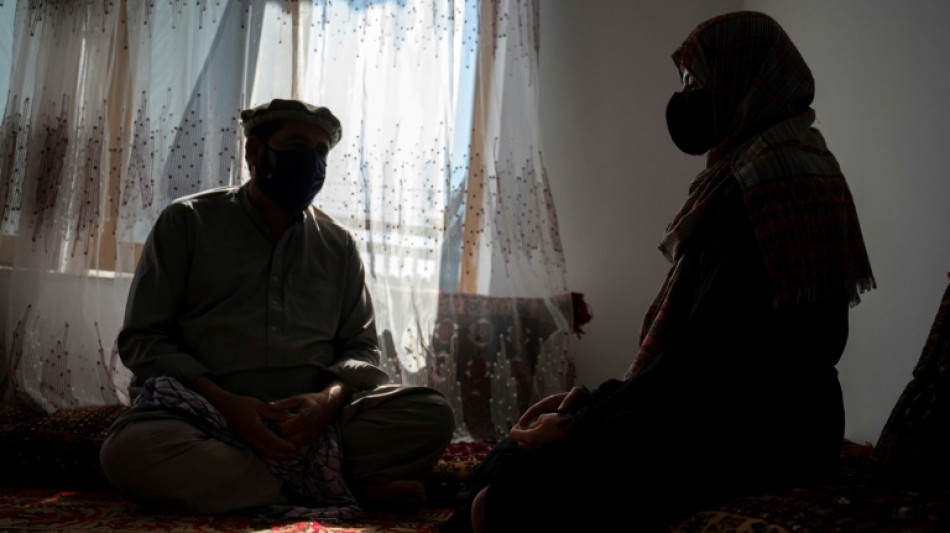
Banned from education, 'idle' Afghan girls are married off / Photo: Wakil KOHSAR - AFP

 Arsenal cruise past Lille into share of Champions League lead

 Trump ousts Greece ambassador over ethics scandal

 Reese Witherspoon, France's Mediawan to buy Hello Sunshine
 Bipartisan US senators urge Trump to scrap Russian diesel deal
 Ex-gang leader sentenced to minimum 40 years for Tupac murder

 Cornell suspends frat parties after alleged gang rape

 Man City deserve to keep titles, says PSG's Luis Enrique

 Regulator 'will resign' if any political interference in Man City case

 Microsoft's Brad Smith calls for 'real and effective' AI safety standards

 Anthropic warns of AI 'worms' spreading across smart gadgets

 Big US banks report strong earnings and stay bullish on AI

 Iraola backs Barcola, Wirtz to come good for Liverpool

 In a first, AI helps UK lawmaker find her voice in parliament

 Pope Leo in Rome hospital for lung operation

 EU watchdog says smart glasses must give 'clear warnings' when recording

 Houthis say Saudi Arabia strikes oil site in Yemen's capital

 France roiled by marches in support of protesting students

 Goldman Sachs profits jump as CEO says no plans to exit

 Apple unveils HomeView smart display in renewed home push

 Novelist Thelyson Orelien denies AI use, admits plagiarism 'mistakes'
 Trump asks Greece ambassador to resign amid bribery scandal: White House

 11 missing after ships struck off Bulgaria in latest Black Sea attack
 France budget debate faces rocky start as Socialists vow to fight

 AI could 'change the stakes' on bioweapons: UK spy chief

 Sweden centre-left leader fails to form government

Thirteen-year-old Zainab should have been shopping for a new school uniform this autumn but, with no prospect of girls' schools reopening in Afghanistan, she was instead forced to pick out a wedding dress.
Since the Taliban seized power in Kabul and banned teenage girls from education, many have been married off -- often to much older men of their father's choice.
"I cried a lot and kept telling my father that the Taliban would reopen girls' schools," Zainab said.
"But he said that's not going to happen, and it's better that I get married rather than sit idle at home."
Her wedding date was fixed within hours of the would-be groom arriving with an offer of a few sheep, goats, and four sacks of rice as a bride price -– a centuries-old custom for many in rural Afghanistan.
As is traditional, Zainab moved in with her new in-laws and husband –- who is 17 years older than her.
"Nobody asked for my opinion," she said.
Afghanistan is the only country in the world where girls are banned from going to secondary school.
Together with economic crisis and deep-rooted patriarchal values, many parents have accelerated the marriage of teenage daughters who have been mostly confined to their homes since the Taliban stopped their education.
"At my parent's house, I used to wake up late... here, everybody scolds me," Zainab told AFP from the Taliban's power base of Kandahar.
"They say, 'We have spent so much on you and you don't know how to do anything'."
Parents increasingly feel there is no future for girls in Afghanistan, said Mohammad Mashal, the head of a teachers' association in the western city of Herat.
"They feel it is better girls get married and start a new life," he said.
When the Taliban took back control of the country in August last year, there was brief hope they would allow more freedoms for women compared to their brutal, austere rule of the 1990s.
But a planned reopening of girls' schools in March by the ministry of education was axed by the secretive supreme leader Hibatullah Akhundzada.
Officials claim the ban is temporary but have wheeled out a litany of excuses for the closures.
For many girls, it is already too late.
- 'Now I wash dishes' -
A team of AFP journalists interviewed several girls who have either married or become engaged in recent months.
Their real names are withheld for their safety.
"Never did I think I would have to stop studying and instead become a housewife," said 16-year-old Maryam.
"My parents have always supported me, but in this situation, even my mother could not oppose my marriage."
She studied to grade six in a village, after which her father moved the family to the nearby town of Charikar, just north of Kabul, where his children could pursue higher education.
"Instead of studying, I now wash dishes, wash clothes and mop the floor. All this is so hard," she said as she served breakfast to her father Abdul Qadir, 45.
Qadir had intended to let Maryam and her sisters study for degrees before searching for suitors.
"I wanted them to complete university education because I had worked hard for it and already spent so much money on them," he told AFP.
Living in a rented apartment, Qadir -- whose salary from a government job has been almost halved under Taliban rule -- has had to sell some household items to feed his family.
"In Afghanistan, girls do not get many opportunities, and proposals for marriage stop coming after a time," he said.
"My previous experience of the Taliban tells me they will not reverse their decision."
Even if a reversal of policy was to come, it would be meaningless to Maryam.
"The first person to oppose my education will be my husband. He will be physically violent with me," she told AFP.
Early marriage can often lead to a lifetime of suffering for girls and women.
Such marriages are particularly common in rural areas of Afghanistan where dowries given to brides' families are a vital source of income.
Experts say education is pivotal in delaying the weddings of girls, and with it childbearing that comes with a higher rate of infant mortality and maternal deaths at a young age.
- A girl is a 'burden' -
The Taliban have imposed severe restrictions on women, forcing them to comply with the group's austere vision of Islam.
Women have been told to cover up with the hijab or preferably with an all-encompassing burqa when in public or, better still, to leave home only if absolutely necessary.
Afghanistan's aid-dependent economy has collapsed since the exit of foreign forces, leaving hundreds of thousands without jobs and half its 38 million people facing hunger, aid agencies say.
In a twisted sense of sacrifice, some young women are offering themselves up for marriage to help alleviate the financial load.
"(My father) did not force me, but the situation was such that I accepted a proposal and got engaged," said 15-year-old Sumayya in the capital, Kabul.
Sisters Sara, 20, and Fatima, 19, had been months away from sitting university entrance exams when their high school was closed, leaving them unable to graduate.
With the family in crisis after their father died from Covid-19, they declared one after the other that the search for husbands should begin.
"My conscience tells me that it's better to marry than be a burden on my family," Fatima said.
X.AbuJaber--SF-PST