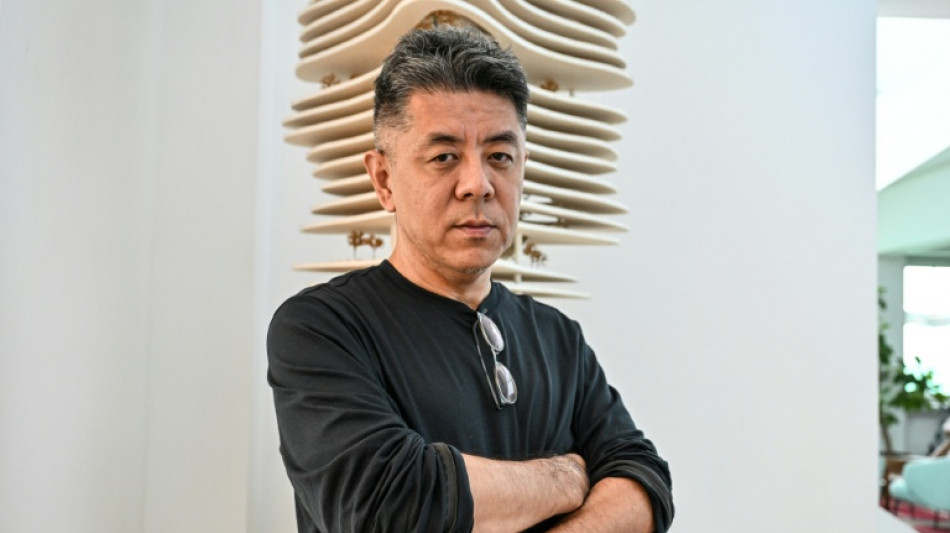
Chinese architect Ma Yansong melds nature with 'futuristic feel' / Photo: Adek BERRY - AFP

 El Nino’s Weakening Grip on Tamil Nadu Rainfall Hinges on Potential Cyclone

 South Africa Places 36 Hospitals on Standby for Possible Imported Ebola Cases

 Two A1 Crashes Create Kilometres of Rush-Hour Congestion

 Luxembourg City Plans €13 Million Abrigado Centre for 2029

 Luxembourg Housing Petition Passes Threshold for Parliamentary Consideration

 Raheem Sterling Receives Suspended Sentence After Lamborghini Crash

 Tamil Nadu Secures Rs 58,214 Crore in Investments at Vettri Conclave

 فرنسا تدعو لتجريم "الفصل العنصري القائم على الجنس" دولياً

 أزمة الصواريخ الاعتراضية في البنتاغون: استنزاف المخزونات يفرض تعبئة صناعية حتى 2030

 Huawei Found Guilty of Trade Secret Theft in Landmark US Case

 Indian Markets Set for Gain as Foreign Inflows Offset Tariff Fears
From a distance, it looks as though a giant spaceship has just landed in the palm tree-dotted streets near downtown Los Angeles.
It could also be a wide-canopied tree or a low passing cloud -- but for its Chinese architect Ma Yansong, as long as the building "sparks curiosity", he's achieved his purpose.
Over the past two decades, Ma has created dozens of visually striking projects in his home country and abroad, integrating nature with sleek, modern designs.
In some ways, his seemingly sci-fi-inspired style is a perfect match for his newest project opening on September 22, the Lucas Museum of Narrative Art in Los Angeles, founded by "Star Wars" creator George Lucas and his wife, Mellody Hobson.
"The building takes on a futuristic feel that generates excitement," Ma told AFP at the Beijing office of MAD Architects, the firm he established in 2004.
"When people visit the Lucas Museum, they will each bring their own unique perspectives," said the 50-year-old, who last year was included on Time magazine's list of the 100 most influential people.
"They might catch a beam of light, see it cutting through the building, glimpse the clouds, the sky, or even the cosmos.
"This sparks curiosity and new ideas -- and those diverse thoughts are incredibly valuable."
- Mountains and water -
A Beijing native, he grew up in a courtyard house typical of the "hutong" alleyways that crisscross the historic centre of China's capital city.
"There was a very close connection to nature," he said, recalling the trees and small pockets of open space interspersed in hutong neighbourhoods.
Later, he went overseas to train as an architect, graduating from the Yale School of Architecture and working briefly at the studio of acclaimed Iraqi-British designer Zaha Hadid.
Ma and his firm have conceptualised landmark works all over China, including the Harbin Opera House, a vast, swooping structure perched dramatically on the banks of the frigid Songhua River.
Abroad, his notable projects include a pair of twisting residential buildings called the "Absolute Towers" near Toronto, Canada, and a migration-themed museum that opened last year in Rotterdam, the Netherlands.
Ma's architectural vision draws inspiration from traditional Chinese paintings known as "shanshui", or "mountains and water", usually depicting natural scenery.
The Lucas Museum is closely interwoven with its external environment by lawns, trees, running water and a roof covered in vegetation and solar panels.
"If you look at a Chinese garden, it is a completely natural environment, even though it is artificially designed," Ma told AFP.
"There is a global conversation (now) about ecology and how to bring people closer to nature, yet I find that traditional Eastern architecture mastered this long ago," he said.
- People-centred architecture -
Ma told AFP that he embraces what he calls a "major shift" in architecture towards placing people, rather than the buildings themselves, at the centre of the design concept.
"We aren't using architecture to flaunt wealth or power," he said.
Although many of MAD's clients wield significant financial resources, Ma said his focus is not merely to impress, but also to create "uniquely valuable space for people to enjoy".
MAD's Beijing office is located in the heart of a hutong neighbourhood near where Ma attended school in his youth.
"I like these small streets, with their trees, the people walking by and that certain atmosphere of everyday urban life," he said.
Ma said when he designs a building he wants to make sure it gives "freedom of movement" to residents -- a concept which drove his design of the Baiziwan Social Housing project in Beijing, a subsidised residential compound for low-income communities.
"Many low-income individuals feel they cannot integrate into the city," said Ma.
"Often, such housing is walled off, isolating residents," he said, adding: "It's a psychological barrier -- they feel the city doesn't accept them."
Unlike the closed, block-like apartments that have sprung up in Chinese cities during decades of rapid urbanisation, Baiziwan features an open layout with an elevated garden level and a design that optimises sunlight.
Ma said he doesn't want his buildings "to be a palace or a temple-like structure that demands reverence".
"I want it to be open, a place where everyone feels they are the masters of the city."
K.Hassan--SF-PST

