Traditional beauty pageant battles to keep pace in modern Ireland / Photo: Paul Faith - AFP

 Seeing pivotal election, Israelis fly from around world to vote
 South Korea's Eom 'racially abused' in England's Championship: club
 Asian markets mixed as tech firms claw back some losses
 India shuts down iconic Delhi protest site after three decades
 Japan urges Russia for 'impartial treatment' of arrested journalist

 Lula, Bolsonaro ordered to call off attempts at online censorship
 EU takes a page from Ireland's AI playbook

 Global deforestation slowed in 2025 but surged in Congo basin: study

 Saudi says Houthi attacks sparked Aramco fire, wounded 4 in Riyadh

 Few buyers for starving cattle in El Nino parched El Salvador

 Bybit Expands Beyond Crypto as CEO Outlines Next Phase of Financial Platform

 Bayern held by Viking after 'super dumb' Olise red in Champions League
 Why AI makes computer worms harder to stop

 US fines Bank of America $1.2 bn for anti-money laundering violations

 Bayern held by Viking after Olise sees red in Champions League

 Atletico down Carrick's struggling Man United
 Croatia trials full driverless robotaxi service
 US stocks dip ahead of inflation data as tech sell-off hits Asia

 No lights, no friends: Cuban youth grapple with loneliness
 Saudi coalition strikes Yemen oil sites after Houthi attacks

 French economy minister denies country caught in debt 'snowball'
 Judge extends halt to Trump's golf course tree-cutting
 Milan's Saelemaekers set for lenghty spell out after ankle surgery
 Nvidia says to invest in French medical website
 Real Madrid's Mourinho has 'trust' in referees despite complaints

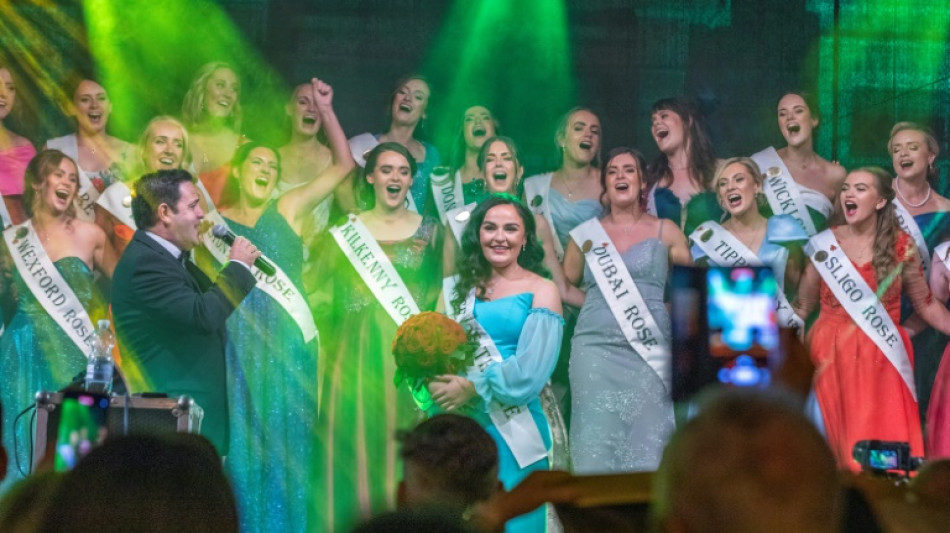
As the Rose of Tralee beauty pageant concluded this week, the contestants in colourful ball gowns and silk sashes swayed as they sang the 19th-century ballad that inspired the competition.
"She was lovely and fair as the rose of the summer," they sang as this year's winner was paraded through the town in County Kerry, southwest Ireland, which gave the contest its name.
When all 33 contestants departed the stage, fireworks burst overhead and ticker tape ribbon fell from the sky.
The beauty pageant returned to Tralee and Ireland's living rooms after a two-year absence due to Covid restrictions to fanfare from its legions of fans.
But critics have raised questions about the pageant's relevance in modern Ireland and the diversity of its contestants, not least because of the show's all-white line up for 2022.
Created in 1959, the Rose of Tralee draws contestants, known as "roses", from across Ireland and around the world from the Irish diaspora.
All of them are winners of local selections that draw thousands of participants.
New York Rose Cathrena Collins, a 24-year-old law student, told AFP it had been "really special" to represent her city's Irish community, just as her grandmother had in 1965.
"It was huge for me. Growing up, I always heard stories. She always talked about what an honour it was," she explained.
- Modern Ireland -
The Rose of Tralee has been a major fixture on Irish television since it was first broadcast in 1967 and has had to adapt to the changing currents in Irish society to survive.
Mary McGill, an Irish lecturer and author, said it originates from a time when a "puritanical notion of Catholicism" was a "huge part" of Irish identity.
At the time, the church had an iron grip on Irish society and womanhood was put "under forms of extreme surveillance and extreme expectation around morality".
"I think because of its origins, that baggage is still there," she said, explaining, however, that Rose of Tralee is still "able to tap into the zeitgeist in a strange way".
"(It is) something that's uniquely Irish and quite traditionalist.
"It also has managed to have a new lease of life in the 21st century because of the connection it has to Irishness, nostalgia and the global community".
This year, the contestants wanted the pageant to reflect modern Ireland as much as possible.
Ireland, home to some five million people, has traditionally been a country of emigration but that began to change when its economy took off in the 1990s, notably with immigration from the EU.
Most people still class themselves as white Irish but ethnic diversity is increasing.
At the same time it has seen once unthinkable social change, including same-sex marriage and the liberalisation of strict abortion laws.
Wexford Rose Joy Quigley, a 26-year-old sometime bodybuilding competitor, showed off a sleeve tattoo on her right arm as she demonstrated muscle poses for the audience in a sparkling green evening gown.
"I think a modern Irish woman isn't your typical glamorous pretty princess," she said.
"We are a bit rough around the edges, and it's important to be relatable like that."
- Rule changes -
Broadcast over two consecutive evenings in prime time, the pageant frequently revels in its own brand of Irish kitsch.
During Tuesday's finale, one rose was admonished by a popular children's TV puppet after she revealed she had worked on a killing line in a poultry processing factory.
Grown men wept openly as a contestant from Queensland in northwest Australia read a poem about missing Ireland, including crisp sandwiches made with the nation's beloved Tayto brand.
Rose of Tralee also celebrates the bonds created by the competition in Irish communities.
Winning rose Rachel Duffy, from Westmeath in central Ireland, spoke of her pride in representing the rural community that had rallied around her following the death of her mother 14 years earlier.
Maysen Tinkler from Toronto, Canada, was diagnosed with autism a little over a year ago, and spoke of how other contestants had supported her.
In December, a series of rule changes were announced, allowing married women and trans-women to enter and raising the age limit from 28 to 29.
Despite the efforts, former Sydney Rose Brianna Parkins criticised the all-white line up during a radio debate for national broadcaster RTE.
"There just seems to be a lack of diversity across the board. It isn't just a racial issue here," the 2016 contestant said.
"We have some diverse people entering but I would love to see those numbers boosted because I don't think they're true reflections of Irish society at the minute."
Executive chair of the Rose of Tralee Anthony O'Gara dismissed the criticism as "lazy" and "nonsense", pointing out three of the last four winners had been of mixed ethnic origin.
"Frankly, I'm fed up with people... finding a different angle every year to have a go at the Rose of Tralee Festival," he added.
N.Awad--SF-PST