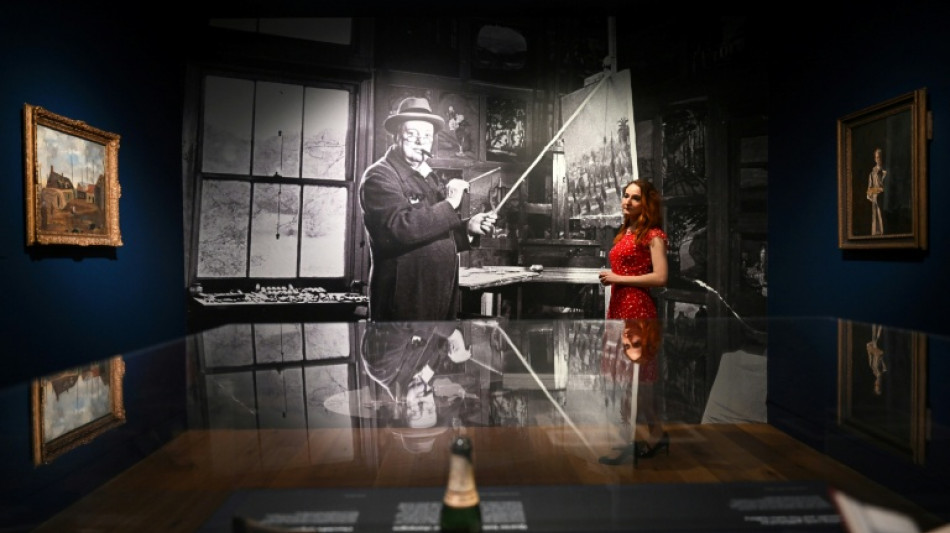
Winston Churchill's 'playful' paintings go on show in London / Photo: Justin TALLIS - AFP

 أين الأمن القومي العربي؟.. تحليل نقدي لغياب الرؤية المشتركة

 Crude Oil Prices Rise on Reports of Houthi Attack on Saudi Refinery

 El Nino’s Weakening Grip on Tamil Nadu Rainfall Hinges on Potential Cyclone

 Black Friday Discounts Cut Prices on Two Top-Rated Wiper Blades

 Twickenham Grounds Team Prepares Pitch for Six Matches in Three Days

 Luxembourg City Plans €13 Million Abrigado Centre for 2029

 Two A1 Crashes Create Kilometres of Rush-Hour Congestion

 South Africa Places 36 Hospitals on Standby for Possible Imported Ebola Cases

 Tamil Nadu Secures Rs 58,214 Crore in Investments at Vettri Conclave

 فرنسا تدعو لتجريم "الفصل العنصري القائم على الجنس" دولياً

 أزمة الصواريخ الاعتراضية في البنتاغون: استنزاف المخزونات يفرض تعبئة صناعية حتى 2030

As Britain's wartime leader, Winston Churchill was known for his stirring speeches, but a new London exhibition explores another side to his creativity -- as a passionate and prolific artist.
The exhibition opening Saturday at the Wallace Collection will be the most significant display of the statesman's paintings for more than 60 years, including over 50 canvases, many of them rarely seen in public.
Churchill first tried painting during World War I after he resigned from the government over the 1915 failed Dardanelles naval attack.
This was a "very difficult time in his life" when "he suddenly finds himself with all this unwanted leisure time", Lucy Davis, co-curator of the exhibition, told AFP.
"And he discovered painting as a way of releasing the stress, the anguish that the situation had caused him."
The museum presents a chronological survey starting with his first paintings, created with advice from renowned artist John Lavery, then canvases painted in the 1920s at Chartwell, the country house where Churchill lived with his family.
Largely self-taught while associating with well-known painters, Churchill quickly became interested in landscape painting and drew inspiration from holidays in the south of France to create brightly coloured canvases dominated by blues and ochre.
- 'Loved the light' -
Churchill "saw painting as a spur to travel" and "just loved the light and warmth and atmosphere, which he captures so beautifully", said Davis.
A whole room is dedicated to canvases inspired by trips to Morocco, including "The Tower of the Koutoubia Mosque", the only painting that Churchill did during World War II. A gift to US President Franklin D. Roosevelt, the painting recently belonged to Hollywood star Angelina Jolie.
The exhibition ends with the postwar period when Churchill, defeated in a general election, began painting again and continued until his death in 1965, with some of his works going on display at the Royal Academy.
Churchill had previously shown paintings at various galleries, but always under an assumed name.
As a statesman, Churchill went down in history for his wartime leadership, but as an artist, he had little interest in depicting current world events, the curator stressed.
"He was a wartime leader. He was known for these very stirring wartime speeches. But in these paintings, you really see his joie de vivre, his witty side, his playful side."
One painting at the exhibition is an exception: "The Beach At Walmer", painted in 1938 as fears grew of imminent war.
It shows a sandy beach in southern England with bathers paddling. But in the foreground, a black cannon points at the sea, suggesting a looming threat.
I.Matar--SF-PST

