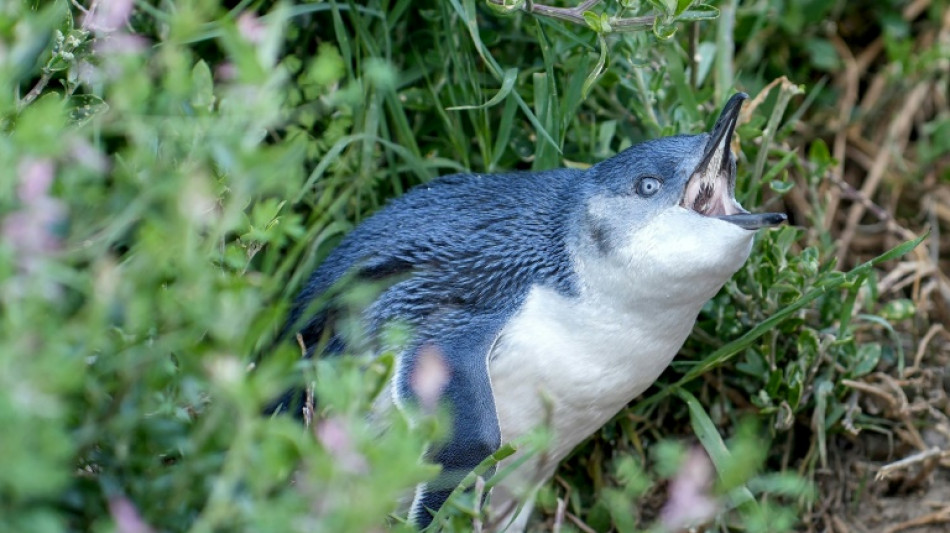
Australia races to shield little penguins from H5N1 bird flu / Photo: HO - Phillip Island Nature Parks/AFP/File

 Hotel Blacklist Launches New Accommodation Industry Risk Assessment Tool

 Bangladesh nuclear plant draws hope -- and worry

 US beat Canada 1-0 to wrap up four-win international break
 Turkey, Australia's joint COP31 leadership raises doubts

 For Turkish NGOs, COP31 offers rare space for action

 Sleep, appetite, gene-editing experts contend for Nobel chemistry prize
 Nobel Peace Prize haunted by the 'spectre' of Trump

 Africa launches own credit agency in bid for cheaper borrowing

 US, China, EU: three paths to regulating AI

 Australia's High Court rules against coal mine in landmark climate case
 Australia touts new funds for Pacific infrastructure at Fiji 'pre-COP'

 Eva Marie Saint, Oscar winner of Hollywood classics, dies at 102

 Australia probes app used in cheap smart glasses over privacy fears

 England needed to 'move on' from World Cup pain, says Tuchel

 O'Neill to stay at Celtic after period of "reflection"

 Kane marks 125th England cap with Wembley Nations League double

 Quebec's incoming separatist leader wants to block Crown from swearing-in

 Emmys gala will now stream its premier television awards

 Paramount completes Warner Bros takeover, creating Skydance
 Trump blames France unrest on Islam, migration

 Apple's Cook praises EU over efforts to protect children online

 Nobel winner Halzen says years of October 'misery' finally over

 Quebec separatist win rattles Carney's unity push

 'Itching' for change: Shiffrin cuts back slaloms this season

 'Gen Z has risen up': Tens of thousands mass for tense France school protests

Australian wildlife workers have launched an unprecedented effort to vaccinate wild populations of little penguins against the highly contagious H5N1 avian influenza.
Hundreds of thousands of tourists a year flock to viewing areas and boardwalks to watch the diminutive sea birds waddle ashore and along the beach in the evenings on the eastern coast's Phillip Island.
The stars of this "penguin parade" are from a wild colony on the island, numbering up to 40,000 seabirds at the height of the breeding season in the southern hemisphere's spring and summer.
It is the world's biggest single colony of little penguins, which have a life span of about six years with habitats in southern Australia -- mostly Tasmania -- and New Zealand.
Also known as fairy penguins, they are the tiniest species of the semi-aquatic sea birds, barely reaching knee height and weighing about the same as a standard bag of sugar.
Now, like the rest of Australia's wild bird population, they face the threat of H5N1, which breached the continental landmass for the first time in June and has since started to spread in local wildlife.
The virus was detected this month in a Phillip Island penguin that had died, the first infection in the colony by a pathogen that has caused severe disease and death in birds worldwide.
- 'Unprecedented' -
In response, wildlife teams started to vaccinate birds in the colony this week, said James Todd, chief biodiversity officer for the state of Victoria in which the island lies.
"This is unprecedented. There has been no vaccination of this scale in a wild population anywhere in the world," Todd said.
The H5N1 vaccination program, which also covers a popular little penguin population at a breakwater in the Melbourne beach suburb of St Kilda, is a challenge, he said.
"Trying to vaccinate wild populations is almost impossible, partly because you need two doses of the vaccine," Todd told AFP.
But wildlife experts are very familiar with the little penguins' burrows at Phillip Island and St Kilda, he said.
The birds, in turn, are accustomed to floodlights for the "penguin parade" tourist attraction, as well as being periodically handled by veterinarian scientists for monitoring of their health.
Vaccination teams aim to inoculate about 5,000 little penguins closest to the visitor areas, the state official said, in a program that is likely to last weeks and months, not days.
- 'State of urgency' -
Ideally, the H5N1 vaccine should be administered in two doses with a gap of three-to-four weeks, Todd said.
"Given that we're in a bit of a state of urgency here, experts have said that it's okay to even think about you know one to two weeks," he said, though a final decision had yet to be taken.
Vaccination teams can pick up the penguins from their burrows and may try to corral some as they come ashore on the beach, using microchips to track those that have been given a shot, Todd said.
"They're wild animals -- they'll squawk and try to, you know, peck you, and do all that sort of stuff -- but as I said, the team down there are very used to handling these animals," he explained.
"If you and I were doing it, we'd probably drop the thing straight away."
T.Ibrahim--SF-PST