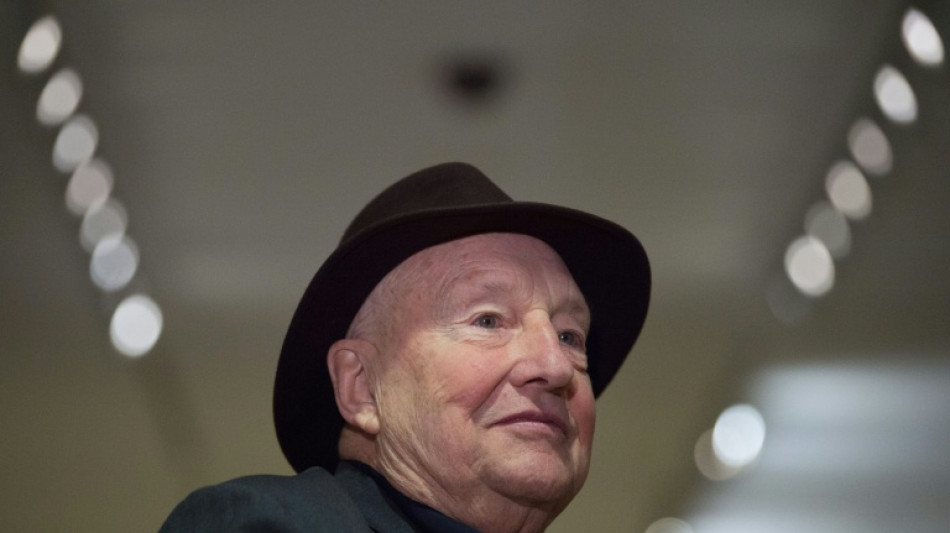
German artist Georg Baselitz dies aged 88 / Photo: Sebastian Kahnert - dpa/AFP

 أين الأمن القومي العربي؟.. تحليل نقدي لغياب الرؤية المشتركة

 Crude Oil Prices Rise on Reports of Houthi Attack on Saudi Refinery

 El Nino’s Weakening Grip on Tamil Nadu Rainfall Hinges on Potential Cyclone

 Black Friday Discounts Cut Prices on Two Top-Rated Wiper Blades

 Twickenham Grounds Team Prepares Pitch for Six Matches in Three Days

 Luxembourg City Plans €13 Million Abrigado Centre for 2029

 Two A1 Crashes Create Kilometres of Rush-Hour Congestion

 South Africa Places 36 Hospitals on Standby for Possible Imported Ebola Cases

 Tamil Nadu Secures Rs 58,214 Crore in Investments at Vettri Conclave

 فرنسا تدعو لتجريم "الفصل العنصري القائم على الجنس" دولياً

 أزمة الصواريخ الاعتراضية في البنتاغون: استنزاف المخزونات يفرض تعبئة صناعية حتى 2030

German artist Georg Baselitz, whose expressive paintings and sculptures stirred controversy in West Germany before winning global acclaim, has died aged 88.
His death was confirmed to AFP by Ropac Gallery, which had a long-standing professional relationship with the artist.
Baselitz, who "defined German visual art for a generation", had "died peacefully", the gallery said in a statement Thursday.
Baselitz, born Hans-Georg Kern, was among Germany's most prominent contemporary visual artists with a body of work over six decades across a range of techniques.
He adopted the name Baselitz in 1961 as a nod to Deutschbaselitz, the town near Dresden in eastern Germany where he was born in 1938.
His works, which reflect the traumas of German history, are now held in some of the most prestigious public collections and he has been the subject of numerous retrospective exhibitions since the 1990s.
Baselitz not only painted but also worked in the graphic arts and was a noted sculptor.
In 1969, he began painting canvases upside-down and inverting motifs, a technique he said sought to find a way between abstraction and straightforward figurative art.
Baselitz spent his early childhood in Nazi Germany and then grew up in communist East Germany.
He initially studied art in East Berlin but moved to West Berlin in 1957.
He burst into national attention in 1963 when authorities confiscated two paintings laden with sexual symbolism from the art gallery where they were on display, leading to a high-profile court battle.
Baselitz achieved his international breakthrough in the early 1980s and in recent decades has been among the most sought-after -- and highest-priced -- living German painters, alongside such names as Gerhard Richter and Anselm Kiefer.
A.AlHaj--SF-PST

