Demolition looms for historic Shanghai neighbourhood / Photo: Hector RETAMAL - AFP

 Trump says 'massive' oil, gas, mineral exploration to begin in Greenland

 China heads for record trade surplus as exports surge

 Vietnam mourns 700 war dead in major push to identify missing

 Relentless Swiatek wins all-Polish battle to launch Wuhan campaign

 Seeing pivotal election, Israelis fly from around world to vote

 South Korea's Eom 'racially abused' in England's Championship: club

 Asian markets mixed as tech firms claw back some losses

 India shuts down iconic Delhi protest site after three decades

 Japan urges Russia for 'impartial treatment' of arrested journalist

 Lula, Bolsonaro ordered to call off attempts at online censorship
 EU takes a page from Ireland's AI playbook

 Global deforestation slowed in 2025 but surged in Congo basin: study

 Saudi says Houthi attacks sparked Aramco fire, wounded 4 in Riyadh

 Few buyers for starving cattle in El Nino parched El Salvador

 Bybit Expands Beyond Crypto as CEO Outlines Next Phase of Financial Platform

 Bayern held by Viking after 'super dumb' Olise red in Champions League

 Why AI makes computer worms harder to stop

 US fines Bank of America $1.2 bn for anti-money laundering violations

 Bayern held by Viking after Olise sees red in Champions League

 Atletico down Carrick's struggling Man United

 Croatia trials full driverless robotaxi service

 US stocks dip ahead of inflation data as tech sell-off hits Asia

 No lights, no friends: Cuban youth grapple with loneliness

 Saudi coalition strikes Yemen oil sites after Houthi attacks

 French economy minister denies country caught in debt 'snowball'
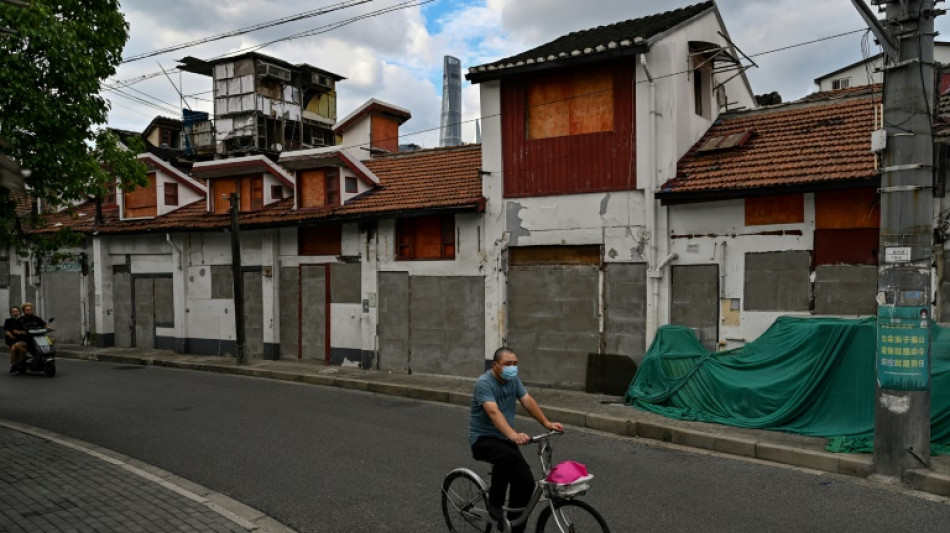
Bricked-up doorways, crumbling facades and a small group of defiant locals: one of Shanghai's oldest neighbourhoods is barely clinging to life as the city presses ahead with demolition and redevelopment plans.
Laoximen or "old West Gate" -- named for its position in Shanghai's 16th-century defensive walls -- was once the city's cultural centre.
Built around the site of a Confucian temple, the mostly two- and three-storey buildings of stone and wood are an anachronism at the heart of Shanghai's gleaming commercial district.
Thousands of residents -- a mix of old Shanghai families and migrant workers drawn to the low rent -- were ordered to leave their homes at the end of 2017, though some have clung to the ageing buildings for years after the deadline.
Yang, who declined to give his full name, is one of the last residents who has resisted compensation from the government and held onto his home in Laoximen, a damp labyrinth of long corridors stacked with old furniture and household appliances.
"This piece of land was bought by my grandfather," Yang, whose family has lived in the area since before the Communist Party took power in 1949, told AFP.
Most of his neighbours have agreed to leave, but Yang is holding out for what he says is compensation that would match "the value of the house".
- Compensation -
According to the local government, Laoximen residents can receive as much as 20,000 yuan ($2,962) per square metre, with bonus payments for moving out early.
But the average pre-owned apartment in Shanghai currently costs more than 55,000 yuan per square metre, according to property company Anjuke.
The final demolition was apparently delayed by the pandemic, but diggers have resumed their work after Shanghai emerged from lockdown earlier this year.
Where locals once dined at popular restaurants, large red-and-white signs on the walls urge cooperation with redevelopment plans.
"Open, fair and just: promote the renovation of the old city," one reads.
Doors and windows have been sealed with cement blocks in the winding streets, pockmarked with piles of old chairs, boards and doors.
A short walk from Shanghai's swanky Bund riverside, Laoximen is one of thousands of ageing neighbourhoods in China where residents have been relocated and the land has been taken back by the government in the name of redevelopment and progress.
Many of the homes in the neighbourhood predated modern building standards, and lack heating or central plumbing.
Residents are typically offered new apartments or a sum of money to give up their homes, though some redevelopment projects have caused public anger and violent confrontations in parts of the country.
Replacing Laoximen's once densely packed alleyways with larger, higher-end developments could also help the city achieve its goal of capping its population at 25 million by 2035.
Authorities announced the goal in 2017 as part of a campaign to curb "big city diseases" including congestion and housing shortages.
- 'Public interest' -
Wu Weigang, a retiree who grew up in the area with his extended family, has especially fond memories of celebrating Chinese New Year in Laoximen as a child.
"Everyone set off fireworks and hung up rabbit-shaped lanterns during the lantern festival," he said.
Wu, who now lives two hours away in a temporary apartment in Qingpu district, occasionally returns to Laoximen to revisit his old haunts and check in with neighbours.
Most of the buildings in Laoximen were built in the 20th century in the "shikumen" style of rowhouses arranged along branching lanes.
Antique dealers have been waiting outside family homes to buy up heirlooms in recent months, as families clear out their last belongings.
When night falls, the yellow glow of the streetlights envelops the enclave's near-empty alleys, while the Oriental Pearl Tower glows in the distance.
Shanghai authorities say the area will be redeveloped to meet "the needs of public interest."
Wu hopes some of the old neighborhood's charm will survive the redevelopment intact.
"They told me my home was being preserved," Wu told AFP. "If it weren't here, I wouldn't come to see it, otherwise I would be so sad."
A.AlHaj--SF-PST