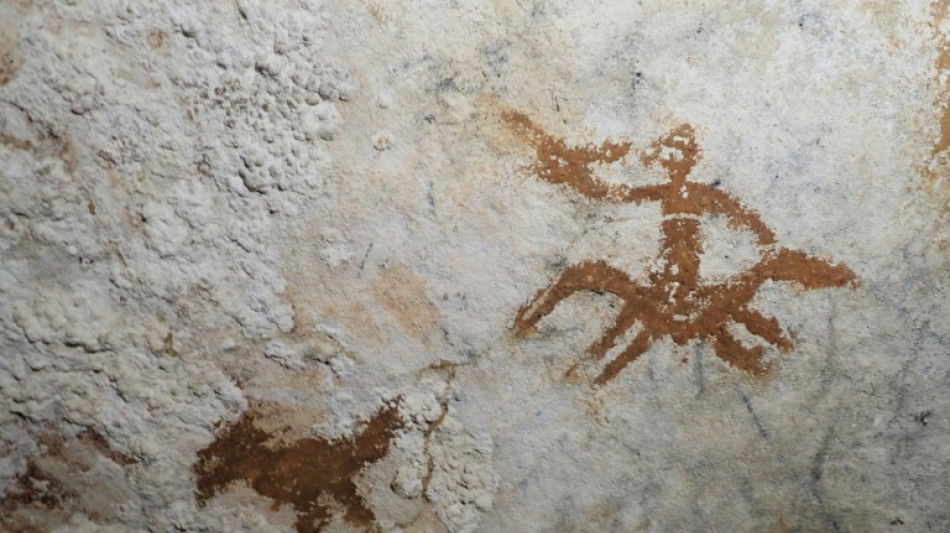
World's oldest cave art discovered in Indonesia / Photo: Maxime AUBERT - GRIFFITH UNIVERSITY/AFP

 The British historian helping the French rediscover de Gaulle

 Dodgers beat Braves to advance, Guardians survive in MLB playoffs

 Latin American, Caribbean women top Nobel literature buzz

 US says Fiji-based Chinese official paid bribes for Beijing

 After botched US execution, Christa Pike was nearly taken off life support

 Guinea-Bissau junta urges military unit loyal to ex-president to disarm

 As species decline, green turtles offer glimmer of hope

 Brothers Scott and Beauden Barrett named to start for All Blacks

 EU trade chief seeks to dial down China tensions

 'Never again Bolsonaro': thousands march ahead of Brazil election runoff

 After botched execution, US woman was nearly taken off life support before revival

 Searing AIDS drama 'Elsinore' opens London film festival

 Evicted pensioner who sparked Spain housing protests dies: tenant union

 Golf star Rahm quitting LIV tour over 'unacceptable' terms

 Thousands march fearing return of a Bolsonaro presidency in Brazil

 French PM denies police ordered to confront student protesters

 Rubio touts US power, calls on Europe to emerge from 'slumber'

 Trump says 'we don't think' Russian plague is bio-weapon

 Five children among 26 killed in Ukraine after Russian strikes

 Man City should 'accept' punishment for rule breaches, says Lineker

 US woman who survived botched execution is awake and speaking

 From 1800s to modern pharma: a Nobel-winning chemistry quest

 Southampton boss Eckert given suspended ban over 'Spygate'

 Russia warns of 'false' information as second plague case reported

 IEA ready to release more oil reserves if necessary

A red stencil of a hand pressed against the wall of an Indonesian cave is the oldest rock art ever discovered, scientists said Wednesday, and sheds light on how humans first migrated to Australia.
The cave art dates back at least 67,800 years, according to research published in the journal Nature by a team of Indonesian and Australian archaeologists.
"We have been working in Indonesia for a long time," study co-author Maxime Aubert of Australia's Griffith University told AFP.
This time they ventured to caves on the island of Muna in the Sulawesi province on the advice of Indonesian archaeologist Adhi Agus Oktaviana, the study's lead author.
There they found "handprints in negative, stencilled, probably using red ochre," Aubert said.
The fingers of one of the hands were "retouched to become pointed like claws -- a style of painting only seen in Sulawesi," the Canadian archaeologist added.
To determine the art's age, the team took five-millimetre samples from "cave popcorn", which are small clusters of calcite that form on the walls of limestone caves.
Then they zapped the layers of rock with a laser to measure how the uranium decayed over time, compared to a more stable radioactive element called thorium.
This "very precise" technique gave the scientists a clear minimum age for the painting, Aubert explained.
At 67,800 years old, the Indonesian stencil is more than a thousand years older than other hand stencils found in a Spanish cave which has been attributed to Neanderthals. However the dating of that cave art "has been controversial," the study cautioned.
The new discovery is also more than 15,000 years older than previous art found in the Sulawesi region by the same team.
The scientists also established that the Muna caves had been used for rock art many times over a long period.
Some of the ancient art was even painted over up to 35,000 later, Aubert said.
- A fork in the road -
Beyond setting a new record, the art also offers clues for a long-running historical mystery.
Scientists have been divided about how Homo sapiens first journeyed from Asia to Australia.
They could have taken the northern route, travelling by boat through Indonesia islands including Sulawesi to Papua New Guinea.
These ancient humans could then have walked the rest of the way -- at the time, Papua New Guinea and Australia were both part of a supercontinent called Sahul.
Or the migrants could have taken the southern route, travelling through the islands of Sumatra, Java and Bali before heading for Timor. Then a boat ride was required to finally make it to Australia.
"These paintings provide the first evidence that modern humans were on these Indonesian islands at that time," Aubert said.
The discovery also "reinforces the idea that people arrived in Australia via Papua, perhaps around 65,000 years ago", he said.
But it could not be ruled that other people were also making their way to Australia via the southern route at the same time, he added.
The researchers also said that the paintings were very likely created by people closely linked to the ancestors of Indigenous Australians.
R.Halabi--SF-PST