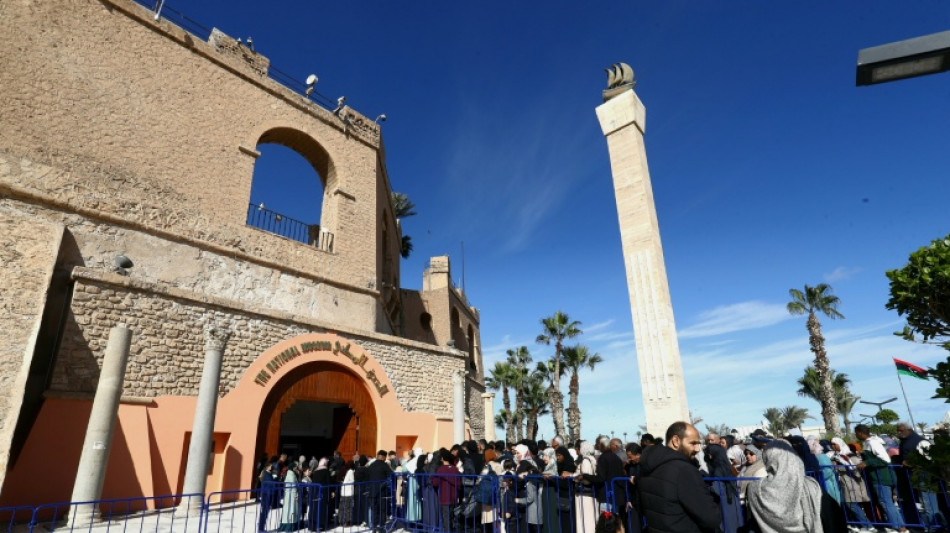
Libyans savour shared heritage at reopened national museum / Photo: Mahmud Turkia - AFP

 Dodgers beat Braves to advance in MLB playoffs, Rays oust Yankees

 'A sun as black as my lungs': how corruption crucified a polluted Albania city

 The British historian helping the French rediscover de Gaulle
 Dodgers beat Braves to advance, Guardians survive in MLB playoffs

 Latin American, Caribbean women top Nobel literature buzz
 US says Fiji-based Chinese official paid bribes for Beijing
 After botched US execution, Christa Pike was nearly taken off life support

 Guinea-Bissau junta urges military unit loyal to ex-president to disarm
 As species decline, green turtles offer glimmer of hope
 Brothers Scott and Beauden Barrett named to start for All Blacks
 EU trade chief seeks to dial down China tensions

 'Never again Bolsonaro': thousands march ahead of Brazil election runoff

 After botched execution, US woman was nearly taken off life support before revival
 Searing AIDS drama 'Elsinore' opens London film festival

 Evicted pensioner who sparked Spain housing protests dies: tenant union
 Golf star Rahm quitting LIV tour over 'unacceptable' terms
 Thousands march fearing return of a Bolsonaro presidency in Brazil
 French PM denies police ordered to confront student protesters

 Rubio touts US power, calls on Europe to emerge from 'slumber'
 Trump says 'we don't think' Russian plague is bio-weapon
 Five children among 26 killed in Ukraine after Russian strikes

 Man City should 'accept' punishment for rule breaches, says Lineker
 US woman who survived botched execution is awake and speaking
 From 1800s to modern pharma: a Nobel-winning chemistry quest

 Southampton boss Eckert given suspended ban over 'Spygate'
In a historic building in central Tripoli, Libyans wander past ancient statues and artefacts, rediscovering a heritage that transcends political divides at their national museum which reopened this month after a 2011 uprising.
"I got here barely 15 minutes ago but I already feel like I've been transported somewhere. It's a different world," said architecture student Nirmine Miladi, 22.
In the waterfront building known as the red citadel -- once the seat of power -- visitors journey through a history that includes ancient art, Greek and Roman antiquities and Ottoman-era weapons and jewellery.
Miladi's sister Aya, 26, an interior design student, said she liked the bright new museum's layout, "the careful lighting, the screens and interactive tools" that all help make the museum accessible to all.
Libya plunged into chaos after a NATO-backed uprising toppled and killed longtime leader Moamer Kadhafi in 2011, and the country has struggled to regain stability.
Since then, the North African country has been divided, with two rival executives vying for power: a Tripoli-based government of national unity and an administration based in Benghazi in the country's east.
Mohamed Fakroun, head of international cooperation at the antiquities department, said the museum went through "a dark period during its 14-year closure".
Fearing looting and vandalism after Kadhafi's overthrow, the antiquities department removed "all the artefacts until the country re-stabilised", said Fakroun, 63, who has worked at the French archaeological mission to Libya for almost four decades.
- 'National symbol' -
Curator Fathiya Abdallah Ahmad is among a handful of people who knew the location of secret, sealed rooms where the museum's treasures were taken into hiding for more than a decade.
She said the antiquities department and staff worked to "preserve a historic and cultural heritage that belongs to all Libyans".
This allowed the works to be safeguarded until the museum could reopen "in a modern format that conforms to international standards", she added.
The bright new facility includes digital projections and interactive screens as well as videos, audio guides and QR codes enabling visitors to delve further.
Fakroun noted the museum has a room dedicated to Roman emperor Septimius Severus, who was born in the ancient city of Leptis Magna -- now a UNESCO World Heritage site east of Tripoli.
Another room is dedicated to stolen items that have since been returned, including from the United States and the United Kingdom, he added.
Interior design student Aya Miladi said many Libyans saw the museum's inauguration as the "return of a national symbol".
It is also "a step towards reconciliation between Libyans and with their often little-known past", after years of war, as well as a sign of stability, she added.
- 'Not without past' -
Teacher Fatima al-Faqi, 48, said there was "a world of difference" between the reopened museum and the dark, dusty facility she visited 30 years ago on a school trip.
This time, she was leading a group of high-school students to help them "discover Libya's history and nourish their sense of patriotism", she said, as pupils goggled at items from naked Roman statues to stuffed animals in the natural history section.
The Tripoli government has invested more than five million dollars in rehabilitating the museum and its surrounding area, despite the oil-rich country's economic woes including frequent cash and fuel shortages.
Fakroun said the six-year renovations were carried out in cooperation with the French mission and the ALIPH foundation -- the International Alliance for the Protection of Heritage.
The museum seeks to convey a hope-filled message about Libya's identity to its visitors, most of whom "were not born when it was last open before 2011", he added.
Visitor Sarah al-Motamid, 34, said that "many people don't know about our country's ancient history and look at us as if we were worthless".
She said she was visiting with her six-year-old daughter Mariam because she wanted her to "understand that we are not without a past or civilisation".
Q.Najjar--SF-PST