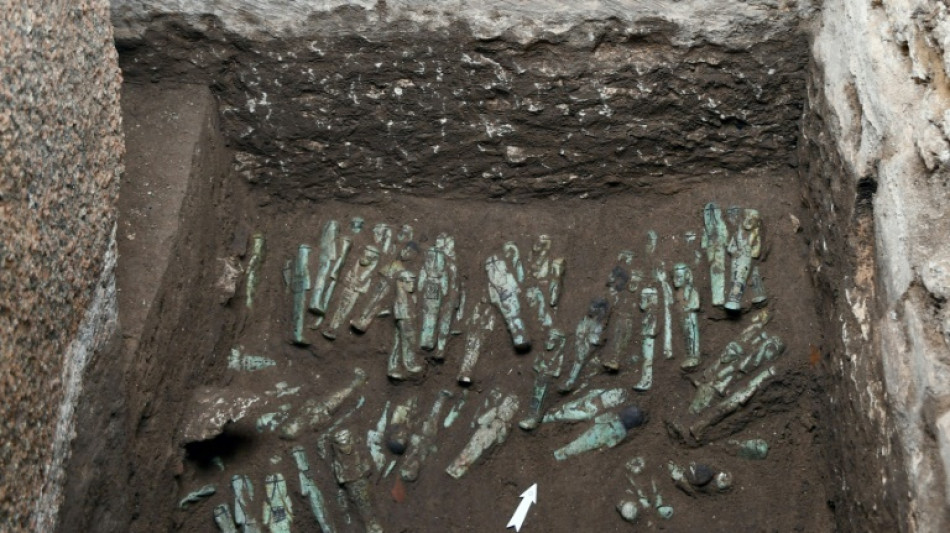
'Amazing' figurines find in Egyptian tomb solves mystery / Photo: Simone NANNUCCI - MFFT - EPHE/PSL/AFP

 فاطمة بوش ترفع شعار 'ليحيا المسيح الملك' في ختام ملكة جمال الكون

 أين الأمن القومي العربي؟.. تحليل نقدي لغياب الرؤية المشتركة

 Crude Oil Prices Rise on Reports of Houthi Attack on Saudi Refinery

 El Nino’s Weakening Grip on Tamil Nadu Rainfall Hinges on Potential Cyclone

 Black Friday Discounts Cut Prices on Two Top-Rated Wiper Blades

 Twickenham Grounds Team Prepares Pitch for Six Matches in Three Days

 Luxembourg City Plans €13 Million Abrigado Centre for 2029

 Two A1 Crashes Create Kilometres of Rush-Hour Congestion

 South Africa Places 36 Hospitals on Standby for Possible Imported Ebola Cases

 Tamil Nadu Secures Rs 58,214 Crore in Investments at Vettri Conclave

 فرنسا تدعو لتجريم "الفصل العنصري القائم على الجنس" دولياً
A treasure trove of 225 funerary figurines have been discovered inside a tomb in the ancient Egyptian capital of Tanis in the Nile Delta, a rare find that has also solved a long-running mystery.
"Finding figurines in place inside a royal tomb has not happened in the Tanis necropolis since 1946," French egyptologist Frederic Payraudeau told reporters in Paris on Friday.
Such a find has also never happened before further south in Egypt's Valley of the Kings near modern Luxor -- apart from the tomb of the famous boy king Tutankhamun in 1922 -- because most such sites have been looted throughout history, he added.
Payraudeau, who leads the French Tanis excavation mission, said the remarkable discovery was made on the morning of October 9.
The team had already excavated the other three corners of a narrow tomb occupied by an imposing, unnamed sarcophagus.
"When we saw three or four figurines together, we knew right away it was going to be amazing," Payraudeau said.
"I ran out to tell my colleagues and the officials. After that it was a real struggle. It was the day before the weekend -- normally, we stop at 2 pm. We thought: 'This is not possible.'"
The team then set up lights to work through the night.
It took 10 days to carefully extract all of the 225 small green figurines.
They were "carefully arranged in a star shape around the sides of a trapezoidal pit and in horizontal rows at the bottom," Payraudeau said.
The funerary figurines, which are known as ushabti, were intended as servants to accompany the dead into the afterlife.
More than half the figurines are women, which is "quite exceptional", Payraudeau said.
Located in the Nile Delta, Tanis was founded around 1050 BC as the capital of the Egyptian kingdom during the 21st dynasty.
At the time, the Valley of the Kings -- which had been looted during the reign of pharaohs including Ramses -- was abandoned and the royal necropolis was moved to Tanis, Payraudeau said.
- One mystery leads to another -
The royal symbol on the newly discovered figurines also solves a long-standing mystery by identifying who was buried in the sarcophagus.
It was pharaoh Shoshenq III, who reigned from 830 to 791 BC.
This was "astonishing" because the walls of a different tomb at the site -- and the largest sarcophagus there -- bear his name, Payraudeau said.
"Why isn't he buried in this tomb?" the expert asked.
"Obviously, for a pharaoh, building a tomb is a gamble because you can never be sure your successor will bury you there," he said.
"Clearly, we have new proof that these gambles are not always successful," Payraudeau said with a smile.
Shoshenq III's four-decade reign was turbulent, marred by a "very bloody civil war between upper and lower Egypt, with several pharaohs fighting for power," he said.
So it is possible that the royal succession did not go as planned and the pharaoh was not buried in his chosen tomb.
Another possibility is that his remains were moved later due to looting.
But it is "difficult to imagine that a 3.5 by 1.5 metre granite sarcophagus could have been reinstalled in such a small place," Payraudeau said.
After the figurines are studied, they will be displayed in an Egyptian museum, Payraudeau said.
A.AbuSaada--SF-PST

