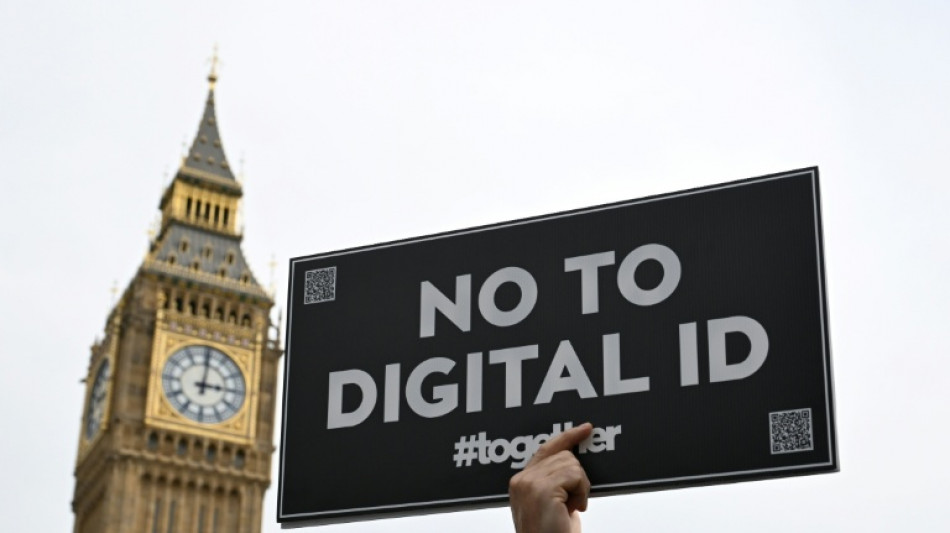
UK far-right figures stoke digital ID fears with unproven claims / Photo: Chris J Ratcliffe - AFP/File

 Morikawa says LIV players face 'business decision' after Rahm exit

 Tenzing Norgay's son says Himalayas sending climate warning

 On your bike! Bottas opts for two wheels to reach Singapore GP

 Alcaraz, Sinner, Osaka commit to Australian Open '1 Point Slam'

 Dodgers beat Braves to advance in MLB playoffs, Rays oust Yankees

 'A sun as black as my lungs': how corruption crucified a polluted Albania city

 The British historian helping the French rediscover de Gaulle

 Dodgers beat Braves to advance, Guardians survive in MLB playoffs

 Latin American, Caribbean women top Nobel literature buzz
 US says Fiji-based Chinese official paid bribes for Beijing

 After botched US execution, Christa Pike was nearly taken off life support

 Guinea-Bissau junta urges military unit loyal to ex-president to disarm

 As species decline, green turtles offer glimmer of hope

 Brothers Scott and Beauden Barrett named to start for All Blacks

 EU trade chief seeks to dial down China tensions

 'Never again Bolsonaro': thousands march ahead of Brazil election runoff

 After botched execution, US woman was nearly taken off life support before revival

 Searing AIDS drama 'Elsinore' opens London film festival

 Evicted pensioner who sparked Spain housing protests dies: tenant union

 Golf star Rahm quitting LIV tour over 'unacceptable' terms
 Thousands march fearing return of a Bolsonaro presidency in Brazil
 French PM denies police ordered to confront student protesters
 Rubio touts US power, calls on Europe to emerge from 'slumber'

 Trump says 'we don't think' Russian plague is bio-weapon

 Five children among 26 killed in Ukraine after Russian strikes

Plans for a new nationwide UK digital ID are sparking widespread public concern, but some critics including far-right politicians are fuelling fears with unproven claims that it will be used to boost government control over people's lives.
They warn that digital ID will be used to store data on vaccinations and carbon footprint and limit access to flying and food, which the government has vehemently denied.
British Prime Minister Keir Starmer in September said the ID card would be introduced by 2029. The government has said it will not be mandatory but will be required to prove the right to work.
Nigel Farage, the leader of anti-immigration party Reform, claimed on TV channel GB News that medical data would soon be added and those unvaccinated would be treated as "second-class citizens".
"Step out of line, say something they don't like and they will switch you off: no travel, no car, no spending, no life," said Renee Hoenderkamp, a doctor and commentator on GB News, a right-wing television channel.
A British government spokesperson told AFP: "None of these claims have any factual basis. We have been clear: digital ID will not be compulsory, and it will not be a crime not to have one."
"Digital ID will give people more control over how their data is used and ensure everyone can access the public services they need," the government spokesperson said.
But the plan is highly controversial in the UK -- one of the few European countries without any ID card and where the idea has long been resisted -- and the main opposition parties are against it.
Public support for digital ID fell after Starmer's announcement. Think tank More in Common in late September found 45 percent opposed it and 31 percent backed it, down from 53 percent support in late 2024.
Nearly three million people have signed a petition against the plan, triggering a debate in parliament's Westminster Hall on December 8.
"It is certainly not a fringe issue. This is a mainstream political issue with concerns shared by people in the highest echelons of politics," said Silkie Carlo, director of Big Brother Watch advocacy group, who addressed MPs about civil liberty fears.
Ryan Wain, executive director of politics and policy at the Tony Blair Institute think tank, told AFP the government needs to "make a broader case" for digital ID, which Blair has long backed.
"Otherwise, a vacuum is left", Wain said, adding this is filled by people "whose default is to think the worst of the best intentions".
- 'It will be like China' -
TikTok creators have posted AI-generated videos of huge demonstrations against digital ID in central London, racking up millions of views, although actual street protests have been relatively small.
Some opponents previously campaigned against public health restrictions and link digital ID to those measures.
A popular post showed an image of Chinese kindergarten pupils lined up with QR codes to take Covid tests in 2022, with the caption: "What happens when you say no?"
David Icke, a prominent British conspiracy theorist who dismissed Covid as a "hoax", took part in a march against digital ID in London in October.
Hundreds participated in the march whose organiser, law student Fiona Hine, was previously arrested at anti-lockdown demonstrations.
"This is entirely about freedom and freedom of choice: nothing should be imposed on us," Hine told AFP.
Digital ID was a topic during past anti-lockdown rallies, with protesters "talking about how it will be like China" and a "sign of an authoritarian state", said Ozge Ozduzen, a lecturer in digital media at Sheffield University.
Repeating popular conspiratorial tropes, Hine claimed digital ID is planned by an international "elite" -- including Blair and Klaus Schwab, the founder of the World Economic Forum -- who want people to be "robots and worker bees for the government".
N.Shalabi--SF-PST