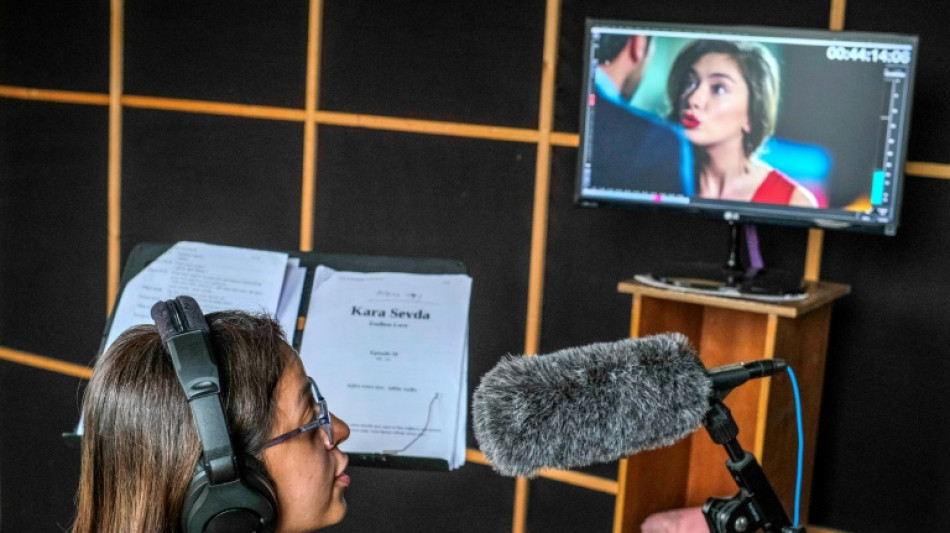
TV soaps and diplomacy as Bangladesh and Turkey grow closer / Photo: Syed Mahamudur RAHMAN - AFP

 فاطمة بوش ترفع شعار 'ليحيا المسيح الملك' في ختام ملكة جمال الكون

 أين الأمن القومي العربي؟.. تحليل نقدي لغياب الرؤية المشتركة

 Crude Oil Prices Rise on Reports of Houthi Attack on Saudi Refinery

 El Nino’s Weakening Grip on Tamil Nadu Rainfall Hinges on Potential Cyclone

 Black Friday Discounts Cut Prices on Two Top-Rated Wiper Blades

 Twickenham Grounds Team Prepares Pitch for Six Matches in Three Days

 Luxembourg City Plans €13 Million Abrigado Centre for 2029

 Two A1 Crashes Create Kilometres of Rush-Hour Congestion

 South Africa Places 36 Hospitals on Standby for Possible Imported Ebola Cases

 Tamil Nadu Secures Rs 58,214 Crore in Investments at Vettri Conclave

 فرنسا تدعو لتجريم "الفصل العنصري القائم على الجنس" دولياً
In a recording studio in Dhaka, voiceover artist Rubaiya Matin Gity dubs the latest Turkish soap opera to become a megahit in Bangladesh -- a pop-culture trend that reflects growing ties between the two countries.
"Yasmeen! Yasmeen! I have fallen in love..." the 32-year-old actor cried in Bangla, her eyes fixed on the screen playing new episodes of Turkish drama "Kara Sevda", or "Endless Love", which has captivated millions of viewers in the South Asian nation.
The success of Turkish shows, challenging the once-unrivalled popularity of Indian television dramas, is the sign of a change that extends far beyond Bangladeshi screens.
It mirrors shifting alliances and expanding diplomatic, trade and defence relations between the two Muslim-majority nations, 5,000 kilometres (3,000 miles) apart.
More Turkish restaurants are opening in Bangladesh and there is a general interest in learning the language, coupled with rekindled warmth between the two governments, set against increasingly fractious relations between Dhaka and New Delhi.
An interim government has led Bangladesh since an uprising last year toppled the autocratic rule of Sheikh Hasina -- who fled to old ally India, where she has resisted extradition, turning relations between the two neighbours icy.
- 'New opportunities' -
Ties between Ankara and Dhaka have not always been smooth, but they "are growing stronger now," said Md Anwarul Azim, professor of international relations at the University of Dhaka.
"The relationship faltered twice," he said, first in 1971 when Bangladesh separated from Pakistan, and then in 2013, when Dhaka hanged men accused of war crimes during the independence struggle.
Bilateral trade remains modest, but Azim noted that Turkey offers Bangladesh an alternative to its reliance on China as its main weapons supplier.
Ankara's defence industry boss Haluk Gorgun visited Dhaka in July, and Bangladesh's army chief General Waker-Uz-Zaman is expected in Turkey later this month to discuss production of military equipment.
Bangladesh has also shown interest in Turkish drones, technology Ankara has reportedly supplied to Pakistan, India's arch-enemy.
Dhaka's interim leader, Nobel Peace Prize winner Muhammad Yunus, said he was "focused on further deepening" ties with Ankara, after meeting a Turkish parliamentary delegation this month.
"Bangladesh stands ready to work hand in hand with Turkiye to unlock new opportunities for our people," Yunus said.
- Classes, clothes and horses -
Alongside formal ties, cultural links are also deepening.
Ezaz Uddin Ahmed, 47, head of programming at the channel that pioneered Turkish dramas in Bangladesh, said that Deepto TV has "a dedicated team of translators, scriptwriters, voice artists and editors" working to meet the growing demand.
Its breakout hit came in 2017 with a historical epic that eclipsed Indian serials and "surpassed all others" in terms of popularity, Ahmed said.
Riding on that success, Deepto TV and other Bangladeshi broadcasters snapped up more Turkish imports -- from Ottoman sagas to contemporary family dramas.
Interest in the Turkish language has followed suit, with several leading institutions now offering courses.
"I have 20 students in a single batch," said Sheikh Abdul Kader, a trainer and economics lecturer at Jagannath University. "There is growing demand."
For some, the love for all things Turkish doesn't end there.
Business owner Tahiya Islam, 33, has launched a Turkish-themed clothing line, and inspired by Ottoman traditions, even took up horseback riding.
"During the Ottoman era, couples used to go out on horseback," she said. "Now, my husband rides too -- and I even have my own horse."
D.AbuRida--SF-PST

