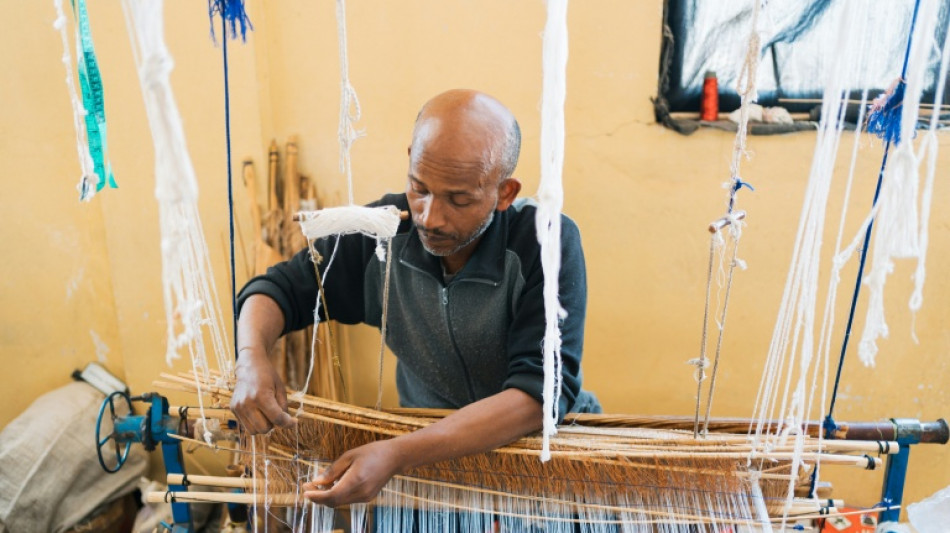
Ethiopia's weavers struggle to keep garment tradition alive / Photo: Sehin Tewabe - AFP

 WhiteBIT Launches Bitcoin Lightning Network Support, Powered by Voltage

 Oil surges, stocks sink as US reportedly eyes fresh Iran strikes

 Anne Carson: modern takes on Greek classics

 Canada's Anne Carson wins Nobel literature prize

 Ethiopia drones hit Eritrean troops in Tigray

 Russian strike on buses kills 30 in frontline Ukrainian city

 Thailand begins extradition process against Chinese journalist

 Quarantine, unease and rumours: Russian city grapples with plague scare

 Taiwan says exports hit record in September on AI demand

 Marc Marquez vows to 'attack' Martin's lead at Indonesian MotoGP

 Diplomats, schools in Saudi take safety measures after blasts heard: sources to AFP

 In Beijing, EU trade envoy says deficit with China 'unsustainable'

 Sri Lanka's de Silva quits as Test captain

 Alcaraz feeling 'mentally fresh' ahead of Shanghai return

 Israel drastically reduces British diplomatic presence in Jerusalem
 Stocks fall further as oil surge fans fresh inflation worries

 North Korea demands South show 'utmost respect' to restore relations

 Saudi says three dead in airport attacks claimed by Houthis

 'Mad dream': New showcase for African film opens in London

 All Blacks coach Rennie says Wallabies exit 'part of the game'

 The growing protests against India's poll body - and PM Modi

 Stocks fall further as oil spike fans fresh inflation worries
 Bad COP, worse COP? EU tempers hopes for UN climate summit

 Rookie Henry named in Wallabies midfield to face All Blacks
 Housing crisis set to dominate Spain's snap election

Behind the looms of a workshop in the heart of Addis Ababa, dozens of weavers deftly repeat the same motions to craft traditional dresses -- a centuries-old skill now threatened by Ethiopia's economic hardships.
For generations, the "habesha kemis" -- long white cotton dresses often adorned with colourful embroidery -- have been handwoven. Their elaborate designs serve as attire for festivities and religious ceremonies.
It takes a week to weave the simplest dresses, and twice as long for those adorned with intricate embroidery -- a meticulous, painstaking craft, several artisans say in a workshop where the steady clink of looms fills the air.
"The work is exhausting... we live day by day," said Asefaw Yemu, 45, a weaver with three decades of experience who earns between 10,000 and 15,000 birr ($68–102) a month, before deducting the cost of raw materials.
In the dimly lit room, men hunch over their looms, shuttling cotton threads back and forth as their feet work a complex pedal system that never seems to rest.
Asefaw said he works nine hours a day, six days a week -- but with inflation hovering around 21.5 percent this year, according to the International Monetary Fund, demand has slowed sharply.
- 'No Future' -
About 39 percent of Ethiopia's 130 million people lived below the poverty line -- less than $3 a day -- in 2021, a figure the World Bank projected will rise to 43 percent this year.
At the same workshop, Getu Derza, 48, carefully embroiders colourful silk threads into intricate patterns.
"What we produce with so much effort can now be made instantly by machines in factories... It affects our income," said Derza, who began the craft at the age of 14.
An influx of cheaper machine-made habesha kemis from China years ago undercut Ethiopia's traditional weavers. Government restrictions came too late for many, who had already turned to other jobs.
In this struggling economy, Derza said what was once a skill passed down from generation to generation now "ends with us".
At 23, Abush Dubule, the youngest among the weavers, is already considering a career change
"There's no future," he said. "The economy isn't what it used to be... it's not just Chinese products. People are buying less overall."
- 'Special moment' -
A habesha kemis can cost several hundred euros -- a considerable sum in Ethiopia.
Belhu Belta, 48, runs a small shop selling traditional dresses and scarves.
He said he struggles to attract customers but stays in business, hoping there are still those who value handmade garments.
"If the market continues like this, the craft might disappear," Belhu said.
Adanech Daniel, 50, was shopping for a wedding dress and refused to compromise on quality -- representing the kind of customer who keeps Belta optimistic.
"When you wear these traditional clothes together as a family or couple, it brings vibrance and joy to the occasion," she said.
"It's beautiful, it shines and makes the moment special."
H.Nasr--SF-PST