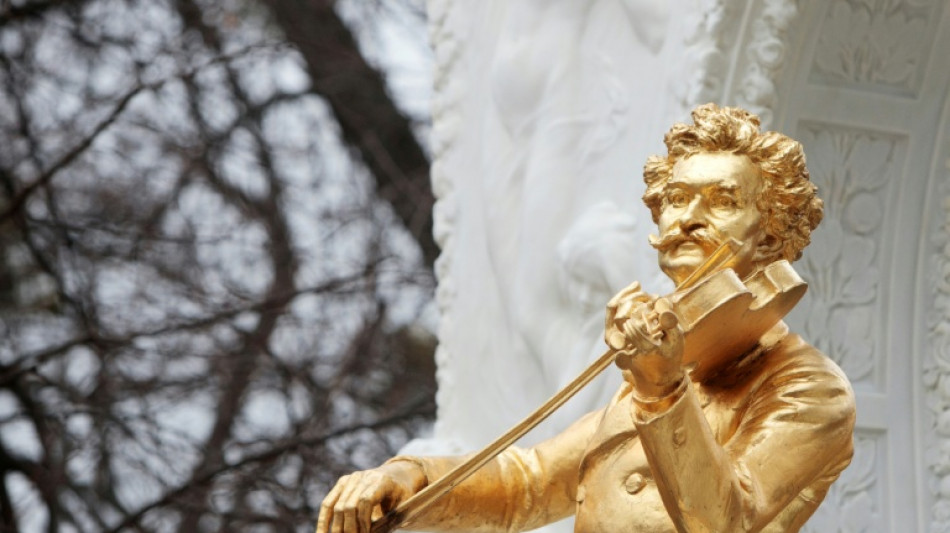
Vienna calling: Strauss's 'The Blue Danube' to waltz into outer space / Photo: Alex HALADA - AFP

 Ms. Rachel Says Celebrity Silence on Gaza Is 'F--ked Up' and Drives Her to Swear

 Maryland Regulators and Air Force Clash Over Jet Fuel Spill Cleanup and Golf Course Exemption

 Bishop Museum Races to Save Rare Megamouth Shark Specimen

 Musk Questions AI Development Viability as SpaceX Leasing Revenue Surges

 مصطفى معروفي ينشر قصيدة 'أصوغ كلامي أهتدي بتجاربي'

 Luxembourg Housing Petition Passes Threshold for Parliamentary Consideration

 Raheem Sterling Receives Suspended Sentence After Lamborghini Crash

 Audience to Choose the Set List at Luxembourg's First FAMIL Jukebox Night

 Luxembourg Pay Rise Delayed as Regional and World Headlines Develop

 مواجهة في البرازيل بين نشطاء وفلسطينيين وسياح إسرائيليين حول جدارية مؤيدة

 رئيس جامعة القدس يستعرض نموذج الشراكة بين التعليم العالي والصناعة في قمة QS بأبوظبي
Austrian composer Johann Strauss II's "The Blue Danube" has, for many people, been synonymous with space travel since it was used in Stanley Kubrick's 1968 sci-fi film classic "2001: A Space Odyssey".
But the world famous waltz will truly travel among the stars on Saturday, when the European Space Agency's (ESA) antenna will broadcast a live performance of it into space to celebrate the composer's 200th birthday.
The Vienna Symphony Orchestra will play a concert in the Austrian capital from 1930 GMT, Josef Aschbacher, ESA's director general, told AFP.
The concert will be broadcast live on the internet and also be shown at a public screening in Vienna, in New York at Bryant Park, and near the antenna in Spain.
"The digitised sound will be transmitted to the large 35-metre satellite dish at ESA's Cebreros ground station in Spain," Aschbacher said.
And from there, the waltz will be "transmitted in the form of electromagnetic waves", the Austrian astronomer explained.
- 'Typical of space' -
Like no other waltz by Strauss junior, "The Blue Danube" evokes the elegance of 19th-century imperial Vienna, which lives on in the city's roaring ball season.
For Norbert Kettner, director of the Vienna tourist board, the Danube waltz is a "true unofficial space anthem" because of Kubrick.
The timeless waltz is the "typical sound of space", Kettner said, with the tunes being played "during various docking manoeuvres of the International Space Station (ISS)".
When the waltz is performed on Saturday, the Vienna Symphony Orchestra will make sure to underline the waltz's airiness as if it were floating through space, its director Jan Nast said.
According to Nast, who put together the programme for Saturday's hour-long "interstellar concert", music is a language "which touches many people" and has "the universal power to convey hope and joy".
- Filling a gap -
Once transmitted via Spain's satellite dish, the signal will travel at the speed of light to eventually reach NASA's Voyager 1 spacecraft -- the most distant man-made object in the universe -- in approximately 23 hours and 3 minutes.
After surpassing Voyager 1, it will continue its interstellar journey.
By catching up with the spacecraft and its twin, Voyager 2, Austria also seeks to right a perceived wrong.
Both Voyagers carry "Golden Records" -- 12-inch, gold-plated copper disks intended to convey the story of our world to extraterrestrials.
The record holds 115 images of life on Earth, recorded in analogue form, and a variety of sounds and snatches of music.
While "The Magic Flute" by Austria's composer Wolfgang Amadeus Mozart was included among the selection of 27 music pieces, Strauss's famous waltz was not.
Y.Zaher--SF-PST

