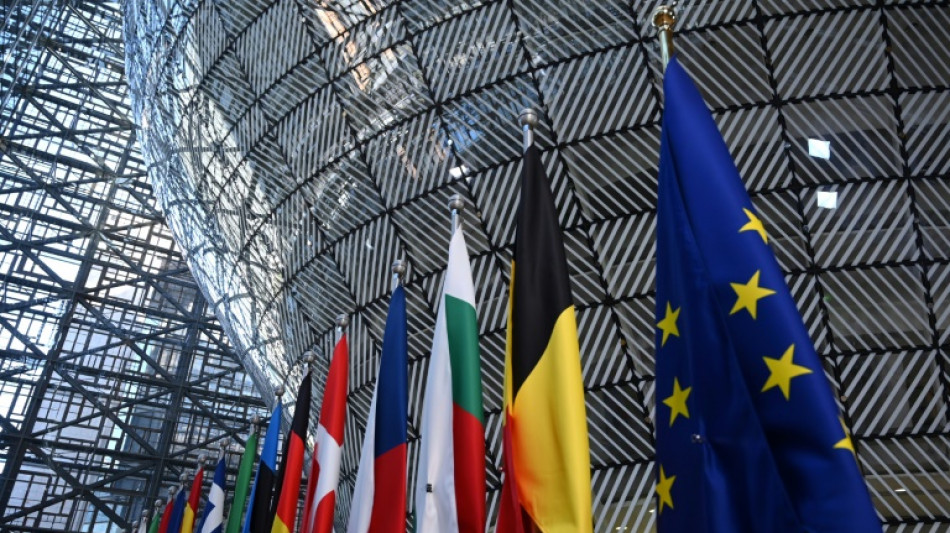
Spain's EU partners punt on Catalan language push / Photo: EMMANUEL DUNAND - AFP/File

 Trump rules out new Iran attack before US midterm elections

 Far-right influencer shows Israel's coarse political turn
 Seals and sea lions get hearing tested at Australia zoo

 Mourinho's Real Madrid playing catch-up in Clasico countdown
 Joy as USS Lincoln back home after troubled Gulf deployment
 OpenAI says Iran, Russia influence ops busted

 Anthropic bans 'cruel' behavior against its Claude AI

 Anne Carson's Nobel literature prize 'a proud moment for Canada': PM

 Montagliani to seek CONCACAF re-election in boost for Infantino: reports

 Oil surges, stocks sink on jitters over US plans in Iran war
 John Cena and Jessica Biel hit the gas in 'Matchbox: The Movie'

 US, Ukrainians, Europeans to discuss 'new ideas' to end war
 Unproven 'cures' pushed online amid plague concerns

 Nigeria looks to ease fuel prices as election looms
 Prosecutors in Maradona death trial seek sentences up to 12 years

 Swiss captain Xhaka gets suspended fine for fake Covid cert

 Ex-prince Andrew raid warrants ruled 'unlawful' but UK police maintain probe

 Two Latvians arrested inside UK military base: police

 Eckert 'forever grateful' for Southampton support over spy scandal
 Venezuela's Maduro, wife hit with new US torture charges

 Argentina friendlies no fairy tale for African footballers

 US suspending Microsoft from visa program: Vance

 Man City must 'stick together' during crisis, says Haaland

 CAS opens hearing into Senegal AFCON title appeal

 UK police agree searches for ex-prince Andrew's homes 'unlawful': judge
Spain has revived a push for Basque, Catalan and Galician to be made official EU languages, despite a less-than-enthusiastic response from fellow European countries fearing a domino effect.
After an unsuccessful bid in 2023, Madrid brought its regional language campaign back to Brussels this week, managing to get it onto the agenda of a meeting of European ministers on Tuesday.
No decision was made -- and the question was punted to a later date for lack of consensus, according to an EU diplomat -- but the awkwardness was palpable as ministers tip-toed around the issue in comments to reporters.
For context, the socialist government of prime minister Pedro Sanchez depends on support from Catalan lawmakers to get most of its legislation through the Spanish parliament.
Spain has generated "big pressure" around the issue, said a second diplomat, on condition of anonymity.
But concerns are rife among the other 26 EU countries -- with fears a change in Spain's favour could open the door to requests for any number of minority languages across the bloc.
"We understand the importance of this issue for Spain," stressed Marilena Raouna, deputy European affairs minister for Cyprus.
"What is important is that it is done in a way that is legally sound and that does not create a precedent," she added.
The European Union currently has 24 official languages but there are around 60 minority and regional languages in the 27-nation bloc.
All legal EU documents -- treaties, laws and international agreements -- must be translated into the 24 languages with interpretation available at leaders' summits and ministerial meetings.
- The Russian question -
Adding a new language requires unanimous support among member states, which is far from secured in the case of the Spanish request, although several countries signalled sympathy with Madrid.
"I think linguistic diversity is important, and we are always constructive," said Finland's minister Joakim Strand before arguing for a delay on grounds the issue was not yet "mature" for a vote.
Some warn against "making a European issue out of a national one", in the words of one diplomat.
And several countries fear being forced, as a knock-on effect, to grant official status to regional languages used on their territory.
In the Baltic countries for instance, there are fears that Russian -- spoken by a large part of the population -- could be made an official language of the bloc, said Marko Stucin, Slovenia's state secretary for European affairs.
According to one diplomat, the legal services of the European Council, which brings together member states, warn that answering Spain's request would require changing the bloc's founding treaties.
"We have to act in accordance with European treaties," said France's Europe minister Benjamin Haddad. "Let's work together with the Spanish to find a solution."
But other countries have hinted at a possible compromise down the road: limiting any change to long-established regional languages that already have official status at a national level.
In that scenario, argues Slovenia's Stucin, only three languages would be eligible: Basque, Catalan and Galician.
Madrid argues indeed that the three tongues -- of which Catalan is the most widely-used with more than nine million speakers -- should be considered in a different category to other minority languages.
Another sensitive issue is cost, with the bloc seeking to pour billions into strengthening its defences, and bracing for a gathering trade war with Washington.
Spain, according to Stucin, has always insisted it would foot the extra translation bill.
That remains to be seen, cautions another EU diplomat.
"We really do see and appreciate the efforts the Spanish government is vesting in this topic," summed up the Croatian minister, Andreja Metelko-Zgombic.
"It deals also with some legal implications, and I think we would be best served to look at it really, very, very closely," she added.
F.AbuShamala--SF-PST