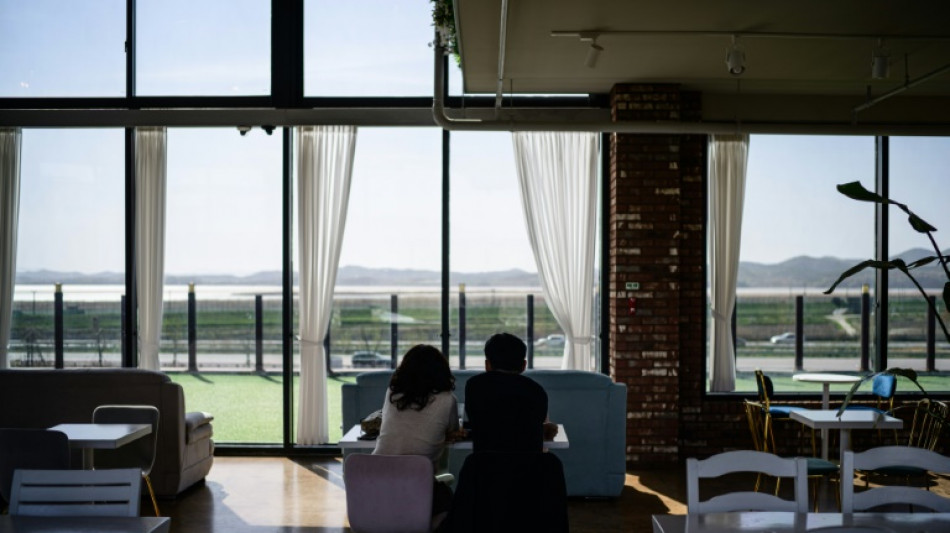
Bunker-cafe on Korean border paints image of peace / Photo: ANTHONY WALLACE - AFP

 Ms. Rachel Says Celebrity Silence on Gaza Is 'F--ked Up' and Drives Her to Swear

 Maryland Regulators and Air Force Clash Over Jet Fuel Spill Cleanup and Golf Course Exemption

 Bishop Museum Races to Save Rare Megamouth Shark Specimen

 Musk Questions AI Development Viability as SpaceX Leasing Revenue Surges

 مصطفى معروفي ينشر قصيدة 'أصوغ كلامي أهتدي بتجاربي'

 Luxembourg Housing Petition Passes Threshold for Parliamentary Consideration

 Raheem Sterling Receives Suspended Sentence After Lamborghini Crash

 Audience to Choose the Set List at Luxembourg's First FAMIL Jukebox Night

 Luxembourg Pay Rise Delayed as Regional and World Headlines Develop

 مواجهة في البرازيل بين نشطاء وفلسطينيين وسياح إسرائيليين حول جدارية مؤيدة

 رئيس جامعة القدس يستعرض نموذج الشراكة بين التعليم العالي والصناعة في قمة QS بأبوظبي
Reclining on sofas at a South Korean cafe, customers sip iced americanos as they gaze past barbed wire fences and watchtowers at the mountains of North Korea.
Daonsoop cafeis so close to the North Korean border that to obtain the building permit, its owners had to construct the property with a bunker and fortified positions for tanks.
Founder Lee Oh-sook and her husband, both the children of North Korean refugees, built the cafe less than two kilometres from the border in Paju, seeking proximity to their ancestral homeland.
"From here, you can see North Korea, so close but inaccessible... Our parents always hoped to return to their homeland, but they died before realising this dream," 63-year-old Lee told AFP.
"We chose to settle here to think of them more often."
The two countries are technically still at war as the 1950-1953 conflict ended in an armistice rather than a peace treaty, and South Korea still refers to the border as the "front line".
Below the cafe's bay windows runs the Jayu-ro motorway, or "Freedom Road", which in an ideal future would link Seoul to Pyongyang, but currently stops at the Reunification Bridge near the border.
The Imjin river, which separates the two Koreas, runs alongside the motorway, while a sign in a military-controlled border area warns that "trespassers may be treated as an enemy or suspect and shot".
- Bunker art gallery -
Every night, giant loudspeakers across the border in North Korea broadcast blood-curdling sounds as part of a noise campaign emblematic of the two countries' steadily declining ties.
The soundtrack of wolf howls, screams and ghostly creaks is so powerful it rattles the cafe's windows.
Daonsoop is far from the only cafe with a view of the North: a Starbucks in an observatory on the border has itself become a tourist attraction.
But it is one of the closest by far, and it also has a bunker -- requisitioned once a year by the South Korean army for military exercises.
The rest of the time, cartoonist and neighbour Kim Dae-nyeon uses the bunker to exhibit his artwork under his alias Danny Kim.
Hung between the bunker's narrow loopholes overlooking the North, his drawings depict the pain of division and hopes for Korean reunification.
"This bunker is a space designed for combat, but I don't see it that way. I see it as a place where freedom and peace begin," Kim told AFP.
In one drawing, an imagined bridge spans the Imjin river. Another shows weasels wearing noise-cancelling headphones protesting the loudspeakers blasting from the North.
Outside, Kim has painted the walls of the tank yard in colours depicting the four seasons.
When life gets tough, "I come here to look at North Korea", he said. "It makes me realise how relatively happy I am."
Before his retirement, Kim was the head of South Korea's National Election Commission. His 40-year career in the service of democracy, he says, has profoundly influenced his art.
- Normalised division -
"I hope North Korea will also adopt democracy and freedom one day. My convictions about peace and freedom have continued first through my public career, and now in my artistic work," he said.
The cafe also attracts North Koreans who have defected to the South. During family holidays such as Seollal (Lunar New Year) and Chuseok in the autumn, they can look across to their homeland from its terrace.
On the other side of the border, North Korean farmers go about their business, burning rice fields at the end of winter in a polluting agricultural practice eradicated in the South.
The pungent smoke billows across the border and envelops the cafe, but some customers, indifferent like many South Koreans to their northern neighbour, are unaware of the cause.
"It looks so calm and peaceful right now, but many visitors don't know that the North is just across the road, so when they find out, they're surprised," Lee said.
"Most people forget that the country is divided and this reality is normalised."
L.AbuAli--SF-PST

