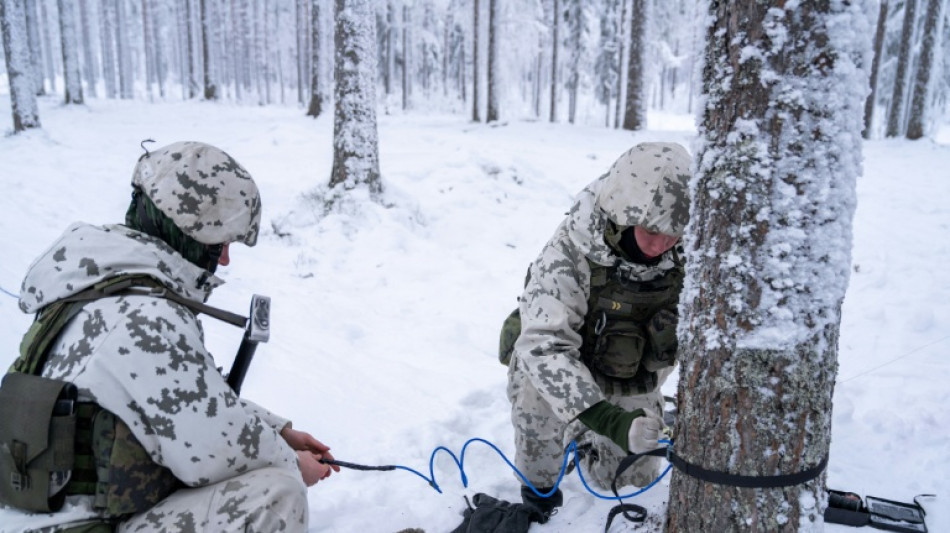
In Finland's forests, soldiers re-learn how to lay anti-personnel mines / Photo: Alessandro RAMPAZZO - AFP

 Vote count begins in Alberta secession referedum, testing Canada unity
 Ukraine claims US missile holdup as Trump floats summit without Zelensky

 Detained Suu Kyi receives UK royal package: Myanmar govt

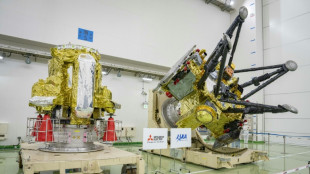 Japan successfully launches probe in historic Mars moon mission

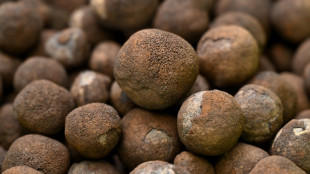 US to auction deep sea mining leases off American Samoa

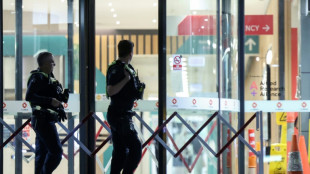 Australian lawmaker hurt in car attack underwent surgery overnight: PM
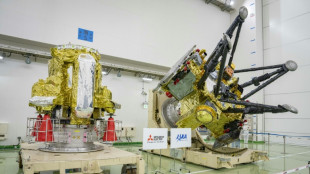 Japan launches rocket for potential world first Mars moon mission

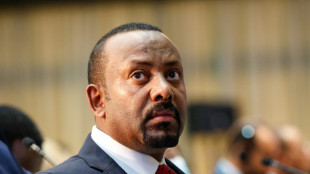 Ethiopia PM warns Eritrea of 'severe consequences' if supports enemies

 Boland grabs opportunity for Australia as South Africa struggle in second Test

 Ronaldo handed 30-day suspension: Portuguese federation
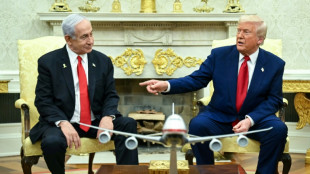
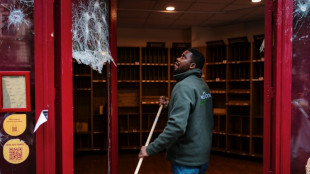 France announces curfews as government grapples with unrest

 Boland sets pace as South Africa struggle
 Ukraine on back foot as Kremlin moots US, China meeting
 'Stay home!': Tourists find themselves in a France convulsed by protests

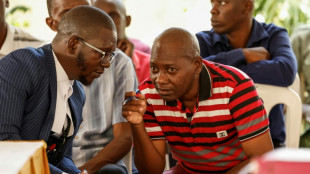 Kenyan cult leader guilty on all charges over 191 starvation deaths

 Eagles star Hurts to miss rest of NFL season: reports

 Oil-rich Alberta votes on Canada breakup

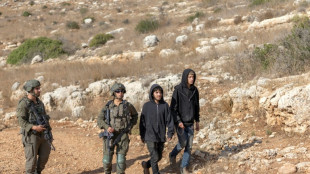 Israel announces arrests after West Bank settler attacks on Westerners
 Guehi insists players have 'trust and belief' in Man City after charges
 UN climate panel head wants swift end to deadlock over key scientific report
 PM calls for curfews in France as govt grapples with unrest
 Man City's Semenyo out for up to eight weeks

 Australian lawmaker critically hurt in 'violent' vehicle attack
 England women's coach Wiegman signs two-year contract extension
 Louvre blocked as France grapples with unrest
Finland is barely out of the treaty banning them but the country's armed forces are already training soldiers to lay anti-personnel mines, citing a threat from neighbouring Russia.
Trudging through snow, a young Finnish conscript carefully draws a thin blue wire between two pine trees. The other end is attached to a hidden mine some 20 metres (65 feet) away.
"We are in the process of figuring out what's the most effective way to use them," said Lieutenant Joona Ratto, who teaches military service conscripts how to use the devices that Finland had banned in 2012.
Stationed with the Kainuu Brigade, which is responsible for defending 700 of the 1,340-kilometre (833-mile) border Finland shares with Russia, Ratto and his colleagues are gearing up to train the 500 active-duty soldiers, 2,500 conscripts, and 5,000 reservists who pass through the garrison each year.
Dropping decades of military non-alignment, Finland applied to join NATO in the wake of Russia's 2022 invasion of Ukraine and became a member in 2023.
Like the nearby Baltic states and Poland, it also decided to withdraw from the Ottawa Convention, which prohibits the use, stockpiling, or production of anti-personnel mines.
No longer bound by the international treaty since January 10, Finland is now free to bury or conceal the small, inexpensive devices, which have been criticised for causing injuries to civilians long after conflicts end.
From a military perspective, antipersonnel mines are a necessary evil, according to Ratto.
"We can use them to either stop the enemy or maybe alarm our own troops in the defensive positions", giving troops time to prepare for "the firefight", he told AFP among the wintery landscape of pine and spruce trees.
While the war in Ukraine has cemented the role of drones, the trench war had demonstrated that, although old, "they are still effective and they have an important role on the battlefield", said Colonel Riku Mikkonen, inspector of engineering for the Finnish Army.
Nearby, other soldiers train on a road.
A warning sign has been put up reading "Miinoja, mines", depicting a skull in a downward-pointing red triangle -- the international symbol for a mined area.
A powerful drill is used to penetrate the frozen ground to bury training anti-tank mines, which were never banned.
- One million mines -
For now, the Finnish army has no caches of antipersonnel mines. It therefore trains with the directional Claymore mine, which projects shrapnel up to 50 metres.
Mikkonen believes the situation will be resolved within two years as Finland's defence industry needs to resume its domestic production of simple, low-cost mines.
Having them produced in Finland guarantees that they can be supplied "also in wartime", he explained.
With 162 states still party to the Ottawa Convention -- but not the United States or Russia -- there also are not enough sellers around internationally to satisfy Finland's needs, he added.
But what those needs are exactly has not yet been finalised.
"We used to have one million infantry mines before the Ottawa Convention in our stocks, that's a good amount, but let's see," he said.
Currently, Finland's army does not intend to deploy mines along its eastern border and it will be a decision for the government to make in a crisis.
Mikkonen hoped that the decision will be made months in advance of actual hostilities, ideally six months out.
Detailed minefield plans would then have to be drawn up, on paper and via a smartphone app which is in development.
With the risk of leftover mines posing a hazard after the end of fighting, some modern mines include a self-neutralising mechanism, but Mikkonen said he would "rather not have them".
"Because the war can last for a long time while the self-destruction happens after three to four months. It makes sense of the humanitarian side, not on the military side."
X.Habash--SF-PST